


In This Episode
- Call Congress – 202-224-3121
- Subscribe to the What A Day Newsletter – https://tinyurl.com/3kk4nyz8
- What A Day – YouTube – https://www.youtube.com/@whatadaypodcast
Follow us on Instagram – https://www.instagram.com/crookedmedia/
TRANSCRIPT
Jane Coaston: It’s Tuesday, November 18th. I’m Jane Coaston and this is What a Day, the show that can’t believe President Donald Trump released those files. You know, the ones on Amelia Earhart, the aeronautical hero who disappeared while trying to circumnavigate the world in 1937? Wait, what files did you think I was talking about? [music break] On today’s show, President Trump is meeting with Saudi Arabia’s Crown Prince at the White House. And the United Nations Security Council approves Trump’s plan for the future of Gaza. But let’s start with Venezuela. After weeks of attacks on alleged drug boats off the coast of the South American country, President Trump made his plans for dealing with Venezuela clear on Monday in response to a question in the Oval Office. And by clear, I mean whatever the opposite of clear is. Opaque, I guess.
[clip of unnamed news journalist] Is there anything you’re ready to rule out at this point? Are you ruling out US troops on the ground?
[clip of President Donald Trump] No, I don’t rule out. That I don’t rule out anything. We just have to take care of Venezuela. They dumped–
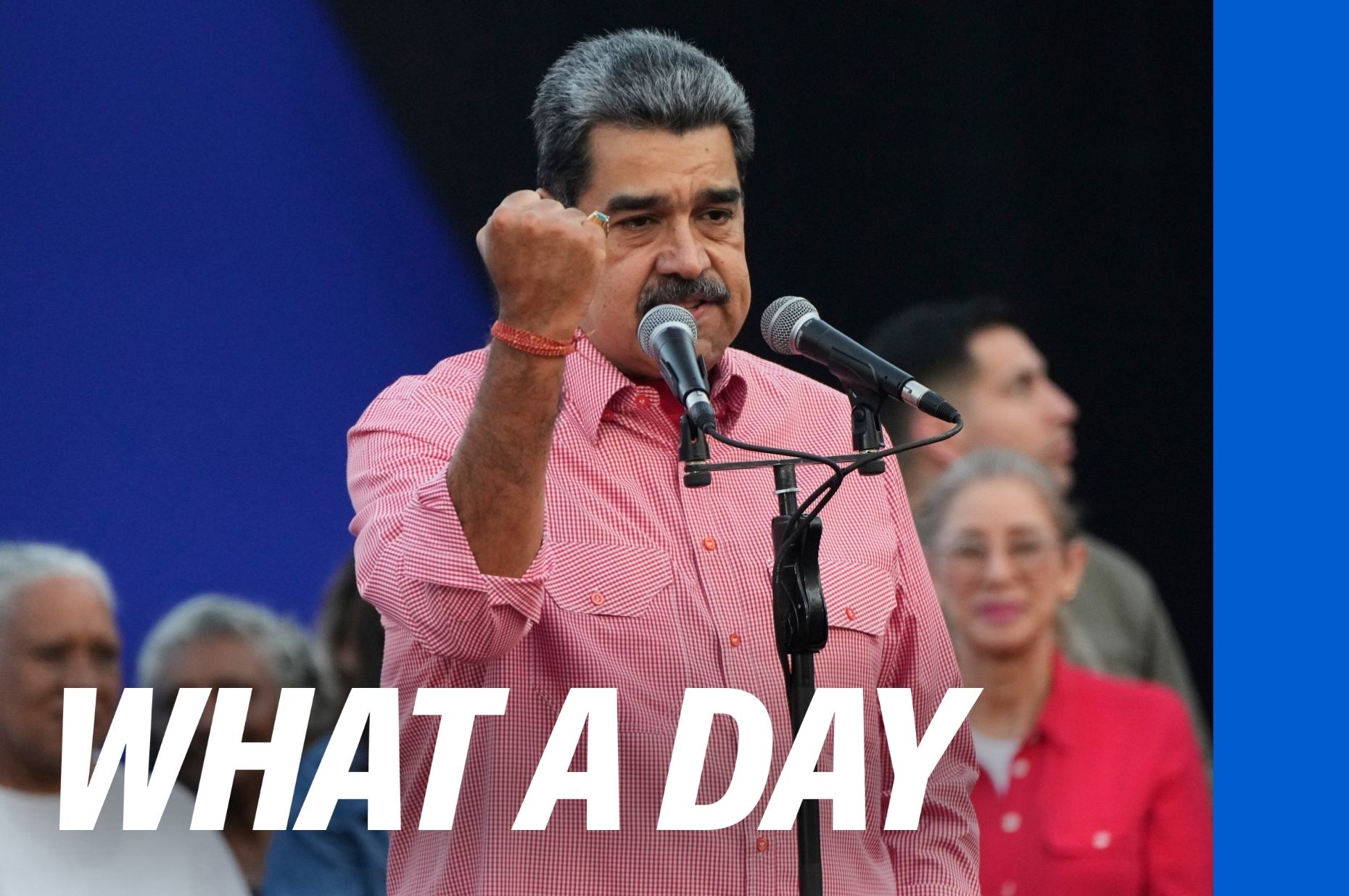
Jane Coaston: Sounds like mob talk to me. This came a day after Trump said that he would be willing to hold talks with Venezuelan President Nicolás Maduro. That was the same day that the Navy’s largest aircraft carrier arrived in the Caribbean Sea for reasons. It seems like the Trump administration is trying to have its regime change cake and eat it too. But why? Well, we’ve gotten contradictory responses. For example, a Justice Department memo giving approval for the strikes on alleged drug boats argues that the United States is in an armed conflict with quote, “narco-terrorist drug cartels.” The memo uses the White House’s own reasoning that cartels are responsible for tens of thousands of deaths in the United States from drug overdoses. But, as the New York Times has repeatedly pointed out, most of those overdoses are from fentanyl, which Venezuela does not produce. And these drug allegations might just be a distraction from the real focus of Trump’s Venezuela ire. Over the weekend, Politico published a piece alleging that White House officials have begun planning for a post-Maduro Venezuela, including different options for countries to exile him to. So to talk more about Venezuela, regime change, and the perils of war in South America, I spoke with Juan Sebastian Gonzalez, former National Security Council Senior Director for the Western Hemisphere under President Joe Biden. Juan, welcome to What a Day.
Juan Sebastian Gonzalez: Thanks for having me.
Jane Coaston: On Sunday, the US Navy announced that the USS Gerald Ford, which is the world’s largest aircraft carrier, has entered the Caribbean Sea. What message is the Trump administration sending with this action?
Juan Sebastian Gonzalez: Well, with the aircraft, we have gone from a symbolic presence to a credible um I think threat posture just off of Venezuela’s coast. So I think I think they’re upping the ante here. And whereas before you had significant naval assets. So in addition to the carrier strike group, they had amphibious readiness group, they had a bunch of destroyers, the F35s are in Puerto Rico. But now they have roughly around fifteen thousand troops. They have enough to actually take um take Venezuela from my perspective.
Jane Coaston: Fanatastic.
Juan Sebastian Gonzalez: Yeah.
Jane Coaston: Um. I love I love doing war for reasons I don’t 100% understand. And that actually gets to something I I was curious to hear from you. So the subtext of the last few weeks has been that the US wants regime change in Venezuela. That’s kind of what people have been saying and what we’ve been hearing. But President Trump told reporters on Monday that he would quote, “probably talk with Venezuelan president Nicolás Maduro at some point. The same Nicolás Maduro, whom this White House has alleged to be basically a narco terrorist. One, what’s going on here? And two, what would you expect to see from those talks if they did actually take place?
Juan Sebastian Gonzalez: Yeah, well, I mean, well, the existence of a a channel for dialog I think is a very good thing, regardless. Um. Because when you have that sort of force presence, there is the risk of an accidental confrontation that would, you know, catalyze a broader intervention that’s incredibly dangerous. Um. But, you know, so when I when I think about what Trump is doing, there’s there’s one cynical perspective. The first is that this is all really about migration. This entire deployment is just so that the administration can continue to use the Alien Enemies Act to deport Venezuelans without due process, right? And right now, the majority of migrants that are getting sent to third countries are Venezuelans. The other is that this is this is Trump really upping the ante to try to get a better deal from from Maduro. Maduro like right away agreed to a migration accord um and has been very pliant. And so, you know, Trump is upping the ante to see if there’s more that he can get. Is this actually a regime change operation? I think I think from Rubio’s perspective, it certainly is. And I and I think that um you know, he has the support of the kind of South Florida diaspora, but the way he’s trying to sell it to the rest of the countries by merging the war on terror with um with the war on drugs, you know, and combined with his fascist domestic migration policy, it is all really interlinked.
Jane Coaston: Can you talk a little bit about that? Because I think that that South Florida note is really important here because this is not new for Secretary of State Marco Rubio. He was talking about Maduro as a threat when he was a senator from Florida. And there has been a real relationship between Venezuelan expats in South Florida talking about the need for regime change and kind of building that up as a political force. And I, can you talk about like where is this coming from? How is this happening? And what part does Rubio play in it?
Juan Sebastian Gonzalez: Yeah, I mean, well, look, its my personal view is that look, even though Mark Rubio is the secretary of state, he’s fundamentally still a South Florida politician. And so I think he’s listening primarily to the diaspora community from South Florida that is very much pushing for the United States to get involved. I think they underestimate, particularly since they’re not listening to the intelligence community, um they’re underestimating the consequences of Maduro’s removal. That’s just the beginning of a process. And even though, you know, you look at the Venezuelan military, they do not have the kind of order of battle to be able to defend against the U.S. assault. So what they’re doing is they’re posturing toward a guerrilla battle and kind of urban disruption. And that’s something where if the US comes in and there is some sort of removal of Maduro, the idea that you’re going to install Edmundo González, who won the elections last year overwhelmingly, or María Corina Machado, who is part of leaders, one of the leaders of the opposition, the idea that they’re just going to govern without significant US troops on the ground really is not has no bearing on on reality. But a lot of this is being pushed primarily by the by the hard line elements of the opposition. The opposition falls into this broader spectrum where you have some that are finding ways to work with the government. There’s still pockets of democracy within Venezuela. Mayors and some governors are elected. It’s the presidency really that is is really stuck. Um. And they want the US basically to fix their problem for them.
Jane Coaston: Before Trump mentioned those potential talks with Maduro, Secretary of State Rubio tweeted that the State Department is planning to designate the Cartel de los Soles as a foreign terrorist organization. The Trump administration has claimed that Maduro is the head of this cartel. But is this cartel even a real organization and what is Maduro’s actual relationship with it?
Juan Sebastian Gonzalez: Yeah, it it isn’t. You know, this the designation significantly ups the ante and by linking Maduro, I think it it provides political and legal justification for these extrajudicial killings at sea, but also potentially for action on on land. Um. But the Cartel de los Soles, and I’m this is not me. You look at Insight Crime, which is a very respected resource institution. You even have the intelligence community, Cartel de los Soles is a made-up name that refers to elements of the Venezuelan government, military politicians that are involved in in drug trafficking. That definitely happens. But, you know, they’re being described as the largest cartel in in the world. That’s that’s Sinaloa in Mexico. I mean, when you look at the cocaine trade, um ninety-five percent of the cocaine that comes to the United States comes from Colombia. Five percent of that trans ships uh transits through Venezuela, the 75% goes through through the Pacific. And so the whole argument that this is a counter-narcotics operation has just no bearing on reality. I mean, even just the deployment is a huge um kind of overcomplement to what would be the requirements of a traditional counter-narcotics mission. So so this is really it it looks, walks and talks like a regime change preparation from my perspective.
Jane Coaston: Earlier this month, Senate Republicans voted against legislation that would have required congressional approval for the Trump administration to keep carrying out strikes against Venezuela. Are there any other ways that checks can be placed on the Trump administration’s ability to carry out these strikes?
Juan Sebastian Gonzalez: You know, if you see the the reporting on it was interesting because I think the administration was concerned that they were gonna lose that as actually the resolution was gonna pass. So Rubio had to go up to the hill and they had to, according to the press, provide assurances that they did not have the legal justification yet to be able to attack inside of Venezuela. And that’s how they actually were able to defuse the passage of this war powers resolution. But if this administration escalates by, you know, maybe shooting tomahawks on land to particular targets, you you may see that that resolution is is revived. And it really is key, because the president of the United States does not have and should never have this authority to engage in unilateral extrajudicial killings. I I think it’s important to mention too that so, you know, if you look at the UN Charter and international humanitarian law thresholds for the use of force, this does not meet those. It has to be an eminent threat against the United States. And just labeling a gang as a foreign terrorist organization is not a license to kill. What is really alarming is that according to some of the kind of national security lawyers that I’ve spoken to, is that there are potential domestic implications to this legal justification the administration has. So if you’re designated as an enemy combatant, even if you’re an American citizen and you’re on US soil, then you’re fair game to either have your assets seized, to be detained without due process or even to be killed on US soil. And I and I think as Americans start to understand that this precedent that the administration is trying to set has a has very much direct link to the domestic project of deploying the National Guard. Using ICE as a as a as a sort of pseudo gestapo to really violate, I think, the the rights and freedoms of even undocumented but even US citizens that are of a certain skin color, I think it should be very alarming to Americans.
Jane Coaston: President Trump already tried and failed to force regime change in Venezuela during his first term. You’ve mentioned concerns about the second order effects, which anyone who remembers the Iraq war will say, yeah, that all makes sense because we were there for twenty years and here we are now. But what are your other concerns if the Trump administration continues to escalate and push for regime change this time around?
Juan Sebastian Gonzalez: Yeah, I mean look the first thing is that this administration is dealing with a with a mess of its own creation. So the, you know, the mismanagement of the economy, the corruption has, you know, has led to an outflow of Venezuelan migrants. But it wasn’t until the administration under Trump one imposed the sectoral sanctions that you see this huge spike in outbound migration. So, you know, and the destabilization, the humanitarian crisis is all now that they’re trying to actually deal with with a regime change effort. So you’re gonna start seeing a situation, kind of a break it-you buy it situation where if they don’t go in after removing Maduro, the country will descend into chaos. Even though 70% of Venezuelans voted against Maduro, the I guess the ingredients exist there for there to be violence. Now, if the US goes in, this is something that’s gonna happen for the long haul. But it is, I mean, you mentioned you mentioned Iraq. There is this mentality right now where if you’re not for regime change, then you’re a supporter of Maduro, just like if you were against the Iraq invasion, you’re a supporter of Saddam. And that’s unfortunately, I think eliminating any sort of space for debate.
Jane Coaston: Juan, thank you so much for your time. I really appreciate it.
Juan Sebastian Gonzalez: Thanks for having me.
Jane Coaston: That was my conversation with Juan Sebastian Gonzalez, former National Security Council Senior Director for the Western Hemisphere under President Biden. We’ll get to more of the news in a moment, but if you like the show, make sure to subscribe, leave a five star review on Apple Podcasts, watch us on YouTube, and share with your friends. More to come after some ads. [music break]
[AD BREAK]
Jane Coaston: Here’s what else we’re following today.
[sung] Headlines.
[clip of unnamed news journalist 2] Are you planning to sell F35s to Saudi Arabia?
[clip of President Donald Trump] Yeah.
[clip of unnamed news journalist 2] And also, are you looking at doing a similar security agreement like you did with Qatar?
[clip of President Donald Trump] Yeah, no, I am planning on doing that yeah.
[clip of unnamed news journalist 2] You’re going to sell them F35s?
[clip of President Donald Trump] They wanna buy them, they’ve been a great ally. They’ve gotta like us very much.
Jane Coaston: In case you’re wondering, Trump said that he lost his voice yelling at quote, “stupid people.” Trump told reporters Monday that he intends to approve Saudi Arabia’s request to buy advanced US-made F-35 fighter jets. That’s just one item on the agenda, when Saudi Arabia’s de facto ruler, Crown Prince Mohammed bin Salman, better known as MBS, meets President Trump at the White House today. According to Reuters, Trump intends to strengthen decades-old partnerships on oil and security and explore new collaborations in tech, commerce, and possibly nuclear energy. It’s MBS’s first US visit since the 2018 murder of journalist and critic of the Crown Prince, Jamal Khashoggi. A killing US intelligence says MBS personally sanctioned. But that pesky detail aside, Trump is looking to capitalize on the $600 billion investment pledge Saudi Arabia made during his visit to the kingdom in May. A trip where he avoided any talk of human rights and is expected to do so again. Shocking. A federal magistrate judge said Monday that the criminal case against former FBI director James Comey may be faltering. Why? Because Lindsey Halligan, the inexperienced prosecutor handpicked by President Trump, made a series of apparent errors before the grand jury. In a lengthy ruling, the judge ordered Halligan to fork over all the grand jury materials used to obtain Comey’s indictment. Judge William Fitzpatrick also posited whether, quote, “government misconduct in the case merited dismissing it altogether.” He even noted that when Halligan appeared alone before the grand jury in September to seek an indictment, she made at least two, quote, “fundamental and highly prejudicial misstatements of law” because of that whole inexperienced prosecutor thing. Fitzpatrick added that the grand jury records she submitted for review appear incomplete. In short, if Halligan offers a masterclass in federal prosecution, do not take it. The decision is the latest hurdle in the effort to prosecute Comey. The case had already been rejected by U.S. Attorney Eric Siebert, who said the evidence that Comey lied to and obstructed Congress fell short, prompting Trump to remove him in September and replace him with Halligan. The decision on whether these grand jury errors warrant tossing the case will rest with U.S. District Judge Michael Nachmanoff, who has already set a hearing for early December to review separate claims from Comey’s lawyers that Halligan misused the grand jury process.
[clip of unnamed UN member] The result of the voting is as follows. Fourteen votes in favor. Zero votes against. Two abstentions.
Jane Coaston: The United Nations Security Council has approved a US plan that authorizes an international stabilization force in Gaza. The resolution was adopted in a 13 to zero vote. Russia and China abstained. And if you’re wondering what exactly an international stabilization force will do, here’s U.S. Ambassador to the UN, Mike Waltz.
[clip of Mike Waltz] The International Stabilization Force will stabilize the secure the security environment, support the demilitarization of Gaza, dismantle terrorist infrastructure, decommission weapons, and maintain the safety of Palestinian civilians.
Jane Coaston: The vote on Monday was a diplomatic win for the Trump administration and a crucial next step for the fragile ceasefire after two long years of war between Israel and Hamas. It endorses President Trump’s 20-point ceasefire plan, which also calls for a group that would lead the transition. Trump wrote on Truth Social that the border peace will, quote, “be chaired by me and include the most powerful and respected leaders throughout the world.” He said board members would be announced in the coming weeks. During negotiations, the U.S. had revised the resolution to say that after advances in the reconstruction of Gaza and other reforms, quote, “the conditions may finally be in place for a credible pathway to Palestinian self determination and statehood.” But Israeli Prime Minister Benjamin Netanyahu said on Twitter Sunday, quote, “our opposition to a Palestinian state in any territory has not changed.” International enrollment at U.S. colleges dipped 1% this fall, defying fears of a steep collapse after the Trump administration tightened visa scrutiny and pushed universities to cap foreign student numbers. But when you pop the hood on that 1%, there’s some smoke. The number of new first-time international students dropped 17%, the sharpest plunge since the COVID-19 pandemic, according to new data from the Institute of International Education. That 1% is buoyed by large numbers of international graduates staying in the U.S. for temporary work. Foreign students make up only about 6% of U.S. college enrollment, but they have an outsized financial impact. Most international students pay higher tuition and receive no financial aid, effectively helping subsidize the cost of educating U.S. students. Their absence is already creating major budget strains at some smaller universities. The Trump administration’s visa delays and new enrollment caps have contributed to the slowdown, with students shifting towards schools in Europe and Asia. Which makes sense, as Trump essentially jaunted into every quad in America and hammered in a sign reading, International Students Not Welcome. And that’s the news. [music break] One more thing. It would take me a very long time to catalog the ways in which the President of the United States is being super weird about convicted sex offender Jeffrey Epstein. From teasing Republican voters with the release of the Epstein client list during his presidential campaign, to suddenly deciding that anyone who expressed interest in the quote, “sordid but boring case of a man who accumulated powerful friends and allies and billions of dollars while preying on young women around the world was a bad person,” it’s been a gross, repulsive journey. And so we come to Sunday evening. After weeks and weeks of attempting to discourage Republicans from voting for a bill to compel the Department of Justice to release all of its files on Jeffrey Epstein, which the president could just do anyway, Trump suddenly changed his mind. He posted on Truth Social quote, “House Republicans should vote to release the Epstein files because we have nothing to hide. And it’s time to move on from this Democrat hoax perpetrated by radical left lunatics in order to deflect from the great success of the Republican Party, including our recent victory on the Democrat shutdown.” And on Monday, he doubled down in the Oval Office.
[clip of unnamed news journalist 3] You posted on Truth Social last night. You urged House Republicans to vote in favor of this Epstein release bill they’re gonna vote on.
[clip of President Donald Trump] Yeah.
[clip of unnamed news journalist 3] Tomorrow. I just wanna be super clear on your position. Do you wanna see that pass the Senate? Would you sign that bill if it gets to your desk?
[clip of President Donald Trump] I do want to s– here’s what I want. We have nothing to do with Epstein, the Democrats do. All of his friends were Democrats. You look at this Reid Hoffman, you look at Larry Summers, Bill Clinton, they went to his island all the time and many others. They’re all Democrats. All I want is I want for people to recognize the great job that I’ve done on pricing, on affordability, because we brought prices way down.
Jane Coaston: He hasn’t, but that’s not the point. It’s worth noting that it’s not clear if the Justice Department will act on this, even if the president signs his legislation. Donald Trump has never been accused of wrongdoing in connection with Epstein. But I think I know what’s going on here. Trump believes that if Democrats are implicated in the Epstein Files, which was why his vice president and FBI director were so gung ho to get them last year, Democrats will obviously just give up on their efforts to get more information about Jeffrey Epstein’s crimes. Because Republicans have pledged their eternal fealty to Donald Trump, I think that Trump thinks that Democrats must have pledged eternal fealty to LinkedIn co founder Reid Hoffman, former President Bill Clinton, and former Harvard University President Lawrence Summers. Newsflash, we have not. I had to Google who Reid Hoffman is. Bill Clinton left the White House when I was twelve, and I know Lawrence Summers best for arguing back in 2005 that women were less intelligent than men. I should also note that according to emails released by the House Oversight Committee, he was using Epstein as a quote, “wingman” to attempt to pursue a relationship with a woman he was mentoring. He was, and is still married. So let’s just put a pin in that intelligence argument for now. If the choice is get no more information, or get more information to bring justice to the survivors of Jeffrey Epstein’s predations, but some Democrats were also implicated. I’m walking through door number two every time. It’s an easy choice unless you’re Donald Trump. [music break].
[AD BREAK]
Jane Coaston: That’s all for today. If you like the show, make sure you subscribe, leave a review, celebrate the true measure of love, and tell your friends to listen. And if you’re into reading, and not just about how FBI director Kash Patel has given his country musician girlfriend a protective detail made up of elite SWAT officers. Like me, What a Day is also a nightly newsletter. Check it out and subscribe at Crooked.com/subscribe. I’m Jane Coaston, and ladies, never settle for less than a full protective detail made up of elite SWAT officers. If they wanted to, they would. [music break] What a Day is a production of Crooked Media. It’s recorded and mixed by Desmond Taylor. Our associate producers are Emily Fohr and Chris Allport. Our video editor is Joseph Dutra. Our video producer is Johanna Case. We had production help today from Greg Walters, Matt Berg, Caitlin Plummer, Tyler Hill, and Ethan Oberman. Our senior producer is Erica Morrison, and our senior vice president of News and Politics is Adriene Hill. We had help today from the Associated Press. Our theme music is by Colin Gilliard and Kashaka. Our production staff is proudly unionized with the Writers Guild of America East. [music break]
[AD BREAK]


