
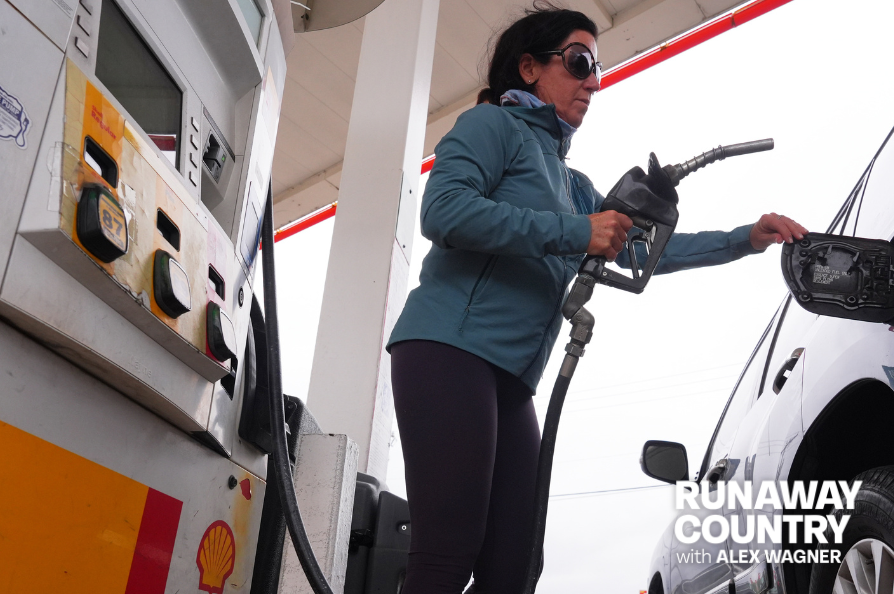


In This Episode
Instead of pumping the brakes on the Iran war, President Trump is breaking the pumps. This week Alex looks at how high gas prices are impacting Americans, and why they’ve long been considered an existential political threat. First, she speaks to an Uber driver and a gas station owner to get first hand accounts of the financial toll of the war. Then Alex is joined by Derek Thompson, writer and host of the Plain English podcast, to break down the other ways financial strain is going to spread across industries and wallets, and why it feels like one crisis after another has made it impossible to afford life in America.
TRANSCRIPT
[AD BREAK]
Alex Wagner: Hi, everyone. As Trump’s disastrous war in Iran comes up on the two-month mark, the vibes at home are really bad. And it’s not just gas prices that are the problem here. Farmers are facing catastrophic price increases in fertilizer due to shortages of natural gas. Here’s Russell Boening a farmer in Texas, speaking to PBS.
[clip of Russell Boening]: We’re buying nitrogen right now, and it’s about 40% higher than it was two or three months ago. But before the conflict, let’s just say that.
Alex Wagner: Young people are upset that, especially after the war in Gaza, America is even further inside Israel’s pocket.
[clip of Naseem Craddock]: We need to focus more on the United States first. I think there’s a lot of problems that could be solved in the United States before going into foreign conflict. To be honest, I think this was more Israel’s fight than the United States.
Alex Wagner: That’s George Washington University student Nassim Craddock also talking to PBS. Even Tucker Carlson is having a crisis of conscience about Trump’s terrible decision to attack Iran.
[clip of Tucker Carlson]: In very small ways, but in real ways, you and me and millions of people like us are the reason this is happening right now. I do think it’s like a moment to wrestle with our own consciences. We’ll be tormented by it for a long time. I will be.
Alex Wagner: Everywhere, all over the place, people are angry and frustrated about the war. But what people seem to be most pissed about are, yes, fuel prices.
Jim Ellinger: What does he know? When is the last time he put gas in his car? Never. When is he last time you went grocery shopping? Never. So our president is out of touch with the people that he governs. And that’s not a great position to be in.
Alex Wagner: That’s Uber driver Jim Ellinger, who we will be talking to later in the show. With Iran’s retaliatory blockade of the Strait of Hormuz, the national average cost of gas in the U.S. now hovers around $4 a gallon and Americans aren’t blaming the new Ayatollah for the spike. A new Quinnipiac poll released last week found that 65% of voters put the blame on president Trump, which is literally every president’s worst nightmare, especially in an election year. Especially when the president says stuff like this in an election year.
[clip of reporter]: Do you believe the price of oil and gas will be lower before the midterm elections?
[clip of Donald Trump]: I hope so. I mean I think so. It could be. It could be or the same or maybe a little bit higher.
Alex Wagner: Especially when the president’s secretary of energy says stuff like this in an election year.
[clip of reporter]: When do you think it’s realistic for Americans to expect the gas will go back to under $3 a gallon?
[clip of Chris Wright]: I don’t know. That could happen later this year. That might not happen until next year.
Alex Wagner: Ironically, Donald Trump really does understand the way in which gas prices represent more than just the cost of a gallon of fuel. They signal to an American audience affordability. If gas prices are high, it means the economy is off track. And if they’re low, things are right on course, which is why Trump was celebrating low gas prices in his yearly address to Congress just four days before he attacked Iran.
[clip of Donald Trump]: Gasoline, which reached a peak of over $6 a gallon in some states, under my predecessor, it was quite honestly a disaster, is now below $2.30 a gallon most states, and in some places $1.99 a gallon, and when I visited the great state of Iowa just a few weeks ago, I even saw $1 and 85 cents a gallon for gasoline. [applause]
Alex Wagner: Today in Iowa, gas costs an average of $3.50 a gallon. It is this reality that is cratering American support for both Trump, who now has an historically low 33% approval rating, and the party he leads. Last week, the influential Cook Political Report moved four key Senate races in the direction of Democrats, a margin that could give them control of the chamber. If we have learned anything from history, it is that high gas prices can be a political killing field for incumbents. It’s basically presidential kryptonite. Given the fact that Trump and his party are now barreling towards a midterm election that could see them lose control of at least one chamber of Congress, if not both, you would think that Trump would do everything in his power to turn this thing around and pump the brakes on the war. Instead of what he is currently doing, which is breaking the pumps. I’m Alex Wagner, and this week on Runaway Country, how Donald Trump and his party are screwing Americans economically and themselves politically through a disastrous and seemingly unending war in Iran. Derek Thompson, substacker extraordinaire, host of the Plain English podcast and co-author of Abundance, is joining me to answer these questions.
Derek Thompson: Both these things are just absolutely factually true. Number one, that a war of choice is effectively acting as a tax on middle-class American incomes, all American incomes if you’re driving. And also that this president. We are learning is making another hundred million dollars off some crypto scheme every few weeks. That is a really, really difficult juxtaposition, I think, if you’re trying to demonstrate to the non-31% of the American public that is full-bore MAGA that you give a shit about this country.
Alex Wagner: But first, I wanted to talk to the people on the front lines of this struggle, Americans who don’t just drive to work, but drive for work. Jim Ellinger is an Uber driver in Las Vegas, Nevada. He’s been working for the ride share company for two years, but is now looking for new gigs as his fuel costs batter his bottom line. Afterwards, I’ll be speaking to gas station owner, Alex Weatherall, who’s struggling to absorb rising gas prices without taking it out on his customers.
Alex Weatherall: I lay in bed last night, told my wife, I was so irritated because based on the delivered cost I was going to get this morning, because the prices change every day, my costs change every day. If you have no choice and you have to get a load, you’ve got to pay that price come what may. And so I saw I’d be paying I think $3.53 and I said to Laura, you know, by rights, I really need to go over $4.
Alex Wagner: And then we will put all of this into context with Derek Thompson. But first up, Jim Ellinger. Welcome to Runaway Country. [music plays] Tell me a little bit about fuel costs. First of all, what did a tank of gas cost before the war for you? And what does it cost now?
Jim Ellinger: Yeah, before the war, and I was gassing up in Las Vegas at approximately, I’m gonna say, we had 2.70 a gallon at some of the cheaper gas stations. And it was costing me about $40 for a full tank of gas. Now, so I filled up just yesterday at 4.37.
Alex Wagner: Wow.
Jim Ellinger: Again, a very cheap gas station in Henderson. And yeah, it’s costing me around $76.
Alex Wagner: Wow.
Jim Ellinger: So almost double. Thank you very much, President Trump. Thank you for that.
Alex Wagner: Have you talked to other drivers about how they’re sort of managing the pretty significant price increase?
Jim Ellinger: I have not, but I can tell that there are fewer drivers on the road. And so that just tells me that there were some Uber and Lyft drivers that are out there saying, you know what, gas is just too expensive, I’m not going to drive today. And so, that kind of works to my benefit because then there are more people out there that need rides, which means I can intercept those. And keep working.
Alex Wagner: But you’re saying you have to dig into your savings to kind of make up the difference.
Jim Ellinger: I am. Yeah.
Alex Wagner: Is that stressful?
Jim Ellinger: Very stressful, very. I’m nowhere near retirement age right now. Uh, in fact, I don’t think I’ll ever retire. What am I going to do? Sit home and read books? No, I don’t think so. I prefer to be active and, uh, dig it into my savings while I don’t like to do that. I’m not just going to say, no, I’m not going to drive Uber, you know, regardless of what it costs. Unfortunately, bills just don’t pay themselves, as though we all wish they did. Uh, yeah. And so, you got to dip into savings when you can.
Alex Wagner: At what point did you realize that this war was going to affect your bottom line?
Jim Ellinger: Oh, immediately, immediately. Yeah, especially when they started talking about the Hormuz Strait. I’m like, no, that’s the wrong way to go. Clearly, the administration is not calling me for my opinions on the situation.
Alex Wagner: When President Trump says, don’t worry about it, we’re gonna get this resolved, gas prices are gonna go down in the next couple weeks, what do you think about that?
Jim Ellinger: What does he know? When is the last time he put gas in his car? Never. When is he last time, he went grocery shopping? Never. So, our president is out of touch with the people that he governs and that’s not a great position to be in.
Alex Wagner: I believe you’re an army vet, right?
Jim Ellinger: Correct.
Alex Wagner: I’m sure this war, you have thoughts about it, not just as someone who’s very much part of the American economy, very much being affected by this, but as someone whose served our fighting forces. What do you think about the war?
Jim Ellinger: I think it’s the wrong course of action. You know, when our president was campaigning, he campaigned on no new wars, no regime changes. But here we are in a war trying to change the regime in Iran. And so this is just another example of the president lying to the people in which he governs the American people. Yes, Iran needed some work, but why is it that America has to do it? Let some other country do it. What happened to America first? How is this putting America first when gasoline prices are going through the roof, grocery prices are goin through the roofs, people are losing their healthcare, Americans are dying? Again, how does this put America first.
Alex Wagner: I mean, if you could communicate something to this administration and tell them about, you know, what this war has cost everyday Americans and sort of what it is like to live with those rising costs, what would you say?
Jim Ellinger: I would say, uh, get out of that bubble, you know, come live in, uh Henderson, Nevada, or better yet go live in San Diego, California, San Diego California is the most expensive city to live in in the country. And I was there for 30 years. You know, let’s give you $5,000 a month. You know, with a family to care for. And, you know let’s see just how well you can do that. They have no clue on what the average American and average American family and what those expenses are on a monthly basis. No clue.
Alex Wagner: Well, Jim, I’m very grateful to get your perspective on this because some of so much of this happens in the abstract, you know, I think people don’t really understand the reality of people who are, for example, Uber drivers who have to live with these gas prices on a daily basis.
Jim Ellinger: Yeah, you know, this is money right off my bottom line and in order to make up that money I find that i’m having to drive more hours during the day which in and of itself is not safe.
Alex Wagner: Yeah, and also it’s more fuel, so.
Jim Ellinger: More fuel, yeah, yeah.
Alex Wagner: Well, we are very grateful that you’re sharing your story and your thoughts. I’m sending you good luck out there. I know it’s tough. It feels like it’s gonna be tough for a little longer, if not a lot longer, depending on what happens, but keep us posted. We love hearing what’s happening on the ground, and I think it’s really important to share the stories of how normal people are dealing with us, so thank you.
Jim Ellinger: Great. No worries. Thanks, Alex.
Alex Wagner: Thanks for your time, Jim.
Jim Ellinger: Sure, thanks for the opportunity. [music plays]
Alex Wagner: After the break, if gas prices are giving you whiplash, think about what it’s like to run a gas station right now. My conversation with Massachusetts gas station owner, Alex Weatherall, right after this quick break.
[AD BREAK]
Alex Wagner: Thanks for doing this, Alex.
Alex Weatherall: That’s my pleasure.
Alex Wagner: Always nice to talk to another Alex out there in the world. I’m eager to know when you first heard about the attack on Iran, the president’s decision to go in, what went through your mind? Were you like, uh-oh, this could be a problem or did you not kind of think about the Strait of Hormuz?
Alex Weatherall: Oh, no, I thought, oh, it would be a problem. I think the only group that weren’t apparently thinking about the Strait of Hormuz or the staff in the White House, I’m not sure what they were thinking. Because I’m 64 years old, I’ve been through this sort of thing before, nothing quite so self-inflicted, but the funny thing is about the supply chains, no one ever learns anything. I mean, 20% of… Of petroleum products, 30% of fertilizer stocks come through the Strait of Hormuz, so our elected representatives should do better.
Alex Wagner: You know, for the layman or laywoman or layperson, oil prices are, you know, they’re set on a global scale, right? But there are other factors that go into determining how much you’re gonna charge a person at a gas station. Can you enlighten me a little bit into how the pricing works?
Alex Weatherall: Yeah, I’ll give you an example. I was at it’s all relative and relative to Boston. I was at 3.87 for a gallon of regular. Until this morning, I got a load of gas. I lay in bed last night, told my wife, I was so irritated because based on the delivered cost I was going to get this morning because the prices change every day. My costs change every, if you have no choice and you have to get a load, you got to pay that price come what may. And so I saw I’d be paying, I think, 3.53. And I said to Laura, you know, by rights, I really need to go over $4. And so I was determined to do that when I got my car and I do what I do, which is I take a long way to the store and I look at what the other guys are charging and and no one has taken their prices up, it’s sort of 3.69, 3.79, 3.99 at Shell. So I reluctantly made the decision to go up, but only the 3.99. That hurts. But that answers your question as to how do I make these decisions? It’s not complicated. You know, my cost goes up. I know what penny margin I’d like to earn in order to pay my bills. But there’s a limit. You know, people like me have got to be conscious of what our competition’s up to. It’s very basic. I wish it were more sophisticated. It’s not.
Alex Wagner: You’re talking about the sort of the price of a load. How much was the how much did it cost to fill your tanks up your pumps up before the war and how much on average does it cost now?
Alex Weatherall: It’s such a great question. I know this because I had to look at it on, I happened to get a load of gas on Sunday the 1st of March.
Alex Wagner: OK.
Alex Weatherall: And we went to war on Saturday the 28th and so prices change. We get our prices supposedly for three days fixed and that price is supposed to be good Saturday, Sunday and Monday. So I had to order gas for Sunday and that load hadn’t been affected by the war yet because we hadn’t gone to war when I got those prices sent over. So $28,300 plus or minus. And this load I got today, I don’t know yet. I’ll get an invoice this afternoon, probably. It’s probably $40,000, Alex.
Alex Wagner: Wow.
Alex Weatherall: That’s a big number.
Alex Wagner: A big increase. How are you thinking about the, you know, the present and the road ahead? Because we get different messages out of the White House, right? The Secretary of Energy, Chris Wright says, these prices could remain elevated till 2027. The President says, we’re working on it now. It’s going to be a couple weeks. We’re going to button this thing up.
Alex Weatherall: It would seem to me that we have a lot to be very concerned about, because to the extent there were supertankers at sea on the way with crude, those ships are arriving right now. So that bolus of trade is hitting its destination. Now what though? If there’s still uncertainty and Lloyds of London isn’t willing to ensure freighters going through the Gulf, then you’re going to have a huge problem. I have a hunch that what you just said is true. This uncertainty as to whether there’ll be sufficient supply is going to prevail for quite some time. I hope it doesn’t, because it stinks.
Alex Wagner: What are your customers saying?
Alex Weatherall: No, not all that much. I think in my case, I’m in an affluent suburb of Boston, and so you have well-off people. Friends of mine who have stores in a blue collar neighborhood are feeling it really badly. And what you see is what you always see in circumstances like this. People come in with cash and they’ll say, give me $20 on pump seven. And if you see enough of that, and this is what we’re seeing right now, it sends a very clear signal, people are hurting. But Alex, you know this because I think you’ve made a science of it. I mean, there’s a lot of pain out there right now. And this episode is just further accentuating that pain. There’s no question about it. If you’re a working person, if you’re a nurse or a therapist in Boston, man, you got to fill up the car and go to work. You don’t have a choice! So it’s it’s painful.
Alex Wagner: I know there are convenience stores too, right? Like we’re talking about price increases across the board on a number of fronts, right. There’s the tariff fallout, there’s healthcare cost increases, there’s gas price increases. I mean, money is, there’s a finite amount of money to go all the way around to pay for all these things. Do you see that evident in like customers who are purchasing, I don’t know, cigarettes or soda at the convenience stores that go alongside a lot of these gas stations?
Alex Weatherall: You have to sort of look for the signs and ask questions. And when you see the signs, and you ask questions of people who you know and who trust you, yeah, you can pull this sort of sense of pain out of them pretty easily. You know, I had a very affluent-looking woman this morning hand me a couple of items and then a $50 bill and included among her two items. She wanted me to give her $30 on pump X, Y, or Z. And she went on to say that she hates credit card companies. I hate them too. But here’s an instance where she and I got into a conversation. She’s very, immediately I could just tell, so forgive me for being profiling, that she was an affluent person, but she’s feeling it and she’s annoyed. So I guess the answer to your question is, yeah, it’s a prevailing theme right now. If you’re in a consumer-facing business, people are feeling it, and they’re annoyed. No question about it.
Alex Wagner: If this extends into the end of this year or next year, I mean, there are refineries that have been taken offline, there are oil and gas fields that have been destroyed, there’s storage facilities that have destroyed. I think the Times reported that like 10% of the world’s oil production has come to a stop. So like it’s gonna take some time to get this stuff. [both speaking] Yeah, it’s going to take time to get this done. It’s a lot.
Alex Weatherall: It’s huge, it’s huge. Financial Times this morning had a I guess just coincidentally, there’s a trade association meeting somewhere of the people who run the major trading firms, the commodities trading firms. Those guys know because that’s how they make a living. My sense from that meeting is that they’re feeling very sobered because as you just said, there is only so much A, cash to go around and as the pipelines now start run dry of not just refined products, but raw, you know. Unrefined oil, it could get really ugly.
Alex Wagner: What are you going to do if it gets really ugly? What does that mean for you?
Alex Weatherall: I [laughs] don’t really want to think about it. I think we are fortunate. This is part of the reason we’re at war is because Americans have gotten so fat, dumb, and happy. They forget that there’s an entire world out there. We do produce a heck of a lot of petroleum products. In North America, we’ll have supply. We’ll just pay a heck a lot more for it. And the economy will suffer really badly because the rest of the world just doesn’t have supply and they’re paying a fortune for it. There’s a real pressure to get American petroleum products through the Panama Canal on its way west, excuse me, east to Asia. And so the petroleum companies have a lot more cash and they are outbidding, for instance, grain bulk carriers of grain for those slots in the Panama canal. Also. The extent there may be food shortages, those will be accentuated by the fact that the grain companies don’t have the… If you have a smaller ship full of raw grain commodities, you don’t have the money to pay the hiked up price to get yourself first place through the canal. That’s just brutal. I mean, think about that. It’s crazy.
Alex Wagner: It’s where the reality of a global economy meets the reality of continents and straits and narrows and canals and conflict, right?
Alex Weatherall: We all have to learn how to get along, come what may. You cannot judge how someone else lives hers or her life. You’ve got to get a long with them. And when you choose to not get along and think you know better, as has happened now, things change for the worse very quickly.
Alex Wagner: What would you say to this administration if you could stroll into the White House right now, have a meeting in the Oval Office, what would you say as someone who’s, you know, directly in the middle of all this on the receiving end?
Alex Weatherall: I would just say, you know, stop whatever I could say, I would sum up whatever words could convey the fact that please stop making conscious or unconscious decisions to aid the biggest of the big and consider the effect of your decisions on everybody, including tiny business people like me. It stinks. I don’t know what I would say, but that’s sort of how I feel.
Alex Wagner: I think that’s a very managed response. Alex.
Alex Weatherall: I’m really, I’m really angry. I it’s, it’s really bad.
Alex Wagner: Well, we are really thankful that you took a little bit of time out of your day to help give us some perspective on all of this. It’s great, it’s just really great to hear from, you know, the people at the center of this, so I’m super appreciative of your time, Alex, and sending you all the best of luck, you know weathering all this. I appreciate it.
Alex Weatherall: Thank you very much. [music plays]
[AD BREAK]
Alex Wagner: I am so thrilled. I don’t think people know, but I used to sit next to Derek Thompson back when I was a contributing editor at The Atlantic and he was the coolest, smartest person that everybody wanted to talk to and whose time I would monopolize. But now we don’t work together and now we are doing a podcast together. Welcome to Runaway Country, Derek Thompson.
Derek Thompson: It’s so lovely to now virtually sit right next to you, but I throw back to 2016, 17. 13?
Alex Wagner: We were so young, we were so innocent back then, and now look what’s happened to the fucking world.
Derek Thompson: I know.
Alex Wagner: Okay, I am very, both socioculturally and economically, financially, politically, interested in the talisman of gas prices. They’ve always been, high gas prices in particular, have always been like an existential threat to an American presidency. And I kind of wonder if you have a big, like an elegant theory as to why, because, Certainly, you know, it matters. It’s a price people can see. But we buy a lot more than gas in our everyday lives. And not everybody has a car. Not everybody even has a driver’s license. And yet it’s the sticker price of gas that really carries so much weight with it. Why do you think that is?
Derek Thompson: I think for several reasons. Number one, just at the level of media, there’s not a lot of prices that are printed at size 10,000 font. If you get a receipt at the grocery store, Sweetgreen, Sweet Leaf, Trader Joe’s, that’s a pretty small number there. Maybe you look at it, maybe you don’t. A lot of people don’t get a at all if they’re paying with their credit card. You can’t avoid the numbers on the side of the road. You have to look at them. And if you drive the same expanse the same commute day after day then you can see when that three turns into a four when that four turns into five and that five turns into a six. That size 10,000 font. The other thing though is that I think because gas prices are so visible and so, can you put this in your question so frequently paid? I mean if you’re driving you you there’s no other way if it’s an internal combustion engine, you got to use gas because it’s such a big price, literally, it’s also talked a lot about by the media. And so maybe there’s a little bit of a self-reinforcing effect where it’s a big price. Therefore, we talk about it. Therefore consumers think about it. Therefore we making media where we can see what people are you know watching and listening to and not watching listening to talk about it even more so there’s a little bit of a almost like a focusing mechanism by which the media and audiences are communicating to each other about the degree to which that this is the ultimate totem of all prices um. And then yeah, I don’t know what else finally. It’s like um. It’s comparable over weeks in a way that a lot of other prices aren’t like you have to buy groceries every week and so people are somewhat aware of their changes to grocery prices but I guess if households are like mine like sometimes you’re buying chicken and sometimes you buy pork and sometimes you’re buy blueberries and sometimes your buying raspberries because the two and a half year old has decided that she wants nothing to do with blueberries anymore. So that grocery bill is always like a little bit different it’s a slightly different basket of goods, so to speak, every week or two weeks. But the basket of good with oil is the exact same week after week after week, it’s the same, you know, 13 gallons. And so I think that also helps to create this like week over week, month over month comparison point where you say where you can have a sticker shock moment, holy shit, it was, there was a three a month ago, and now it’s 5.
Alex Wagner: Yeah, I do think the 10,000 font actually really matters because gallon of milk is the other, you know, is the analog in the grocery store, but it’s not at 10,000 font and just seeing those numbers and Trump understood that and understands that. How do you think things are looking for him right now, Derek, given the how large the gas price figures in the American imagination?
Derek Thompson: Well, I it’s not just about the gas prices. It’s like everything else like in in a weird way If everything else was happening and gas prices basically weren’t budging I still think Donald Trump’s approval rating would be somewhere close to 32 percent, like below the Bush line. This is someone who I think came into office by winning what was essentially an affordability election in 2024 Inflation was raging in 21 22 23 24 itself when Biden was president, Kamala took over the ticket. And if you asked voters or you polled voters that switched the Democratic to the Republican column in 2024, what are you doing? They would say over and over again, this is about cost of living, this is a about cost of living. So he comes into office as a supportability candidate and like, what’s the first thing that he does? Like the first that he do is drive up the cost of everything that he’s tariffing and then drive up the cost of anything wherein immigration is an input because if you reduce legal immigration, then labor is gonna be scarcer and so prices are gonna go up. You know, in states like California, construction is like 40% foreign born. Um, and so he looks at all these problems in America that I would think of as problems of scarcity. We don’t have enough houses, you know we don’t have enough clean energy and he finds ways to solve those crises of scarcity by introducing more scarcity right fewer people to build the homes less copper to come in with which to build you know transformers and other technology that’s necessary to move electrons around the energy grid. So I think this is a profoundly missed bungled mandate from the public, and that’s not even getting into the fact that this is someone who advertised himself as the peace candidate and then started a war without explaining himself. Offering like 19 different motivations for the war over the course of 12 hours to see like which trial balloon floated the highest and now seems like incredibly bored by this war that he somewhat accidentally haphazardly started and trying to get out. People are upset with the president because he has done an absolutely horrendous job not only validating the premise of his 2024 victory but also living out the explicit promises that he made to his voters.
Alex Wagner: Yeah, I’m so, nothing Trump does should surprise me, right? And yet the one thing I sort of felt like he had a handle on was the messaging. I mean, he has pursued a messaging strategy unlike most American presidents, which is to deny any wrongdoing or any failure or any shortcomings ever. And like some certain part of the electorate has rode with him, just like, yeah, he’s amazing. And yet, on the gas thing in particular, and his management of the war, the messaging has been so flawed. And even he, I think, might recognize that, right? Like, you have the president on one day saying to Maria Bartiromo, gas prices might go up during the midterms. Then you have his energy secretary saying on CNN, they’re likely to remain elevated through 2027. And then the next day, Trump says to the Hill… I think Chris Wright, the energy secretary, is totally wrong on that. Totally wrong. Now, what I get why he doesn’t want to tell people that gas prices are going to be an issue, but strategically speaking, don’t you want the American public to price in this war at some point? I don’t understand setting aside the communications debacle that this represents. Just strategically. He needs to prepare people for elevated gas prices. Otherwise, they’re just gonna be angrier and angrier and angrier as time goes on and they remain high. I guess I don’t, that part of it has seemed, all of it, has been woefully inept, but that part seems decidedly, decidedly problematic amidst deceive problems.
Derek Thompson: Yeah, I I really try to remind myself that as confounding as Donald Trump’s behavior can be on a day-to-day basis, he’s fundamentally like the simplest person in the world. Like in a weird way the thing that’s confusing about Donald Trump is that he’s so simple like he’s an adult but he has like the internal like simplicity of a child. And when you look at his business record He tries to walk away from failure all the time.
Alex Wagner: Yeah.
Derek Thompson: He tries to build a hotel, it doesn’t work, walk away. He tries build a casino, oh it doesn’t works, he walks away. He tries hire a contracting team to add some edifice or fix up some facade, up. He decides he doesn’t wanna pay them, he tries to walk away, what’s he doing right now? He’s just trying to walk way from the war. He thought that this war would be easy. He was like, oh, it’s really easy to decapitate foreign leadership. It works in Venezuela. I’m sure it’ll work in Iran. Those are both two countries. They both have vowels in their names. I’m certain it’ll be similarly easy. He tried. It didn’t work. And like a casino that doesn’t seem to be profitable after three years of operation in Atlantic City, New York, he’s just trying to walk away from the war. And the trouble is while he has no compunction and he has like almost no like, working memory of the previous day, and no emotional or philosophical or moral attachment to things that he said 12, 24, 36 hours ago, he has no problem just saying one thing and then moving on to the next thing like he’s trying to walk away from this mess that he made. The problem is if you’re the energy secretary. Because you’re going to be called on [both speaking] and I mean like you can quit I suppose.
Alex Wagner: Yeah.
Derek Thompson: But you are the energy secretary people are gonna ask you a couple times Hey, what do you think’s gonna happen to the price of gas? And if you’re on the record day after day week after week saying the price of gas isn’t gonna go up the price of gas isn’t gonna go up and every time they ask you that question a week later the price of gas is going up another 30 cents you look like a fucking moron and so.
Alex Wagner: Or worse.
Derek Thompson: Normal people. Yeah, or a liar and normal people who aren’t Trump, who do have this kind of consistency of personality, this working memory and this moral philosophical to net connection to things that they happen to have said a day or a week ago want to retain some kind of Internal consistency in the communication. Well, that’s the problem. Trump doesn’t want internal consistency in your communication. He wants to attack attack attack and move on and so I look I I have not been asked to work for the Trump administration if asked I do not think I would but there’s there’s a way in which despite the fact that I disagree with practically everything emerging from the white house these days in which I have the tiniest tiniest tiniest little violin the tiniest bit of sympathy of what it must be like to work for someone who has absolutely no concept of the virtue of, um, honest consistency on a week to week basis because there is no way to argue yourself out of the fact that if you start a war that shuts down the ACL of the global economy, the Strait of Hormuz, gas prices are going to go up and you’re probably going to be asked about it.
Alex Wagner: I mean, or maybe Chris Wright is a deep state plan to make the case for renewables. Did you ever think of that, Derek Thompson? Hmm.
Derek Thompson: Yes, actually, no, I’ve thought about it consistently that like, I mean, Donald Trump, he’s so interesting because he’s, so good at running for president and so bad at maintaining popularity as president. It’s like the second this anti institutional genius makes contact with the establishment himself, the moment he sits in that Oval Office chair, the public starts to despise everything that he does.
Alex Wagner: With reason. I mean, with reason.
Derek Thompson: Of course, with reasons. But like, I would absolutely agree, but like, you know, pro-immigration sentiment is at an all-time high. That’s a response to Trump’s ICE policy.
Alex Wagner: No, we’re becoming an open borders, green, like—
Derek Thompson: Pro-free trade sentiment [both speaking] is at an all-time high. That’s a reaction to the tariffs. And it’s one thing that’s really remarkable is like, if you were, to your point, like a terrorist trying to help the cause of solar energy and battery storage, one really smart thing you could do. Is like lay a series of mines underneath the Strait of Hormuz in order to shut down the global waterway transport of hydrocarbons to force countries to insource their energy by building local renewable energy. That would accelerate, you know, solar and batteries as much as anything else. And I mean, that is the world that we’ve walked into. So once again, Trump is his own worst enemy when it comes to advocating for policies that he supports the second that butt hits the Oval Office chair.
Alex Wagner: Yeah, I mean, is it the IRGC or ELF, the Earth Liberation Front? We’ll never know. I’m kidding everybody who’s listening. It’s obviously the IRGC [laughter] and it’s a maniac that has no interest in supporting the renewable energy industry. I want to go back to something you said before about how people want consistency out of this White House. It seems to me that when you’re talking about affordability, they also actually want the price of goods to go down, right? They want that. They want their lived reality to change. But they also want some empathy for the struggle that they have to engage in to just survive in America. When a president is managing the affordability crisis, that I think is made manifest in two ways. One, he’s actually driving down the costs of everyday goods and just life in America, and two, he seems sensitive and just clued, connected to the struggle itself. I think those are both important, right? On a practical level and an emotional level. I wanna play a clip. Of how Barack Obama spoke about rising gas costs and compare that to the way Donald Trump talks about rising gas costs.
[clip of reporter]: Your critics will say on Capitol Hill that you want gas prices to go higher because you have said before that will wean the American people off fossil fuels onto renewable fuels. How do you respond to that?
[clip of Barack Obama]: Ed, just from a political perspective, do you think the President of the United States going into re-election wants gas prices to go up higher? Is that – is there anybody here who thinks that makes a lot of sense? Look, here’s the bottom line with respect to gas prices. I want gas prices lower because they hurt families, because I meet folks every day who have to drive a long way to get to work, and them filling up this gas tank uh… Gets more more painful as attacks out of their pocketbooks out of the paychecks.
[clip of reporter]: And then on gas prices, how much longer will Americans continue to see these high gas prices?
[clip of Donald Trump]: Well, they’re not very high. If you look at what they were supposed to be in order to get rid of a nuclear weapon with the danger that entails. So the gas prices have come down very much over the last three, four days. I know, you know, that’s what ABC says. But the fact is that if you look at the stock markets up, everything’s doing really well. And the big thing we have to do is we have to make sure that Iran does not have a nuclear weapon because if they do, you want to talk about problems, you’d have problems. So.
Alex Wagner: OK, the TLDR on that is like Barack Obama, I feel your pain, I want to fix it. President Trump, fuck you, the stock market’s high. Right?
Derek Thompson: Well, look, it should be said that, like, some people love this, right? Like, some people love the fact that the media asks him a question and the first thing that he does is make fun of the media, right. And so like a part of his appeal, which is mathematically dwindling by the week, it must be said, but a part of his appeal has always been this attack dog mentality when asked critical questions from the media. It’s like, oh, you attack me for something. Well, I think ABC is lying.
Alex Wagner: That’s his natural posture.
Derek Thompson: It’s his natural posture, but this goes back to the point I was making about how it’s a useful posture when you’re running for president. It’s a difficult posture to adopt once you’re not only running to be bequeathed with power, but you are the person who has power. And the problem with his administration is not just the material reality that gas prices are rising, and it’s also not just these quotes where Trump is sounding, frankly, I’m guessing exactly as as he feels about the median American’s plate. It’s also the fact that this administration is, and you’re starting to see this message connect with certain democratic politicians like Jon Ossoff, really doing a fantastic job setting itself up for being accused of carelessly hurting American lives while doing everything that it can to… Absorb as much crooked money as it possibly can from deals within crypto and international governments. And it’s that juxtaposition that I think in the long run is going to be the administration’s downfall. And the Republicans downfall even before the administration, I think, in 2026. That juxtaposition of clearly the median American doesn’t feel good about this economy. The University of Michigan consumer sentiment survey found that we just hit our lowest rate. Ever. I believe the Federal Reserve, New York Federal Reserve survey of job satisfaction hit its lowest point ever. Americans feel quite miserable about this economy. And every two weeks, there’s a headline about the Trump family doing something that allowed it to make another 100 million or $1 billion, based on some crypto coin where it’s bilking, you know, all of its counterparties. It’s that juxtaposition, I think that’s really, really going to be difficult for the president or anybody who supports him to slip out of because both these things are just absolutely factually true. Number one, that a war of choice is effectively acting as a tax on middle class American incomes, all American incomes if you’re driving, and also that this president, we are learning, is making another $100 million off some crypto scheme every few weeks. That is a really, really difficult juxtaposition, I think, if you are trying to demonstrate to the non, sort of 31% of the American public that is full-bore MAGA that you give a shit about this country.
Alex Wagner: Yeah, it’s also giving Marie Antoinette vibes to be focused on a ballroom project and like gold leafing it and building an arch in your name that is goes against all principles of architecture and focus on self aggrandizement, you know, in the most acute and public ways while people are suffering and need your help running, you know, a better government and a better democracy. We’ll have more with Derek Thompson right after this quick break.
[AD BREAK]
Alex Wagner: I just to get off the gas for a second, because I mean, I do think there’s just a, it occupies a specific part of American, the American political imagination. But the reality is like, this thing is going to touch a whole lot more of the global economy or is touching than I think we realize, right? There was a survey that the American Farm Bureau Federation did, and at least 70% of farmers say they can’t afford the fertilizer they need because of the rising costs of war. Right. If you didn’t know then, you know now, a third of the world’s fertilizer travels through the Strait of Hormuz. And part of the reason we haven’t seen the impact of that is because there’s a longer lead time with agriculture and planting seasons differ by region. Some people have already put seeds in the ground. Some people will continue to put them through the summer. But I kind of wonder whether you think that food whether food prices are actually the sleeping giant in terms of the real impact both politically and financially here in America.
Derek Thompson: Yeah, I mean, I think, you know, certainly I got an education, I think many Americans got an education on just how much stuff moves through the Strait of Hormuz every single year, right? It’s not just 20% of seaborne hydrocarbons. It’s not just oil we’ve been talking about or gasoline it’s made from oil. It is natural gas. It’s urea, which is a key input for fertilizer. The consequences of this war are probably more softly felt in the US than they are around the world. I’ve had on my podcast a lot of folks who live in Singapore or in East Asia. I mean, the crises there are incredibly acute, right? Countries like, you know, Taiwan, for example. Are not rich in fossil fuels, like they rely on natural gas exports from the Middle East that travel through the Strait of Hormuz, and they’re facing a scenario where it was described to me like they’re gonna have to face a choice in the summer months if this continues. Do we send the electricity that we make from natural gas to our computer chip factories, which are responsible for an enormous share of our GDP, or do we send it to folks’ homes as air conditioning when the temperature rises over 100 degrees Fahrenheit. Those are the kind of decisions the countries are gonna have to make. In East and Southern Asia, you know, you look at even gas prices, the U.S. pays less for gas than practically any country in Western or Central Europe. I believe Germany now pays something closer to $8 a gallon. My God, can you imagine Trump’s popularity if it’s 32% at $4.50 a gallon, what does it look like at eight? So the gas prices in the US are incredibly important. As you said in the top, they have this really this totemic power, not only for individual families, but also for sort of guiding the media’s analysis of where the economy is and what’s happening in the global economy that affects gas prices. But if what you’re interested in understanding, it’s like, what is the effect of this war on the world. What’s already happening in Asia is absolutely gobsmacking. I mean, you’ve got countries announcing that they’re going to take Wednesdays off from school because they don’t have enough energy. For five days from school. You’ve got governments begging their employees to stay at home because they don’t have enough gas to put in their cars. I believe the Prime Minister of Australia begged Australia, rich Australia, essentially said, look, if you can work from home, if you can handle a little bit warmer living rooms, we are asking you now to start conserving because we can see the energy crisis coming down the pike and it’s going to be that serious. So, while of course the implications of the American president choosing a war that hurts American consumers affects American politics like that is that is an important question. But to the larger issue of there are seven billion people in the world and close to all seven billion are going to feel the impact of this war negatively. I mean that is also really really serious and tragic.
Alex Wagner: Yeah, well, I mean, last week, the IMF said there could be a global recession because of this. As you talk about the global community and how they’ve had to bear the brunt of the president’s terrible decision-making. I really wanna highlight something else that happened this week on that front. We’re all familiar with the fact that on Liberation Day, the president decided to announce tariffs for the entire world. That decision was effectively struck down by the Supreme Court, who said, “‘No, sir, you don’t actually have that authority.'” And now the US government has to refund almost $200 billion. They’ve opened up a portal this week. Not into another dimension, as I had hoped, but for small businesses to file for refunds from the government because the government unconstitutionally took money from them in the form of tariffs. But the people who also bore the brunt of this stupid ass, and that’s an official term, tariff decision are the American consumers who aren’t going to get any of their money back. Do you have a sense of how any of this is fair and whether the system of returning money could actually, you know, do what it’s supposed to do?
Derek Thompson: I have no idea if the system of returning money is gonna do what it’s supposed to do. That relies on a degree of confidence in the Trump administration that is not a frequent hallmark of their behavior. I will say, you know, the tariff picture as I see it is even worse than what you described. It’s one thing to have a dumb tariff policy that raises the cost of key inputs that you need to, for example, build transformers and wires that move energy from one place to another at a time when energy prices are rising around the country, right? It’s bad enough to raise prices on American consumers based on what I consider to be an entirely faulty philosophy of political economy. But this is so much worse than that. The Trump administration or Trump himself does not see tariffs merely as a means of revitalizing American infrastructure. He sees it as a mean of enriching himself. I mean, I love slash absolutely despise the story that the tariff rate on Switzerland was something in the 35, 40 percentile range. And then Trump cut it in half after Switzerland gave him personally a gold bar from Switzerland. Right? Your tariff is 40%. Can I have a gold bar? Here’s a gold bar—
Alex Wagner: This reminds me of your toddler metaphor. This is your toddler metaphor.
Derek Thompson: I got a two and a half year old and a four month old at home. So I know exactly how this kind of candy bargaining is done. Will you please stay in your bed tonight and not scream at 2 a.m. In the morning—
Alex Wagner: I don’t give them, you know you don’t. You do not give them candy in the middle of the night. You’re not even, not even you would do this. Not even not even you would do this— [both speaking]
Derek Thompson: You promise the candy the next morning. You say you will get a treat if you stay in your crib. Please stop waking up mom and dad because we’re so exhausted, right? You promise that candy later, but it’s the same thing, right? You’re bargaining with a two foot tall terrorist at home. In this case, you’re bargaining with the terrorist in chief in the Oval Office who’s saying, right, I’m gonna tariff you to death unless you personally enrich me. The New York Times reported the story where I don’t have the exact details but basically Trump wanted some free steel bars in order to build his you know Xanadu palace in the east wing and um right now we are tariffing steel but he got a I think it was a European steel manufacturer that had a facility in Canada to um give him or promise him millions of dollars of steel and as a result reduced the relevant tariff rate to allow that steel to be brought into the country. I mean the level of gobsmackingly obvious cronyist bullshit that’s happening every single week and every single month is it’s it’s honestly like, it’s exhausting to the soul. Like at some point I think, I’m not holding out hope that like a MAGA folks are gonna turn on Trump for whatever reason. He has threatened their allegiance far too long for me to be confident that it can be conceivably or plausibly threatened in the near future or broken in the future. But at some point enough people should say I understand the principle of morality and this man is a moral monster and we need some kind of decency to return to politics even if it’s going to come from whatever the democratic party the republican party and some third party in the same way that Donald Trump is an incredible an incredible anti-magnetizing force for immigration he is policy axed an Americans race towards saying I’m pro-immigrant he has tariffs and Americans race toward a pro-free trade mentality, I do wonder, I hold that hope, that the ghastliness of this immorality might, you know. Kind of like a slingshot to propel us toward a candidate or a mode of politics that’s considerably more decent than what’s on offer right now.
Alex Wagner: Yeah, I mean, I think also that just as you say, the corruption that this all goes back to corruption and self enrichment, right? And that’s very understandable that Donald Trump gets a gold bar, so Switzerland gets special treatment. He’s losing Joe Rogan support. So he fast tracks psilocybin because that’s something Joe Rogan cares about. Just the personal favoritism, you know, to benefit Trump is so clear. And as you said, it happens every single week. And that is something. That, you know, I do think MAGA voters, it’s hard to get people who have long ridden for Trump to disavow him to a pollster or publicly, because it’s such a personal and emotional and visceral connection they have to him. But that doesn’t mean that they still support him, right? There’s a difference between being asked to sort of say, I fucked up to a third party, and also, and there’s a different between that and saying, like, quietly to yourself. Do I need to support this person anymore? Is he really my guy? And I think that that’s what I think, one of the things that’s being missed, and I think even the stuff that you see this week with Tucker Carlson and to some degree, Megyn Kelly and Theo Von, a lot of that’s convenient and financially beneficial to people who make a, you know, whose business is stoking rage and staying in touch with where the, you know, audience is. But some of it I think is genuine. And the sense of betrayal feels particularly piercing right now. I think we’ve lost, we’ve lived through so much trauma in the second decade of this millennium that we sort of can’t contextualize it all together. But like, a lot of parts of our economy and our country have not even really fully recovered from COVID, right? Then there’s the tariff policy, which has had ripple effects and continues to across the globe. And now there’s the Iran war, which, you know, we’re in the middle of it. And even after it quote unquote “ends,” we are going to feel the after effects of it for months, if not years. What do you think the long-term effect of all these multiple stressors may be as far as America and not just the American economy, but the American psyche?
Derek Thompson: Yeah, it’s remarkable you’re asking this question. I just literally in the seconds before I fired up this fireside window, put the finishing touches on an essay from my Substack called How the 2020s Broke Our Brains. And it begins with a paper published by the economist, Sam Peltzman, just earlier this year, March 2026. Where he analyzing general social survey data showed that American self-reported happiness, which really had bounced around a very steady line before the 2010s plunged in 2020 and has barely recovered. And this decade is by far, it’s not even close, the decade of greatest sadness that’s ever—
Alex Wagner: Of sucking?
—recorded. Of sucking. Yeah, I’m gonna call it the tragic 20s. It’s not just the general social survey data It’s the world happiness survey that showed this I mentioned the US or University of Michigan consumer Sentiment report which found the consumer sentiment is lower than ever. So you ask Americans as individuals. Are you happy you ask American individuals? How’s your well-being you ask them as consumers? How optimistic are you at this economy? They’re offering the same answer to every single survey. It’s shitty. It’s shitty its shitty. And what’s so interesting about the way you framed this question is that I reached your conclusion, or what I’m picking up as your conclusion in two ways. My number one answer to the question, what broke our brains in the 2020s, is that the pandemic never ended.
Alex Wagner: Yeah.
Derek Thompson: The biological crisis of pandemic. Yielded to an economic crisis, the supply chain disruptions, inflation, rising interest rates, which added to the cost of money, buying a home, taking out money if you’re a business or trying to get a car loan. And we have been living in a period of sustained and elevated prices for a long time. One way to make that statistic really, really clear, and I hope this stat will translate for a podcast audience, but in housing. The Case-Shiller U.S. National price national home price index, which basically is a measure of like where home prices going, are they going up or down? Increased by 50% between 2020 and 2025. They increased by the same amount 50% between 2004 and 2020. What that means is that home prices have been rising three times faster than their average this century in the 2020s. It’s the same with overall consumer prices. It’s same with restaurant prices. The overall inflation rate is basically three times what most people are comfortable with. That I think is a huge, huge reason why people are so upset about the economy. Yes, sometimes they’re making more money than they used to, but they’re getting the sticker shock everywhere they go because prices are rising three times faster than we are used to. That’s number one. Number two, I think that another way the pandemic never ended is that I call it institutions down, individualism up. There was a study done of the Spanish flu epidemic in the late 19 teens, early 1920s, that found that after the pandemic, sort of ironically given that the etymology of pandemic is pondemos, all people, the effect of the pandemic was the opposite of some kind of wholeness. Trust, social trust absolutely broke apart after the Spanish Flu. And the same has clearly happened after COVID, right? Trust in basically every single institution, in particular public health institutions, medicine, science, doctors, universities, it’s all plunged. And at the same time, we’ve seen this sort of ghastly triumph of a dark kind of individualism, historic amounts of time that people spend alone. People spend more time in their homes in the 2020s than they ever have in recorded history. That’s according to a Princeton sociologist named Patrick Sharkey. So reason number one, the pandemic never ended, is that we used to have the biological crisis. Now we have the economic crisis, inflation. Reason number two. Is that the same sort of institutions down, individualism up that happened right after the pandemic, that hasn’t ended. We’re still living in that world in which I think that social comedy and community can sometimes be a buffer against the crises of the world, but at a time when people trust each other less and trust institutions less and think of themselves as just, I just wanna be protected and like go inside and be on a couch and look at my phone for seven hours, that’s not an environment in which you’re going to feel very buffeted against the crises that you see in the outside world. And the final thing that I think is a way in which maybe you could say the pandemic never ended is that, you know, this has been a perma-crisis decade. We had COVID, then we had the supply chain crisis that came out of COVID, and we had an inflation crisis that came out the supply chain crisis, then the interest rate increase that came out of inflation itself. Then we had a war in Ukraine and a war in Gaza, and now a war Iran, and who God knows what next. On the existential crisis front, there was climate change, which was the existential crisis of the late 2010s early 2020s now the existential crisis of the mid 2020s is artificial intelligence which is going to apparently take everybody’s job if it doesn’t destroy the world first It feels like a decade in which people cannot catch their fucking breath. And it happens to be the case that at the same time that the external world feels like it is constantly on fire, we are spending an historically large amount of time looking into our phones and absorbing all of this news, thereby feeling like we can’t get away from the perma crisis that surrounds us. So I think when you put that all together, the diagnosis is like really similar to what you lay down. The pandemic never ended because of inflation, because of institutions and individualism sort of Good coming into a new a new era and because of this this permacrisis mode that we can’t seem to get out of
Alex Wagner: Oh great.
Derek Thompson: Sorry. Um, but on the, on the good side—
Alex Wagner: No, first of all.
Derek Thompson: Salads are better than ever, and I think that’s really important.
Alex Wagner: Don’t even try to leave it on a positive note. That was a mic drop, totally brilliant, amazing, you know, macro analysis of why we’re feeling like utter garbage, both financially, politically, socially, culturally, mentally, all of it. And we needed you, Dr. Thompson, to diagnose what was going on. But man, it’s not looking fucking good.
Derek Thompson: I’ll send you the super bill. Thank you very much. [laughter]
Alex Wagner: Great. There’s all this money floating around. So, Derek, we’re going to leave it there. Cause like, what do you say after that? There’s not much to say, but I mean, this is what we needed you to come on this program because of things like that. You may not feel good, but you know more. Right?
Derek Thompson: Thank you very much. I appreciate it.
Alex Wagner: Thank you. Thank you for that. And thank you for your time and thank you for your brilliant mind. It’s great to have you on the show.
Derek Thompson: It’s great to see you again, Alex. [music plays]
Alex Wagner: That is our show for this week. Please do not forget to check out the show and our rapid response videos on our YouTube channel, Runaway Country with Alex Wagner. And if you are not sick of me yet, take a look at my Substack, How the Hell with Alex Wagner. There’s interviews and essays and all kinds of stuff that you just really won’t wanna miss. Last but not least, if you have been impacted directly by the Trump administration or policies, send us an email or a one minute voice note at runawaycountry@crooked.com and we may be in touch to feature your story. Big thanks to everybody who has written in already. Runaway Country is a Crooked Media production. Our senior producer is Alyona Minkovski. Our producer is Emma Illick-Frank. Production support from Megan Larson and Lacy Roberts. The show is mixed and edited by Charlotte Landes. Ben Hethcoat is our video producer and Matt DeGroot is our head of production. Audio support comes from Kyle Seglin. Our theme music is by Breakmaster Cylinder. Adriene Hill is our Head of News and Politics. Katie Long is our Executive Producer of Development. Our production staff is proudly unionized with the Writer’s Guild of America East.


