


In This Episode
- Check out Somini’s reporting – www.nytimes.com/by/somini-sengupta
- Call Congress – 202-224-3121
- Subscribe to the What A Day Newsletter – https://tinyurl.com/3kk4nyz8
- What A Day – YouTube – https://www.youtube.com/@whatadaypodcast
Follow us on Instagram – https://www.instagram.com/crookedmedia/
TRANSCRIPT
Jane Coaston: It’s Thursday, November 20th, I’m Jane Coaston, and this is What a Day, the show that has learned Parmigiano-Reggiano, yes, the cheese, has signed with a talent agency. Okay, to be clear, it’s the Parmighiano- Reggiano Consortium that has signed with United Talent Agency to get the cheese placement in movies and television shows. Well, I happen to have a show, and I would love to see Parmigiano-Reggiano get a prominent place in my lunch, I mean, podcast. [music break] On today’s show, Elon Musk has some good news for us. AI will make working optional. Wait, maybe that’s bad news. And President Donald Trump nominates a new director for the Consumer Financial Protection Bureau. Kind of. But let’s start with the 30th Annual United Nations Climate Change Conference, better known as COP 30. I know a lot has been going on, especially in Washington. But for the last two weeks, a critically important climate conference has been taking place in Belém, Brazil. For the first time ever, the United States did not send a delegation to the conference, but California Democratic Governor Gavin Newsom attended last week, announcing that his state has formed new partnerships with Colombia, Chile, and Brazil to focus on climate change prevention and clean energy. He argued that while the U.S. may be ignoring climate change, California isn’t.
[clip of Gavin Newsom] China, they’re not interested in this debate. They are flooding the zone, and they’re going to dominate in the next great global industry. So I’m here as well from an economic present. The United States of America is dumb as we want to be on this topic, but the state of California is not. And so we are going to assert ourselves, we’re going to lean in, and we are going to compete in this space.
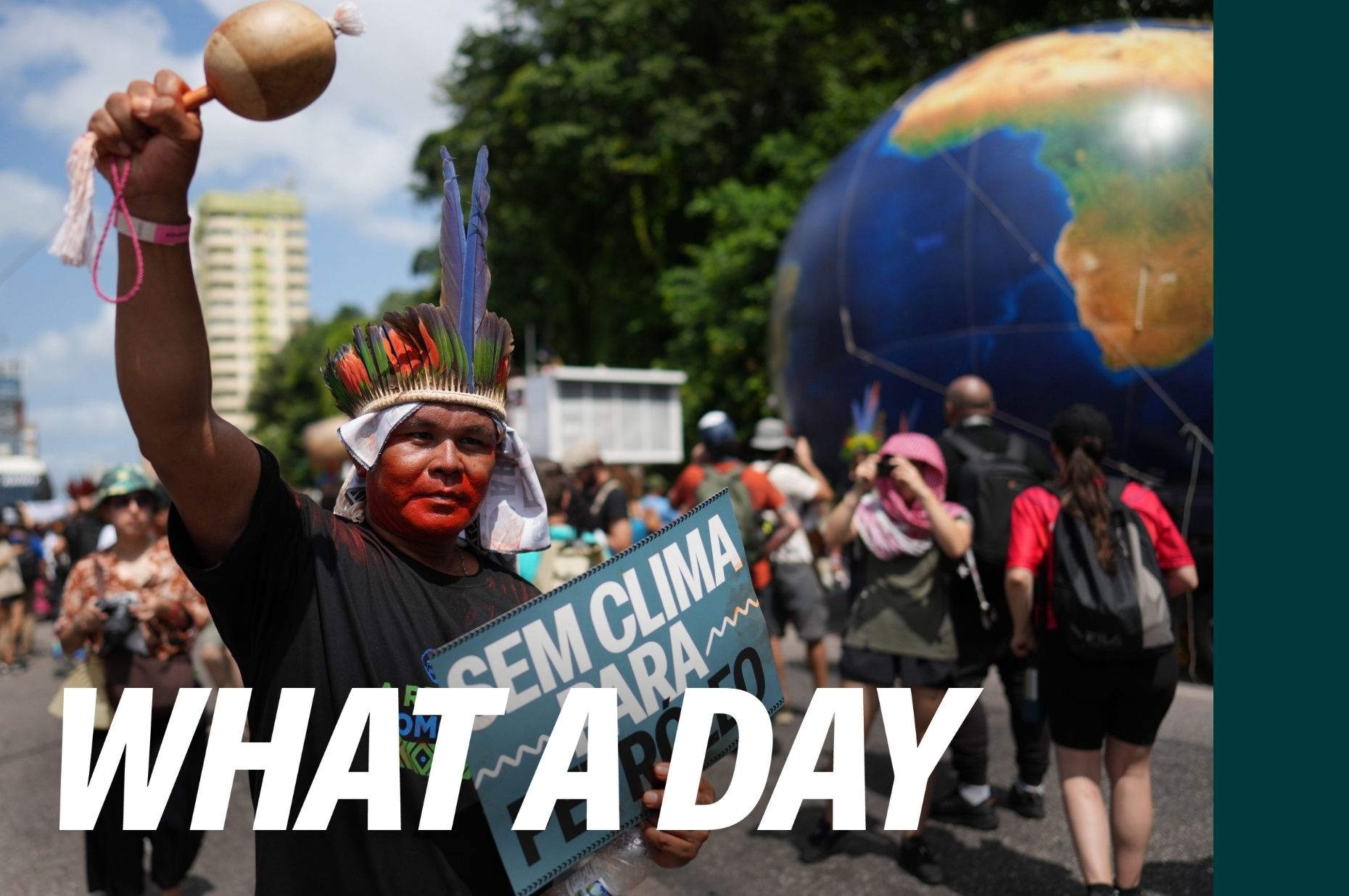
Jane Coaston: Very presidential, one might say. The conference has also seen massive protests from Indigenous people who say that they are facing the brunt of climate change and need global leaders to do something about it. People from native tribes across South America, from the Andean mountains to the Amazon rainforest, came to COP 30 to demand better. Here’s a protester speaking earlier this week interpreted by Democracy Now.
[clip of COP30 Protestor interpreted by Democracy Now] We are here fighting for our land, for our wildlife, for our birds that are facing extinction. We are at this COP for results. We ask that Brazilian President Lula come and demarcate the land so that the illegal miners don’t enter our land and our river.
Jane Coaston: So for more on COP30, I spoke to Somini Sengupta. She’s an international climate reporter for the New York Times, who is in Brazil for the start of the conference. Somini, welcome to What a Day.
Somini Sengupta: Nice to be here.
Jane Coaston: So the COP30 summit is being held in Belem, Brazil. Why did Brazilian leaders choose this city as the location for the summit? Good question.
Somini Sengupta: A lot of people were wondering that because it’s a little bit hard to get to. It’s pretty much like in the Amazon rainforest. Um. And Brazil chose it because it really wanted to draw attention to tropical forests and the Amazon in particular. It’s considered the lungs of the planet, super important in like absorbing carbon. Um and under this Brazilian government of President Lula. They’ve been kind of successful in slowing down deforestation. So, you know, he wanted to show that off too. I gotta say, being a tropical swamp creature myself, um I was born in the Bay of Bengal Delta and it was like hot and steamy and funky and it was great. I loved it.
Jane Coaston: I also, I love the way in which COP 30 really tried to emphasize the role that Indigenous leaders play in the fight against climate change. But it was interesting because you had more Indigenous leaders taking part in the summit this year, but also a number of protests by Indigenous groups with regard to the summit. So what what did that look like? And what are some of–
Somini Sengupta: Yeah.
Jane Coaston: The main issues that Indigenous leaders have been trying to spotlight?
Somini Sengupta: Well, Indigenous leaders are making the case that you can’t talk about nature protection and solving climate change without talking about our rights to maintain our territories and you know to have control over our territories. So they have really increasingly put that at the center of these big international climate negotiations. Uh. This was unusual for the robust, palpable presence of Indigenous leaders, um many of them from Brazil because, you know, we were in the we were in the Amazon, we were in the territory of Indigenous communities. Um. But also from across Latin America, Brazil had made an effort to make sure that many of them had the official accreditation to be in the conference. But you know there were also others who were not in the conference and who were protesting um outside. One of their main issues was um land rights, again, the right to control their um territories. Um. Also because it’s a pretty good climate fix and a nature fix, the areas, the forests that are actually controlled by Indigenous communities. The research shows that they’re better protected. Biodiversity in those forests are far greater than other forests that they don’t control. So there’s pretty robust evidence um for that too.
Jane Coaston: And last weekend, thousands of protesters marched outside of Cop 30. What message were they trying to send?
Somini Sengupta: As you can imagine, these were climate activists, youth activists, Indigenous activists calling for you know a couple of things, a fast transition from away from fossil fuel burning, which is the driving cause of rising global temperatures, um money to help especially poorer countries adapt to all of the climate damages that they’re seeing, and also especially from the Indigenous groups, land rights.
Jane Coaston: Now, in surprise to probably not very many people, the Trump administration did not send any officials to COP 30 this year. How noticeable was that absence?
Somini Sengupta: I mean, yeah, noticeable. It was the first time that senior officials, senior U.S. Officials were not participating in the actual negotiations. Um. Does that matter? Yes, sure. But really what matters much more to real people around the world is the United States’ position on climate change. So this administration has called um climate science uh a scam um and has most importantly really doubled down on the production and export of oil and gas. That of course has a real impact on emissions, on greenhouse gas emissions. So that’s really the most important um role that the Trump administration is playing, not just that it’s checked out of the Paris Agreement, that it isn’t in these negotiations. But that it is really doubling down on fossil fuels and urging countries around the world to buy more and then to pump more for decades to come.
Jane Coaston: One person from the U.S. who definitely made the trip was California Democratic Governor Gavin Newsom. What did we hear from him during his appearances at COP 30?
Somini Sengupta: He was there to make the case that California is a big economy which is correct um and that he is the stable American partner to the rest of the world which is you know America’s not exactly been a stable partner over the last couple of decades you know there’s been quite a bit of um back-and-forth but I have to say, having trailed Gavin Newsom for um his entire presence at cop he was a very popular figure all his events were totally mobbed and you know he was there also to make like side deals with different states to share knowledge and to share research um stuff like that.
Jane Coaston: I noticed in some of his remarks that basically he said that he was there because while the U.S. was checked out of this conference and from the fight against climate change, China was very much checked in. How much of an opportunity did that present the U. S. absence for Chinese officials to make inroads on green technology–
Somini Sengupta: yeah.
Jane Coaston: Around the globe?
Somini Sengupta: Well, again, like what really matters is is not just what China is doing at COP 30, but–
Jane Coaston: Right. Like in real life.
Somini Sengupta: What China is doing in the world, right? Um. So we’re like we’re 10 years from this landmark Paris Agreement. And in those 10 years, a lot has changed. While the US is really doubling down on oil and gas, China has spent the last 10 years, turning itself into the clean energy super power in the world. It controls the mining rights and the processing of all the minerals that go into the clean energy technologies. It makes more solar panels and wind turbines and batteries than any other country in the word. Um. It make more electric vehicles than any other countries in the world. And it is increasingly investing in setting up factories to make those things in different countries, particularly big emerging economies. So there are Chinese EV factories in Brazil, in Thailand, in Turkey, in Indonesia. There’s concern about one country dominating the production of all this like new energy kit and caboodle, but it’s also making it affordable and accessible for a number of these like really big emerging economies um to kind of leapfrog, uh not stop burning fossil fuels, but meet their new energy demands increasingly through renewables produced by China. And as you said, Gavin Newsom was there to notice that China is kind of dominating this race. You know, the U.S. right now isn’t really even in the race.
Jane Coaston: So I saw that there are some agreements or concepts of agreements happening with regard to climate. Are you expecting to see any specific goals or commitments announced by the end of COP 30?
Somini Sengupta: The deal now, um there are probably like three big issues right now. One is our country is going to emerge from this COP with some sort of deal on how to raise more money for developing nations, particularly for adaptation. Because no matter how quickly you bring down emissions, we’re still living on a fundamentally different planet and so cities need to adapt to sea level rise, to more intense storms, communities need to adapt to rising heat. So there’s a lot of money that’s needed for climate adaptation, and all eyes are on these negotiations. Is there going to be a way to come up with that money? Two, is there going be some sort of a plan, a roadmap as they call it, to phase out Fossil fuels, very controversial as you can imagine, um but that’s one of the things that they’re kind of working on and so let’s see by the end of the week if they can come up with that. Um. And I think three, uh the kind of big picture here is, can they just keep the idea and the mechanics of international climate diplomacy alive in a moment like this? That’s really the big test for this Cop.
Jane Coaston: Somini, thank you so much for joining me.
Somini Sengupta: Thank you so much. It’s been a pleasure.
Jane Coaston: That was my conversation with Somini Sengupta, an international climate reporter for The New York Times. We’ll get to more of the news in a moment, but if you like the show, make sure to subscribe, leave a five-star review on Apple Podcasts, watch us on YouTube, and share with your friends. More to come after some ads.
[AD BREAK]
Jane Coaston: Here’s what else we’re following today.
[sung] Headlines.
[clip of Elon Musk] Say like in the long term, where will things end up? Long term, I don’t know quite what long term is. Maybe it’s 10, 20 years, something like that. For me, that’s long term. Um. My prediction is that work will be optional.
[clip of unknown speaker] Optional?
[clip of Elon Musk] Optional.
Jane Coaston: Sure. Speaking of the US-Saudi investment forum, where nothing shady ever happens, on Wednesday, Elon Musk made the bold and very normal prediction that one glorious day, like in 10 years, work may be optional. The former chainsaw-wielding leader of Doge and current Tesla CEO foresees a future where AI and robots do everything and humans work for fun. Fun in the same way, according to Elon, people grow vegetables or play sports. Two things Elon has neither picked nor was ever picked for. Musk also added that as automation takes over, it could affect the concept of money itself.
[clip of Elon Musk] Um. I think at some point uh currency becomes irrelevant.
Jane Coaston: Work is optional, money is irrelevant. When did Elon start talking like the guy you most regret speaking to outside a widespread panic concert? But seriously, the man who has accumulated more money than anyone in history tells the rest of us, sure, you don’t have this, but don’t worry, it won’t matter soon. But also, I’m keeping all of mine. Nvidia CEO Jen-Hsun Huang, sitting next to Musk, took a more grounded view, saying AI will change jobs, not erase them, and might even make people busier, not freer. So Future A, Elontopia, or Future B, still Monday, but worse. For the love of God, please, please let there be a Future C. The Trump administration has been engaged in talks in conjunction with Russia to develop a new plan to end the war on Ukraine, according to reporting from Axios. The new framework would, unsurprisingly, give Russia portions of eastern Ukraine not currently under its control. In exchange, Ukraine would get security guarantees from the United States against future incursions by Russia. What could possibly go wrong? Trump’s 28-point proposal would give Russia full control of Luhansk and Donetsk, aka the hotly contested Donbas region. Even though Ukraine still holds a significant percentage of that territory, according to the latest assessment from the Institute for the Study of War. Though under the new plan, the Donbas would fall under Russian control, which is exactly what Russia has been angling for. But the region would become a demilitarized zone, meaning Russia would be barred from stationing troops there. As famously, Russia always listens to treaties. A Ukrainian official also confirmed to Axios that the framework would limit the scope of the size of Ukraine’s army and long-range weapon capabilities in exchange for U.S. Security guarantees. Though beyond the promise to defend against future Russian aggression, it’s unclear what the U. S. Security guarantees would mean. Again, what could possibly go wrong? A federal judge said Wednesday he intends to restart criminal contempt proceedings against Trump administration officials to find out who allowed those deportation flights to take off for El Salvador in March, even after the planes were ordered to turn around. Of course, this is none other than U.S. District Judge James Boasberg. You know, the poor judge who oversaw one of the most contentious events of Trump’s second term to date. Trump’s use of wartime powers to deport 137 Venezuelan men to a notorious and human rights-unfriendly prison in El Salvador. Trump accused the men of being members of Tren de Aragua, a claim many of them contested. Boasberg discovered the accused men were on flights that were already underway and immediately ordered the government to stop them, finding the Trump administration had likely violated due process for the passengers. Boasberg said during a hearing on the lawsuit, quote, “I certainly intend to find out what happened that day. He now plans to take testimony from former Department of Justice lawyer, Erez Reuveni. Reuveni was fired in April and is now accusing his superiors of ignoring court orders. And from Deputy Assistant Attorney General Drew Ensign, who told Boasberg he knew nothing about the flights even as they were taking off. Trump has named his pick for the next director of the Consumer Financial Protection Bureau, Stuart Levenbach, and he works at the Office of Management and Budget. But don’t be fooled, Levenbach is probably just a placeholder. According to an administration official who spoke to the Associated Press on condition of anonymity, his nomination is not even meant to go through to confirmation. Why? Because as we discussed last week, Trump’s lackeys are working to shut down the CFPB and OMB director Russell Vought who has also been serving as the acting director of the CFPB, is charging full steam ahead to fulfill that mission. So far, he’s stopped most of the Bureau’s work and moved to fire around 90% of staff. Thus, Trump nominated Levenbach, but used a convenient-for-Donald legal maneuver so that Vought can stay in the position. Apparently, under the Vacancies Act, Vought’s time as acting CFPB director is limited. But now that Trump has nominated someone to that position, the countdown has been paused until the Senate approves or denies Levenbach as director. How convenient. And that’s the news. [music break]
[AD BREAK]
Jane Coaston: That’s all for today. If you liked the show, make sure you subscribe, leave a review, say what’s up to a comet, and tell your friends to listen. And if you’re into reading, and not just about how NASA released photos of an interstellar comet on Wednesday, just the third confirmed object to visit our solar system from another galaxy, like me, What a Day is also a nightly newsletter. Check it out and subscribe at Crooked.com/subscribe. I’m Jane Coaston, and like so many good things, the comet will make a brief appearance 167 million miles away from Earth. And then head out to interstellar space forever. I hope it remembers to text occasionally. [music break] What a Day is a production of Crooked Media. It’s recorded and mixed by Desmond Taylor. Our associate producers are Emily Fohr and Chris Allport. Our video editor is Joseph Dutra. Our video producer is Johanna Case. We had a production help today from Greg Walters, Matt Berg, Caitlin Plummer, Tyler Hill, and Ethan Oberman. Our senior producer is Erica Morrison, and our senior vice president of news and politics is Adriene Hill. We had help today from the Associated Press. Our theme music is by Colin Gilliard and Kashaka. Our production staff is proudly unionized with the Writers Guild of America East. [music break]
[AD BREAK]


