

In This Episode
- Check out Lucian’s book – https://tinyurl.com/ytkkh6d3
- Call Congress – 202-224-3121
- Subscribe to the What A Day Newsletter – https://tinyurl.com/y4y2e9jy
- What A Day – YouTube – https://www.youtube.com/@whatadaypodcast
Follow us on Instagram – https://www.instagram.com/crookedmedia/
TRANSCRIPT
Jane Coaston: It’s Tuesday, May 19th, I’m Jane Coaston, and this is What a Day, the show that totally agrees with Vice President JD Vance. Here he is speaking in Kansas City on Monday.
[clip of Vice President J.D. Vance] If you want to rebuild the American dream for the next generation, vote against the crazy leadership in Washington D.C.
Jane Coaston: Co-sign, Mr. Vice President. [music break] On today’s show, President Donald Trump’s approval rating is down in the dumps. And we get new insight on anonymous bettors profiting from war. But let’s start with Russia’s war on Ukraine. When he was on the campaign trail, Trump said he’d end the conflict on day one back in office. Which didn’t happen. But hope springs eternal for Trump, I guess. Remember back in March of this year, after the start of Trump’s war in Iran, when the president told reporters that Russia’s War on Ukraine was quote, “very high on his priority list”?
[clip of President Donald Trump] I thought this was going to be much easier than it is. It’s very there’s tremendous hatred between President Putin and President Zelensky. Tremendous hatred. I’ve seen a lot of hatred in my life, but I think this is about top-scale. I believe it’s going to happen.
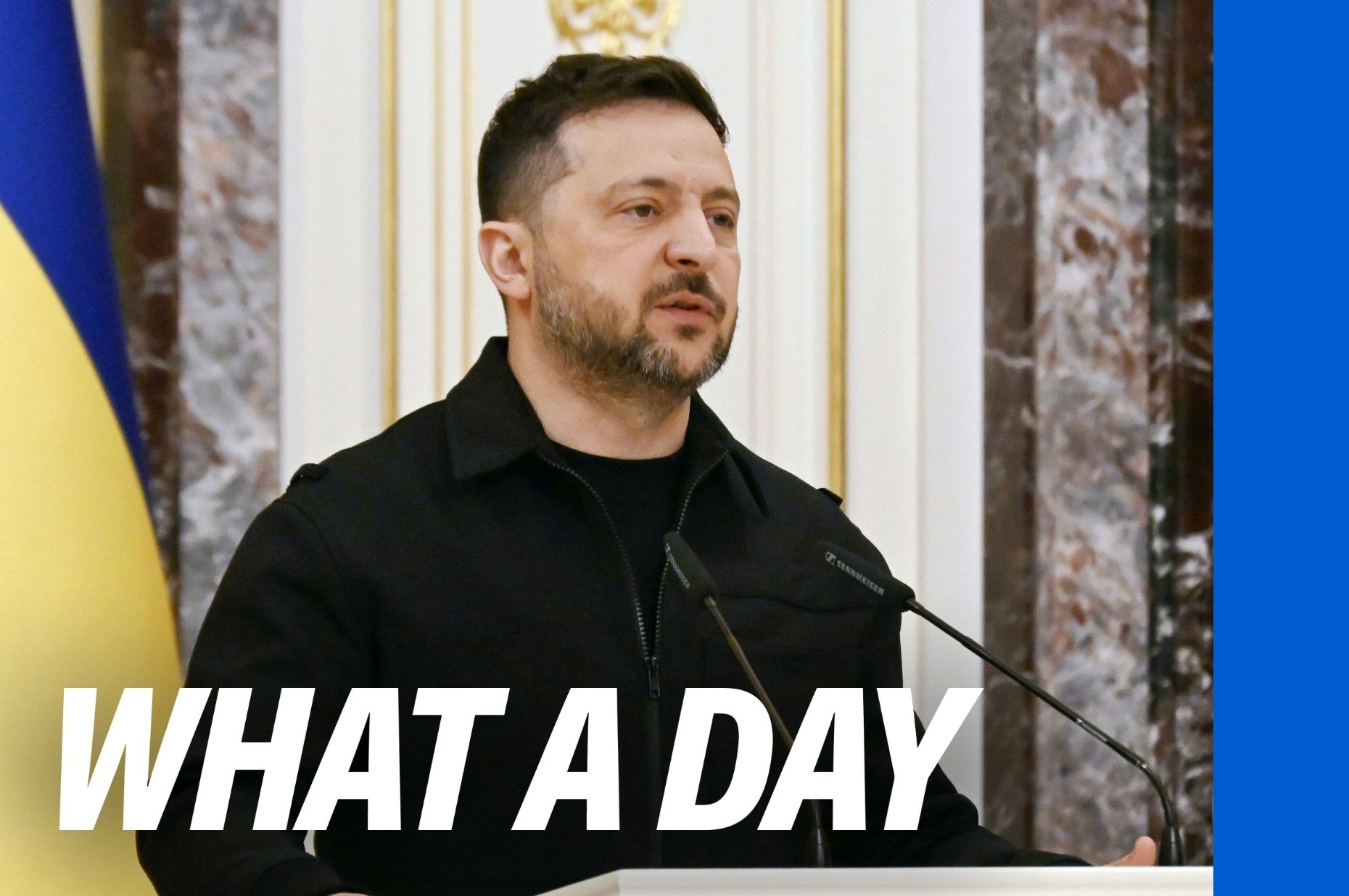
Jane Coaston: No such luck. Russia invaded Ukraine on February 24th, 2022. In a speech given that same day, Russian President Vladimir Putin said that the quote, “special military operation was to rescue the people of Ukraine’s Donbas region who quote, “suffer from abuse and genocide from the Kyiv regime.” Russian state media argued that the war would last just weeks, if not days, but four years later, Ukraine and Russia are still at war. Over 300,000 Russian soldiers have died in the war, compared to roughly 150,000 Ukrainian soldiers. The number of civilian deaths is harder to track, but we do know that at least 15,000 Ukrainians have died. Russian state news says that more than a thousand Russian civilians have been killed since the war began. This war has been brutal and deadly, and it seems like it just keeps going. So how can both sides end this conflict, and what will the U.S. do to help or hurt the peace process? To find out, I spoke to Lucian Kim. He’s the senior Ukraine analyst for the International Crisis Group. When we spoke, he had recently returned from an 11-day trip to Ukraine. Lucian, welcome to What a Day!
Lucian Kim: Great to be here, Jane.
Jane Coaston: Russia’s war against Ukraine started more than four years ago, and at this point I feel like I’ve heard Trump say the war is almost over or that a peace deal is imminent a bunch of times, but you just got back from a trip to Ukraine last week. What’s it like on the ground?
Lucian Kim: You know, it’s it’s kind of two different feelings. On one hand, it’s a bustling big city with a lot of life uh going on. And the disconcerting thing is that at night there are often air raid alarms. And Russian drones, often missiles, strike Kyiv and other big cities. And that’s what makes the whole thing so surreal. You think you’re in just a normal European city. Yet you often have sleepless nights, and there was a devastating attack right after I left last week that killed 24 people in Kyiv.
Jane Coaston: I want to back up for a second, because I remember reading last week that Russia’s war against Ukraine has lasted longer than the Soviet Union’s war against Nazi Germany. And that was something I studied for a very long time. So it’s just wild to me to think that this has lasted that long. When Russia first invaded Ukraine in February of 2022 as a special military operation, how did Putin think this would go?
Lucian Kim: Well, you know, you’re using air quotes to say special military operation, and many people think it’s a euphemism. In fact, he thought it was a special military operation. He thought that he could get the job done, uh if not in a couple of days, then no more than a few weeks. He thought he was just going to roll over Ukraine, decapitate the Zelensky government, and install a puppet regime in no time. Why did he make this great miscalculation? Well uh, most of all, he was getting a lot of poor uh poor intelligence. He was being told by his intelligence services things that he wanted to hear. And he has um you know he had been already in power for more than 20 years at that point. And he had a very small circle of advisors. And they were also he was in an echo chamber. And the things that were he was hearing was that Zelensky uh Volodymyr Zelensky, the president of Ukraine, was very unpopular, which was actually true at the time. And he figured that Russian soldiers would be received as and welcomed as as liberators. And as we know now, that was a grave miscalculation. He had basically convinced himself, after repeating it enough times, that Ukrainians and Russians were one people, in his in his words.
Jane Coaston: And what was his thinking after taking, basically taking over Ukraine? What was his plan after installing this puppet regime in Ukraine? Like what next?
Lucian Kim: Well, Ukraine occupies a very special place in not only Vladimir Putin’s mind, but in the mind of many Russians. So they believe that Ukraine is essential for some Russian-led civilization. That this is it was Ukraine played a key role in the Russian empire um as a breadbasket, as an industrial powerhouse and later in this in the Soviet Union when Ukraine was part of the Soviet Union. It was after Russia, it was really the most uh economically important part of the Soviet Union so it was this idea that we need to uh before Ukraine goes and and runs off uh to join Europe or the Americans we better stop this uh once and for all and reestablish control.
Jane Coaston: Well, fast forward four years from 2022, and last weekend, Ukraine pulled off its largest and most deadly attack in the Moscow region using drones. Ukraine is reportedly fending off Russia on the frontlines, even winning back some of its territory, and at at worst seems to have forced Russia into a stalemate. What’s changed?
Lucian Kim: It’s really you know unbelievable because, as I mentioned, it was supposed to be a special military operation over you know in a matter of weeks at the most. And if somebody had said back in 2022 that Ukraine would still be fighting back and that uh Russians would be feeling drone attacks on their own territory as far away as Moscow or St. Petersburg, nobody would have believed that. So it’s actually close to miraculous what the Ukrainians have pulled off. They have managed to survive, they they consolidated as a nation, and um even though they never got enough Western assistance that they wanted, and despite the fact that the Trump administration has more or less turned its back on Ukraine, uh they have started their own indigenous drone industry and have really innovated on uh on an incredible scale.
Jane Coaston: Back in 2024, President Trump said he could end this war in 24 hours. It turns out ending wars is hard, and now he’s wrapped up in his own war in Iran. Where do peace negotiations go from here? With the U.S. distracted by its own conflict and, as you mentioned, not providing very much assistance to Ukraine at all in the first place.
Lucian Kim: I think the Ukrainians realize that they are now on the back burner as far as the Trump administration’s attention, and they’re trying to make the best of it. So interestingly enough, when the American attack began on on Iran, one of the first world leaders to support it on social media was Volodymyr Zelenskyy. And what he was really trying to do was put Iran and Russia in the same bag, sort of to illustrate it to Trump that uh these guys are actually in the same camp. The reason for that, of course, is that Iran supplied Russia with its Shahed drones early on in the invasion of Ukraine, and that played a critical role. So suddenly these drones were now attacking U.S. allies in the Gulf, and Zelenskyy tried to um tried to use the war to to gain attention to developments in Ukraine’s drone industry. And he made a big tour through the through the Middle East and signed drone agreements with some of the main players like Saudi Arabia and the United Arab Emirates and tried to make the best of it. Of course, you know there’s certain optimism right now in Kyiv, but it’s it’s still it’s still a hard war. And you know if if they can get it back on a negotiating track, that would be great. Zelenskyy has said that he would very much like Jared Kushner and Steve Witkoff to come and visit him in Kyiv. Those are, of course, the two Trump negotiators. But let’s be realistic. Nobody in Kyiv right now is expecting the negotiations to um pick up anytime soon.
Jane Coaston: Yeah, it seems like what it would take to get Russia and Ukraine on the same page for a peace deal would be very different. What does each party want here and is it something that they could come to some sort of meeting in the middle on.
Lucian Kim: That’s a very good question. I mean, what does Russia want? And I think in order to um make peace, find peace in Ukraine, it’s very important to understand uh the motivations of the two sides. And for for Russia, I think there’s a misunderstanding sometimes. There’s a there’s this idea that, oh, well, if if Russia just gets to keep what it what it invaded already, uh they’ll be happy uh with adding four or five new regions to the to the Russian uh Federation.
Jane Coaston: Lucian, I can tell you, I have never thought that. I I know that Putin has always admired Peter the Great. I I know he does not want four to five new regions.
Lucian Kim: Exactly. This is a war of uh to subordinate Ukraine, right? Putin is not going to rest until Ukraine is subordinated. I think everybody in Ukraine understands this. Putin is at this stage in his career as Russia’s leader to understand that he’s thinking of his historical legacy, and he wants to be remembered as the Russian leader who reconquered Ukraine and who did not lose Ukraine. So this is really an obsession for Vladimir Putin. As for the Ukrainians, this is a war of survival. It’s as simple as that. Of course, um at the beginning of the full-scale invasion, the Ukrainians successfully defended the capital, Kyiv, and they actually had a very successful counteroffensive where they regained a lot of their own territory back. Uh. And that caused some optimism, and people said, you know, we want to have Ukraine in its original 1991 borders. Uh. That, of course, is, um I think most people on the ground see that as aspirational. That is something that Ukrainians would like as sort of for historical justice. But they understand that you know in the current circumstances, probably the best they can get is a freezing of the front lines.
Jane Coaston: Lucian, thank you so much for joining me.
Lucian Kim: Thanks so much for having me, Jane.
Jane Coaston: That was my conversation with Lucian Kim, senior Ukraine analyst for the International Crisis Group. This is a podcast that does not try to forecast how long wars are going to last, which is a weird thing to brag about, but hey. If you like the show, make sure to subscribe, leave a five-star review on Spotify and Apple podcasts, watch us on YouTube, and share with your friends. More to come after some ads. [music break]
[AD BREAK]
Jane Coaston: Here’s what else we’re following today.
[sung] Headlines.
[clip of President Donald Trump] And there seems to be a very good chance that they can work something out. If we can do that without bombing the hell out of them I’d be very happy.
Jane Coaston: Trump said Monday he is holding off on a military strike in Iran that was planned for today. He told reporters during an event on health care that he was calling off the strike at the request of allies in the Middle East because they feel they are close to a deal with Iran.
[clip of Nicolas Vaiman] This might be the most insane pattern we have found on Polymarket so far.
Jane Coaston: Bubblemaps CEO Nicholas Viaman told 60 Minutes that the data analytics firm made an interesting discovery about several bettors on Polymarket.
[clip of Nicolas Vaiman] We spotted nine polymarket accounts, all connected who made collectively $2.4 million, betting almost exclusively on U.S. military operations.
Jane Coaston: According to Bubblemaps, the users placed bets on important dates pertaining to the Iran War. The kicker? The accounts won 98% of 80 bets. The double kicker, the traders are anonymous. Trump’s Department of Justice announced that it’s creating a 1.776, get it, billion-dollar quote, “anti-weaponization fund to help those who claim to have been unfairly targeted by previous administrations.” Trump defended the DOJ slush fund during Monday’s health care event.
[clip of unknown news journalist] Why should tax payers pay for the January 6’ers?
[clip of President Donald Trump] Well, it’s been very well received, I have to tell you. I know very little about it. I wasn’t involved in in the whole creation of it and uh and the negotiation, but this is uh reimbursing people that were horribly treated, horribly treated. It’s anti-weaponization. They’ve been weaponized. They’ve been in some cases imprisoned wrongly. They paid legal fees that they didn’t have. They’ve gone bankrupt. Their lives have been destroyed. And they turned out to be right.
Jane Coaston: Very well received, and yet he knows very little about it. Trump’s team unveiled the fund after it moved to dismiss its $10 billion lawsuit against the IRS. Trump officials have been holding secret talks with Greenlandic leaders for months about the nation’s future, according to the New York Times. Local politicians are worried that Trump’s team is trying to exert influence over Greenland. Proposals reportedly include allowing American troops to stay in Greenland indefinitely and granting the U.S. veto power over investment deals from Russia, China, and others. Time for one of my favorite comfort reads, Trump’s plummeting polling. On Monday, Trump hit an approval rating of 37%, according to a New York Times Sienna poll. That’s the lowest approval rating from the poll for Trump in either of his terms in office. Why is Trump’s polling so low? Let me count the ways. For one thing, the Times reported that just 30% of Americans think Trump’s decision to go to war in Iran was a good idea. 31% of Americans approve of Trump’s handling of the war. It’s no wonder, then, that for the first time in his second term, Trump’s average job approval in the RealClearPolitics poll aggregator has fallen below 40%. And speaking of firsts, according to CNN, a majority of white voters without college degrees disapprove of Trump. Ah, the soothing sounds of failure. And that’s the news. [music break]
[AD BREAK]
Jane Coaston: That’s all for today. If you like the show, make sure you subscribe, leave a review, celebrate Elon Musk losing a lawsuit because of those pesky, woke deadlines, and tell your friends to listen. And if you’re into reading, and not just about how according to the New York Times, a jury ruled on Monday that Musk would lose his $150 billion lawsuit against OpenAI because he didn’t file it within the timeline required by law, like me, What a Day is also a nightly newsletter. Check it out and subscribe at Crooked.com/subscribe. I’m Jane Coaston, and it’s always so sad when a man who spends most of his time complaining about the casting decisions of movies he hasn’t seen, loses a lawsuit because he can’t get his shit together. [music break] What a Day is a production of Crooked Media. Our show is produced by Caitlin Plummer, Emily Fohr, Erica Morrison, and Adriene Hill. Our team includes Hayley Jones, Greg Walters, Matt Berg, Joseph Dutra, Johanna Case, and Desmond Taylor. Our music is by Kyle Murdock and Jordan Cantor. We had help today from the Associated Press. Our production staff is proudly unionized with the Writers Guild of America East. [music break]