

In This Episode
- Check out Stacey’s podcast –
- Call Congress – 202-224-3121
- Subscribe to the What A Day Newsletter – https://tinyurl.com/y4y2e9jy
- What A Day – YouTube – https://www.youtube.com/@whatadaypodcast
Follow us on Instagram – https://www.instagram.com/crookedmedia/
TRANSCRIPT
Jane Coaston: It’s Thursday, May 14th. I’m Jane Coaston, and this is What a Day, the show that sees you, a person who also listens to a lot of true crime podcasts. You’re very busy right now, and yet you’ve decided to take a break and catch up on the news. I salute you. [music break] On today’s show, Vice President JD Vance announces steps to take more steps to prove steps are being taken in the administration’s anti-fraud initiative. And the effort by Senate Democrats to halt the Iran War continues to go nowhere. But let’s start with voting and race. We’ve talked about how the Supreme Court’s ruling in Louisiana vs. Callais dismantled a critical portion of the Voting Rights Act. Since then, a bunch of states, largely in the South, have moved to redraw their voting maps. And they’re eliminating majority Black voting districts. The Supreme Court seems to believe that states are creating districts based on politics, not race, because it’s fine if lawmakers protect their party seats. But to me and everyone else, including Republicans, it seems pretty clear that’s not true when it comes to drawing districts. Here’s South Carolina Republican representative Ralph Norman speaking on Newsmax.
[clip of Representative Ralph Norman] Jim Clyburn, I like him personally, but he does not represent the rest of South Carolina, which is conservative. His district is 40 close to 47% African American and 41% with 6% makeup of Hispanics.
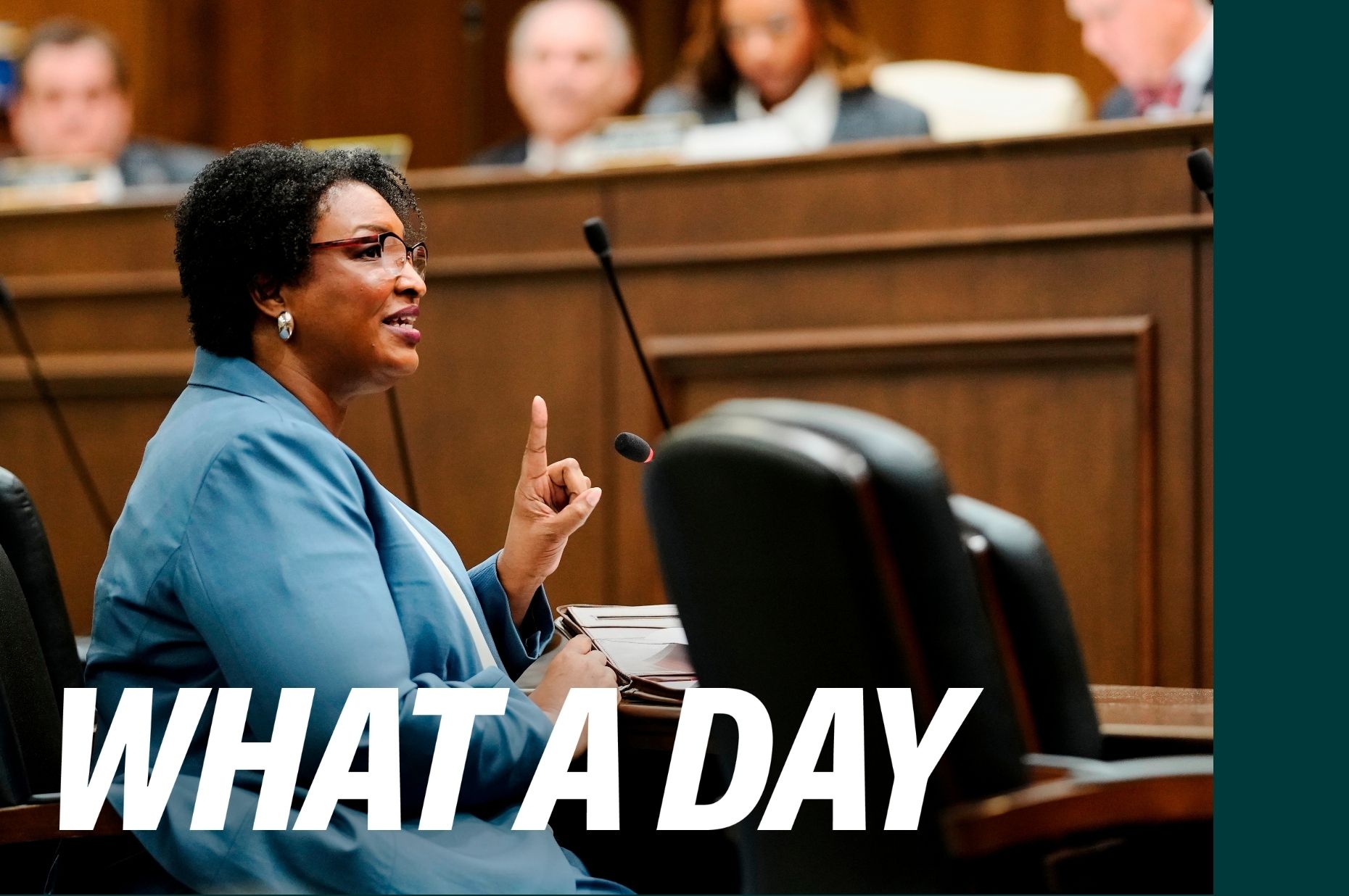
Jane Coaston: Notice how he shifts pretty quickly from political ideology to race. Norman’s numbers are, it should be noted, slightly incorrect, but talk about making my point for me. There are not many people who have done more for the rights of Black voters in the South than Stacey Abrams. So I had to talk to her about the racist implications of Louisiana versus Callais and where we go from here. Stacey, welcome back to What a Day.
Stacey Abrams: It is always a pleasure to see you, Jane, even if the world is burning around us.
Jane Coaston: Well, when you put it like that. Yeah. Um. Speaking of, in the past year, we have seen multiple states redraw their congressional maps, diluting Black and Latino voting power. You have been fighting against voter suppression for decades. Did you see this coming?
Stacey Abrams: Yes. We know what they’ve been intending to do for 60 years. There’s a cohort that has never wanted the Voting Rights Act because it diluted their power, particularly in the South. And that faction has joined with the authoritarian regime that understands that the only way to seize political power and to hold dominion in the United States is to fracture and suppress the pluralistic part of our pluralistic democracy. That requires that you suppress, dilute, crack, and eliminate the voting rights of communities of color as a precursor for going after everybody else.
Jane Coaston: The Voting Rights Act was passed to prevent discriminatory voting practices. Voting practices that were obscene for decades. But last month, a Supreme Court decision, as you know, gutted Section 2 of the VRA, and Justice Alito essentially said, the Voting rights act worked and we’re good now. He wrote, quote, “as this court has recognized things have changed dramatically in the decades since the passage of the voting rights act.” What was your reaction when you read that?
Stacey Abrams: That this was a fiction and that he understood very explicitly what he was doing and much as they did in the 1890 Mississippi constitution, as Andrew Johnson did when he became the president of the United States, they pretend race neutrality to disguise what is very clearly racial animus. And we know that race neutrally was the pretext for the voting laws that passed during Jim Crow.
Jane Coaston: Right.
Stacey Abrams: Every one of the voting laws were technically race neutral.
Jane Coaston: Right, it’s just, oh, if your grandfather could vote, oh, can you pass this test? Anyone could pass that.
Stacey Abrams: Exactly. They use racial context to pretend racial neutrality to achieve racial animus. That’s been the pattern in this country for centuries now. We’re not talking decades. We’re talking centuries. It’s been more than 200 years of this. And I think it’s really important that as we hear the narrative about colorblindness and race neutrality, that if we’re going to use that notion. Then, and I’m borrowing this from someone I saw on TikTok. Well, why do we need the second amendment? A lot of people own guns now. We’ve got all these laws. We no longer need the protection of guns. The second amendment is no longer necessary because people have all the guns they need. If we believe that any one person is at risk because of the potential to seize power, which has been the raison d’etre of Texas, of Louisiana, of Mississippi, of Alabama, of Georgia, of Tennessee. If we believe that they will ever use race to deny access to the right to vote, then we have not achieved the ends of the 15th amendment, which means we still need the voting rights act.
Jane Coaston: So something I thought was interesting, not interesting good, was that the defense that you’re hearing from some Republicans, including Republican Senator Tim Scott, who is African-American, is that this is partisan gerrymandering, which is somehow not against the law and not racial gerrymandering. And that, you know, it has nothing to do with race. It’s just about Democrats and Republicans, which is like, I mean I want to hear your thoughts on it. Because at a moment in which the rights of marginalized groups are under threat again, it is almost impossible to untangle race from politics, and we keep seeing it over and over and over and over and over again.
Stacey Abrams: The notion that it’s just partisan, we talk about the Shelby v Holder decision in 2013, we talk the Branovich decision in 2021 that also diminished the Voting Rights Act, but we don’t talk about Russo versus Common cause. That’s the Supreme Court case, the interceding one that said that partisan gerrymandering was perfectly fine, because they’ve been planning this and they laid the breadcrumbs perfectly. First you weaken pre-clearance, then you say, oh, as long as it’s partisan, it’s fine. Then you weaken the responsibility to prove that there was racial animus. And now you get to a place where you have to be a psychic to know that it was racial animus, not a detective. And show you have show the intent, not the outcome. But the reason this matters is that they’ve done this before. When the Jim Crow laws came into place, context mattered. They had literacy tests because Black people prior to Jim Crow were prohibited from learning to read. They knew that it would only affect a certain community. You had poll taxes because the enslaved did not have money. The formerly enslaved still were part of an economic system that did not give them full access. And then to make sure it didn’t hurt the wrong people, you had, as you mentioned, the grandfather clauses. It said, well, all of these things don’t count as long as your grandfather could vote before the civil war. Well, what they’re using now instead of a grandfather clause is partisanship. It is a fiction. They know that race is the strongest predictor of political leanings in this country, especially in the South. They are using partisanship as a proxy to attack race. And we know it because we’ve seen them do it before.
Jane Coaston: And I think to me and to a lot of other people, the invective that we’ve been hearing from Republicans over the last couple of days, over the last couple of weeks, going after Benny Thompson, going after African-American electeds like Jim Clyburn, if I’m a Black Southern voter, I see this and I know what they’re doing. And I think Republicans had really talked themselves into creating this big multiracial tent in 2024, a tent that has collapsed. Do you think this will also ultimately backfire on Republicans?
Stacey Abrams: It will if we take advantage of our numbers. What they are counting on is not only the expansion they saw in ’24, but they’re counting on the regression that we’ve seen actually over the last few years. Fewer and fewer Black people are voting based on the percentage that we have in the population. You are seeing a retrenchment and it’s slow, but what they’re counting on are the people who’ve never registered, the ones who registered and voted, but didn’t get what they needed, the once who voted and are now being shifted around. So they believe that the math works in their favor if they can get to ’28 and change the rules again, and if they can get to 2030 and change the census. So they know that this isn’t a permanent solution. It’s part of their plan. And I think that’s the most important part for us to understand. This isn’t about winning the midterms in ’26. This isn’t just about winning Congress in ’28. This is about holding all of the power so that in 2030, they can do what they tried to do in 2020, which is change the census. If the count is wrong, then the rest of the rules don’t matter. And so we have to think about this longitudinally as well. There are enough people of color who share political values. There are enough people of color and white people who have common interest that if we actually organize, if we show up at the ballot box, if we show up in the courts, if we show up in community, we absolutely can fight back. And if we remember this is a national fight, not a state by state fight, you cannot abandon the South. We have to recognize that what they’re doing in the South is designed to hurt people in Massachusetts, in Illinois, in Oregon, because if they can take out 60% of Black voters, they also can take all of the electoral votes that come along with all of those States. And the sunbelt is where power is moving. They know it and they’re trying to freeze that power right now. So we have to seize that power right now.
Jane Coaston: Yeah, I think that goes to my final question, which is that the Voting Rights Act itself was a result of years of organizing and struggle. People died to get that passed. Now it’s been significantly watered down. Where do we go from here, Stacey? What can we do?
Stacey Abrams: The reason the Voting Rights Act was so critical was that it made manifest the promise of the 15th Amendment, which said that the right to vote would not be impinged upon due to race. They are now trying to leverage every tool they can to take it back. And if we do nothing, they win. But we have won before. We defeated slavery. Slavery was not just Abraham Lincoln. It was abolitionists. It was organizing. It was the work of the Underground Railroad. We didn’t just defeat Jim Crow, with the civil rights movement. It was the civil rights movement that took decades, but it took all kinds. We can defeat them again, but part of what we have to believe is that the tools that could have helped us, when they are removed, that does not mean we lose. That just means we have to find another way to recreate that tool. We have to find another way to get to the end, because if they know 2030 counts, so should we. If they know 2028 matters, so should we. If they know that the midterms count, so should we. We have the numbers. We have to have the will and we cannot be lulled into the complacency of their meanness into believing we’ve already lost. That’s why I created Ten Steps campaign. That’s what I’m so delighted to be working with Vote Save America and organizations across this country. We can win, but we have to work harder than they will. And they know that this is existential. They know that by 2046, this is a majority minority country, and they’ve got to do everything they can in this next decade to make certain that that doesn’t matter. We can fight back and we can win.
Jane Coaston: Stacey, as always, thank you so much for joining me.
Stacey Abrams: Thank you for having me.
Jane Coaston: That was my conversation with Stacey Abrams. She’s the host of Crooked Media’s Assembly Required. Good news, you will not hear anything about Samuel Alito for the rest of the show. If that’s something you’re into, make sure to subscribe, leave a five-star review on Spotify and Apple podcasts, watch us on YouTube and share with your friends. More to come after some ads. [music break]
[AD BREAK]
Jane Coaston: Here’s what else we’re following today.
[sung] Headlines.
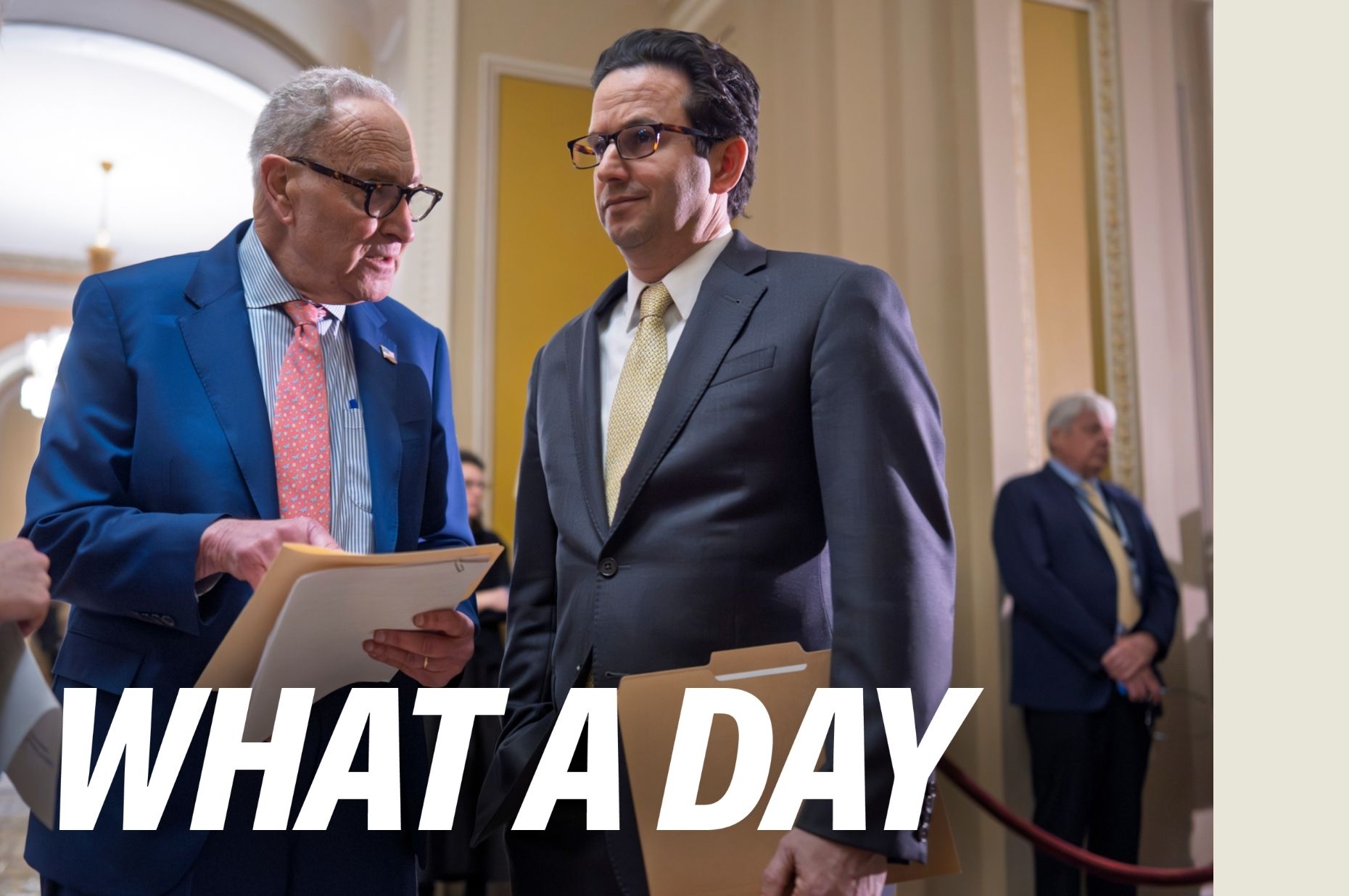
[clip of Chuck Schumer] Today’s vote will be the Republican’s seventh, seventh opportunity to support our resolution to withdraw our troops from hostilities with Iran and stop the economic fallout from this historic blunder.
Jane Coaston: Looks like we’re going to need an eighth try. Senate Minority Leader Chuck Schumer spoke before Senate Republicans blocked Democratic legislation that would halt President Donald Trump’s Iran war. But three Republicans broke with their party and voted against the war. Alaska Senator Lisa Murkowski, Susan Collins of Maine, and Rand Paul of Kentucky. The legislation ultimately failed to advance 49 to 50. And there’s news in healthcare, but not the news any of us have been hoping for.
[clip of Vice President J.D. Vance] We’re announcing that the federal government is deferring $1.3 billion in Medicaid reimbursements from the state of California.
Jane Coaston: Vice President Vance announced on Wednesday new steps in the Trump administration’s initiative to root out fraud in federal health programs. His latest target? California. Officials said the administration is also imposing a six-month freeze on some new Medicare enrollments and warning states to investigate fraud or risk losing funding. The Trump administration has lost in court more than 10,000 times in ICE detention decisions, according to a new Politico analysis released on Wednesday. In response, a Justice Department spokesperson said, quote, “that’s great. Now the American people can see how judges are putting personal policy preferences ahead of proper interpretations of the law.” Weird how hundreds of judges, including judges Trump himself appointed, all have the same, quote, “personal policy preferences.” Trump is in China to strike big business deals, but lawmakers are worried about one potential investment from China, electric vehicles. Michigan Democratic Senator Elissa Slotkin recently introduced a bipartisan bill to ban Chinese EVs. She says the high quality and expensive vehicles could decimate the U.S. Auto industry and may have technology that could spy on drivers and scan their surroundings. Crooked Media’s Matt Berg spoke with Slotkin about the bill on Wednesday.
[clip of Senator Elissa Slotkin] I think the president is desperate for a deal of any kind. I think he needs China’s help resolving the blockade of the Strait of Hormuz, and he’s willing to give almost anything to end the war that he started.
Jane Coaston: Trump’s public agenda for his China trip doesn’t mention the EV issue. The State Department is suspending a pricey bond requirement for some World Cup fans headed to the U.S. The Department imposed the requirement last year for countries that it said had high rates of people overstaying their visas and other security issues. But on Wednesday it announced that people from five countries that have qualified for the World Cup – Algeria, Cape Verde, Ivory Coast, Senegal, and Tunisia and who have already bought tickets for the tournament are exempt from the payment. The bond waiver is a rare loosening of immigration requirements under the Trump administration. So who’s actually behind it? According to U.S. Officials who spoke to the Associated Press, FIFA had requested the waiver. Guess they didn’t want to refund all those tickets. And that’s the news. [music break]
[AD BREAK]
Jane Coaston: That’s all for today. If you like the show, make sure you subscribe, leave a review, get ready for a very shark girl summer, and tell your friends to listen. And if you’re into reading, and not just about how great white sharks are showing up in big numbers off the coast of Southern California, which apparently means the waters are getting healthier, like me, What a Day is also a nightly newsletter. Check it out and subscribe at Crooked.com/subscribe. I’m Jane Coaston, and I plan to have a very Shark Girl summer myself, constantly moving, sandpaper-like skin and never ever changing for 400 million years. [music break] What a Day is a production of Crooked Media. Our show is produced by Caitlin Plummer, Emily Fohr, Erica Morrison, and Adriene Hill. Our team includes Hayley Jones, Greg Walters, Matt Berg, Joseph Dutra, Johanna Case, and Desmond Taylor. Our music is by Kyle Murdock and Jordan Cantor. We had help today from the Associated Press. Our production staff is proudly unionized with the Writers Guild of America East. [music break]