

In This Episode
- Check out AG Rayfield’s work – https://tinyurl.com/2ds3y767
- Call Congress – 202-224-3121
- Subscribe to the What A Day Newsletter – https://tinyurl.com/3kk4nyz8
- What A Day – YouTube – https://www.youtube.com/@whatadaypodcast
Follow us on Instagram – https://www.instagram.com/crookedmedia/
TRANSCRIPT
Todd Zwillich: It’s Thursday, November 6th, I’m Todd Zwillich in for Jane Coaston, and this is What a Day, the show watching House Speaker Mike Johnson process his party’s brutal election losses, one stage of grief at a time. First, of course, there’s denial.
[clip of House Speaker Mike Johnson] I don’t think the loss last night was any reflection about Republicans at all.
Todd Zwillich: Then there’s anger.
[clip of House Speaker Mike Johnson] I think people are frustrated and angry as we are.
Todd Zwillich: Then you move on to bargaining.
[clip of House Speaker Mike Johnson] We look forward, we’re looking forward to a great election running on our record. And uh we’re gonna we’re gonna get all of our incumbents re-elected.
Todd Zwillich: And depression.
[clip of House Speaker Mike Johnson] We woke up very early. Um. And we talked about the outcome.
Todd Zwillich: Still waiting on that final stage, Mike. What does it take to reach acceptance when you’re Mike Johnson? [music break] On today’s show, President Donald Trump notches another record into his belt, the longest government shutdown in American history. And in California, Republicans sue the state over Prop 50, just hours after it passes. But let’s start with the Supreme Court. The two things Donald Trump loves most, okay, two things besides money and revenge, tariffs and going to court. That means it was a big, big day for Trump at SCOTUS as justices heard arguments on his administration’s unilateral power grab, claiming the power to declare an emergency where none exists and then using that emergency to inflict economic chaos on friends, adversaries, American consumers, and well, just about everyone. Justices seemed skeptical. Even Trump-friendly ones like Neil Gorsuch, who questioned Trump administration lawyers on their claim that, hey, tariffs are foreign policy, and the president can do whatever he wants.
[clip of Justice Neil Gorsuch] I want you to explain to me how you draw the line because you say we shouldn’t be concerned because this is foreign affairs and the president has inherent authority and so delegation off the books, more or less. If that’s true, what would prohibit Congress from just abdicating all responsibility to regulate foreign commerce, for that matter, declare war, to the president?
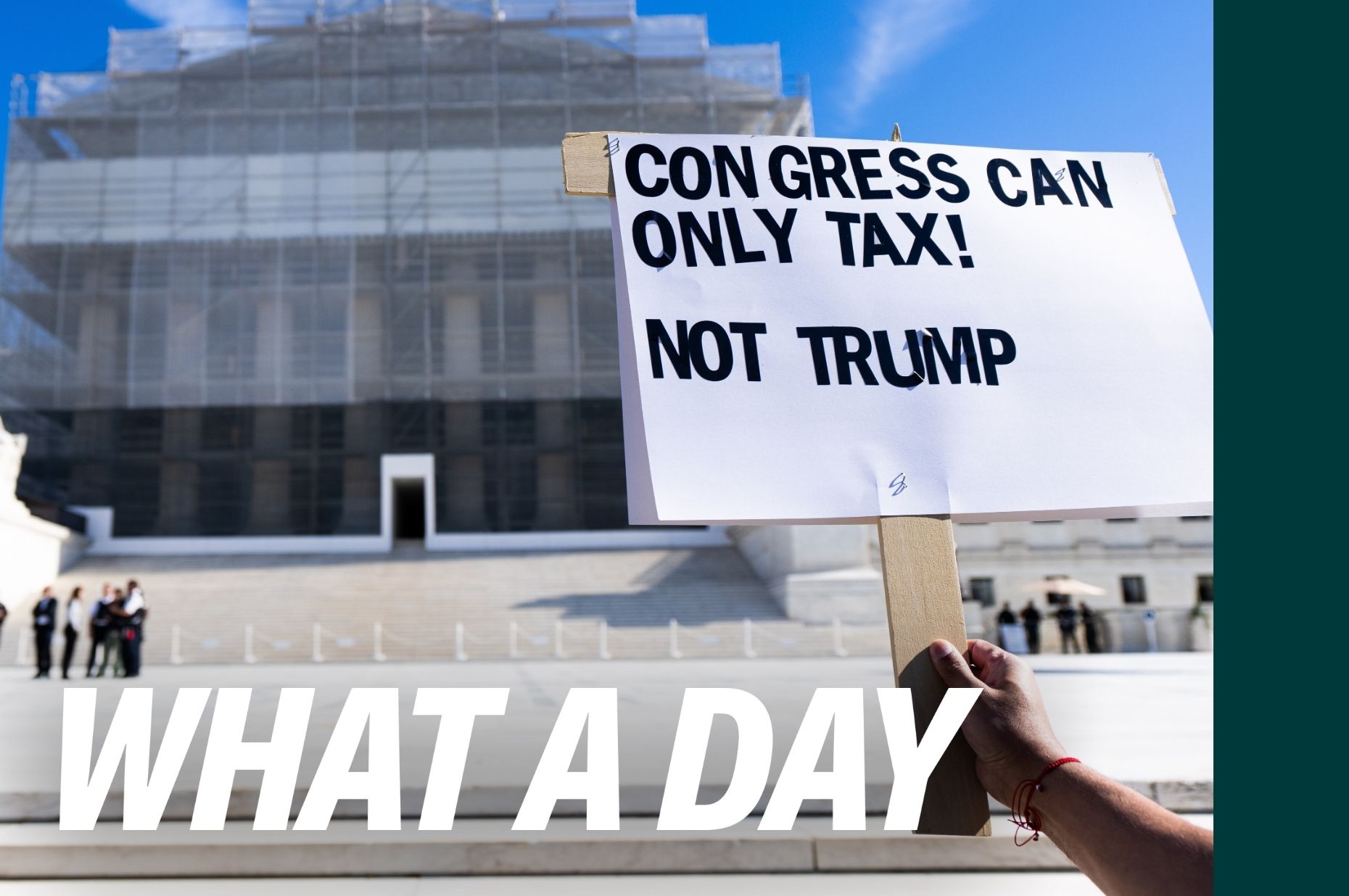
Todd Zwillich: Then there was the question, what is a tariff? Because if a tariff is a tax, only Congress can tax. It’s right there in Article One of an admittedly obscure document called the Constitution. Here’s Justice Sonia Sotomayor.
[clip of Justice Sonia Sotomayor] I just don’t understand this argument. Um. It’s not an article, it’s a congressional power, not a presidential power to tax. And you want to say tariffs are not taxes, but that’s exactly what they are.
Todd Zwillich: Of course, even if you’re not a lawyer, maybe especially if you are not a lawyer, the main effect of Trump’s tariffs is confusion. Liberation days followed by deadlines that never materialize and global economic policy by Truth Social Post. And Nebraska Republican Don Bacon, who’s not running for reelection in the House, knows that that spells chaos. And markets, they hate chaos.
[clip of Don Bacon] The tariff strategy has been a lot of tears on and off again, and it’s been very unpredictable. And I think our economy has has instability because of this, and the average person, when they go to the supermarket, as you say, they’ve not seen an improvement.
Todd Zwillich: Oregon is one of the states suing the Trump administration over tariffs. To find out more about what they argued at SCOTUS and what might happen if skeptical justices give Trump a very rare L, I talked to Dan Rayfield. He’s the attorney general of Oregon. Attorney General Dan Rayfield, welcome to What a Day.
Dan Rayfield: Hey, thanks for having me.
Todd Zwillich: Great to have you. Well, the lawsuit that your state is leading argues that President Trump is misusing what’s called the International Emergency Economic Powers Act, otherwise known as IEEPA, to impose his expansive tariffs. Um. First of all, did Neil Gorsuch say IEEPA today? And second of all can you break down the argument at the heart of your case?
Dan Rayfield: Yeah, absolutely, uh you know, I think that’s the one thing Americans didn’t think they would have to learn this year is what IEEPA stands for. But and the case is pretty darn simple, right? In the history of IEEPA, right, this emergency power, no president has ever used it to set tariffs. And there’s a reason for that, is because Congress, when they contemplated how much power they should give to the president, and that’s one thing America’s got to remember is that the Constitution gives that sole power to Congress. Congress has given some of that power to the president. And they created these specific statutes to do that, and they created safeguards, right? They wanted safeguards for our consumers, so our prices don’t go up. They want a predictability for small businesses. So you have length, duration, amounts, all these type of safeguards for American people, frankly, as Congress and their, what I would say, their sole discretion to really engage in this area. This is the first president that used this emergency power to set tariffs. So incredibly unusual in the way that they went about it. And that’s why the lower courts, three judges, ruled that he’d abused an emergency power, he being Trump. And then now you had the federal circuit say, yep, you abused a power, now we’re at the Supreme Court. And today you really started to hear the justices grapple with the gravity and the immensity of the power that Trump is trying to claim.
Todd Zwillich: Were there any specific moments at the oral arguments? I know you attended here in Washington. Any comments from particular justices stand out to you that give you an indication of of how uncomfortable they are here?
Dan Rayfield: For me personally, um one was Justice Gorsuch, which was really questioning, can Congress give all of the power that they’ve been granted under the Constitution to the president? If you think about that, if you gave all the powers that Congress was given in the Constitution to the president, you’ve effectively gotten rid of one of those three co-equal branches of government. And to prevent that, that’s why we have this non-delegation doctrine, right? This major questions doctrine is another version or a different type, flavor of that. And so it was a very heavy moment where we’re talking about the framers of our Constitution, really looking at the checks and balances, the stuff we learned in grade school, um and Gorsuch really stress testing that with Trump’s attorneys. Um and I think the, you know, Trump’s attorneys uh did the best they could to answer that, but I think their answers were wholly inadequate, were effectively saying, yeah. They can give us all this power. What are you gonna do about it?
Todd Zwillich: What did you see from Amy Coney Barrett? I ask about her because she’s one of the members of the court who calls herself a textualist. She’s not alone, but that’s a big thing with her. You know, that sort of says, read the statute. Read the words. If the statute doesn’t say tax, we don’t have to talk anymore. It’s not in there. This statute, IEEPA, doesn’t say tax. Is it more complicated than that?
Dan Rayfield: It depends on what avenue you’re going for. It obviously you know and when we look at this we don’t think it’s more complicated than that. You’re really looking at the definition of this term regulate and a lot of time is spent on that but the simple answer truly is no Congress has ever used this term regulate to ever mean tariffs in the way that the president is currently using them because remember these lawyers are coming into the courtroom looking these justices in the eye and say you know what we can put tariffs at 200% um on anything for any amount of time, on any good, for any reason, and it’s okay. We get to do that in the way that this was written. You absolutely know that no Congress ever intended to do that. Effectively, when they come in and look at those same justices in the eyes and say, hey, you know what, our best calculation is that only 30% of those tariffs are paid by Americans, but it’s as high as 80%, which is consistent with what Goldman Sachs um and Morgan Stanley say. They’ll say about 60% to 80% of those tariffs, those are paid by us. Not anyone else, um and that’s a hidden tax.
Todd Zwillich: Well, financial analysis and legal analysis are great. What about Oregonians back home? The New York Times reported earlier this week that nearly half of all goods coming into the United States right now had been subject to tariffs over Donald Trump’s program here, so how are people in Oregon coping, feeling about how these tariffs are affecting them at the store?
Dan Rayfield: Well, again, I think people should start with not taking, you know, my word for anything, but take Trump’s lawyer’s word. Um. They came in and their filing showed that they believe they’re gonna rake in $4 trillion. That’s with a T, trillion dollars in tariff revenue. Their own estimates, right, 30 to 80%. Let’s just give them 25%. That’s $1 trillion of American taxpayer dollars that is being raised, taken out of our pockets, being put in the treasury without a vote of Congress. That’s wild. Um. That what’s going on right now. In fact, I ran into Bessent earlier in the courtroom um and he was bragging, literally bragging that these tariffs are bringing money into the treasury and I looked at him and said, that’s my money.
Todd Zwillich: Now, just to be clear, Mr. Attorney General, Scott Bessent, the Treasury Secretary, bragged to you about the trillions of dollars. Did you say that to him? That it’s your money? What did he say?
Dan Rayfield: Yeah, I think I was in the defendant’s side of where these folks were sitting. Um. And myself and A.G. Mayes had a quick exchange with him. Um. And he basically tried to tell us that we just don’t get it. This is great for the Treasury. Um. And that was roughly what his quote was and I was frustrated. Um. And my response back to him was like, that’s our money. That’s Americans’ money um that’s coming into your Treasury without a vote of Congress. Um. So that was the frustration that you’re seeing right here. The disconnect from just common economic policy, the disconnect from the arguments that his own lawyers were making in the courtroom, um pretty absurd and silly. Um. You know, it’s also a weird world where you have Republicans bragging about how much money that they’re stealing from Americans right now.
Todd Zwillich: I was about to say the same thing. I feel like I’m in a little bit of a fun house. Republican is bragging about how much money a tax is bringing into the treasury and a Democrat is saying, hey buddy, hands off. That’s my money. What? So the administration says that they have a plan. They have a Plan B here that if the court strikes down emergency powers under IEEPA in the way that you want them to, they have a whole bunch of other laws and statutes they can use to justify tariffs and to make them work legally. You expect that to happen?
Dan Rayfield: Of course, I mean, this is a president who loves his tariffs. Uh. This is also a party that pretends that they’re not raising taxes on Americans, um but you know by God, they’re gonna find a way to do it. Uh. And in this space, you know what? I’m okay if you use the statutes that Congress allocated for tariffs. That’s the policy that Congress intended for presidents to use, but it has those safeguards, right? You can’t increase your tariffs to 150% because you don’t like the way someone looked at you in the hallway. Right? You can’t do them forever. So if he wants to use them as Congress intended, go forth. He just isn’t going to be able to you know have his feelings hurt and you know jack up the tariffs you know on a whim’s notice or via a tweet.
Todd Zwillich: Well, just yesterday, I mean, Democrats won a mini blue wave across America. I mean you’re a lawyer, not an economist or a political analyst, I guess. But do you have a sense in what role, if any, tariffs and price uncertainty played in what we saw on Tuesday night?
Dan Rayfield: You, what I really believe right now is that the economic messaging that is resonating with America is this stuff is too darn expensive. We’re trying to get day-to-day on the bare essentials. Like you have um utility costs, right? Healthcare costs, food costs, clothing. All of this is increasing, and this just didn’t, you know, crop up overnight. This has been a nine-month, ten-month trajectory that the president has put us on, and he has been unresponsive on these issues and has only made things worse. And the people that were successful, you know frankly, I don’t know if it was necessarily party, but the people that were successful were the ones that were talking about an economic message that is helping struggling Americans. And that’s why those candidates won, in personal opinion, why I believe that they won last night. Um. And I think we, as elected officials, have to do better to help the people that are struggling and not do these have-have-not policies that you’re seeing coming out of the Trump administration. I don’t know any American that is pleased with the president because he’s holding back food benefits, cutting food assistance, cutting health care, and then at the same time doing these regressive tariff policies that is increasing the cost of all the goods for all of us that we’re paying. This is about as backwards as it could get, um and this is entirely the opposite of what the president was claiming he was going to do a year ago. Um. It is it is a um a betrayal of his campaign promises and where they’re going. I think they’re gonna, you’re gonna continue to see this go on to the next year. I think hopefully next election cycle we’ll have another positive election cycle and we start turning this country around.
Todd Zwillich: Dan Rayfield, attorney general of Oregon. Thanks for joining us.
Dan Rayfield: Thanks.
Todd Zwillich: That was my conversation with Dan Rayfield, attorney general of Oregon, we’ll get to more of the news in just a moment, but if you like the show make sure to subscribe, leave a five star review on Apple podcasts, watch us on YouTube and share with your friends. More to come after some ads. [music break]
[AD BREAK]
Todd Zwillich: Here’s what else we’re following today.
[sung] Headlines.
[clip of President Donald Trump] So, as you know, we are in the midst of a disastrous, Democrat-created government shutdown. And it is Democrat-created, but I don’t think they’re getting really the blame that they should. That’s now officially the longest shutdown in American history.
Todd Zwillich: President Trump addressed a room full of Republican senators at a White House breakfast on Wednesday and again called on lawmakers to end the Senate filibuster. The filibuster requires a 60-vote threshold for advancing most legislation, and ending it would let Republicans steamroll the Democratic minority and end the shutdown, among many other things. Multiple people who attended the breakfast told Axios that the room was, quote, “eerily silent” and also, quote, “uncomfortable.” One reason for that might be that Senate Republicans have no interest in nuking the filibuster, no matter how mad Trump gets. Senate Majority Leader John Thune told reporters Wednesday that ending the filibuster is quote, “Just not happening.” Trump also used the time to blame the shutdown for the widespread Republican defeat in Tuesday night’s elections. Maybe he’s onto something.
[clip of President Donald Trump] I think if you read the pollsters, the shutdown was a big factor, negative for the Republicans. And that was a bit factor. And they say that I wasn’t on the ballot was the biggest factor. But I don’t know about that. But I was honored that they said that.
Todd Zwillich: Maybe the fact that you were honored is why they said it? Anyway, Democrats have been fighting to extend the enhanced subsidies that have made Affordable Care Act premiums more affordable since 2021. Trump has refused to negotiate the issue until the government is reopened, and look where that’s gotten him so far. Senate Minority Leader Chuck Schumer said on the Senate floor Wednesday that he warned President Trump that ignoring Democrats would come back to haunt him.
[clip of Chuck Schumer] Republicans shouldn’t ignore us anymore for their own good and the country’s good. So this morning, leader Jeffries and I once again demanded a meeting with the president. It’s time to sit down and negotiate with Democrats to bring this Republican shutdown to an end.
Todd Zwillich: Republicans said Wednesday they’re working on a new proposal for a deal, but Dems said they haven’t even received it yet. So don’t bet on things opening up any time this week.
[clip of Mike Colombo] We have filed this lawsuit because the map enacted in Proposition 50 for California’s congressional districts is unconstitutional. The map is designed to favor one race of California voters over others.
Todd Zwillich: Lawyer Mike Colombo spoke on behalf of the California Republican Party Wednesday, which wasted zero time trying to undo Democrats’ massive election day win. The California GOP filed a federal lawsuit claiming the districts created by Prop 50 are unconstitutional, after voters overwhelmingly approved it. The suit argues the plan gives Hispanic voters a disproportionate voice in House elections, violating the 14th and 15th Amendments. In other words, a racial gerrymander that Republicans don’t like. It’s the exact argument Democrats made against Texas Republicans earlier this year when the GOP redrew maps seemingly to dilute Black voting power through its own brand of creative cartography. Republicans have been redrawing maps to maximize white voting power for decades. Just look at Alabama, Louisiana, North Carolina, the list goes on. But California’s Prop 50 was a direct response to the new map in Texas this year. California Democratic Governor Gavin Newsom’s office responded to the lawsuit in a tweet that ended simply, quote, “good luck, losers.” A fragile truce between Israel and Hamas is holding, barely, as both sides continue a grim exchange of remains under last month’s U.S. brokered ceasefire. On Wednesday, Gaza’s Nasser Hospital received 15 more Palestinian bodies returned from Israel. Since the deal began, the Red Cross has transferred 285 remains in total, though Health officials in Gaza say they’ve struggled to identify them without DNA kits. Israel has returned 15 bodies for each Israeli hostage, returned by Hamas. This week’s exchange came after Hamas handed over the body of Itay Chen, an Israeli soldier killed in the October 7th attack that ignited the war. Both sides accused the other of violating the deal’s terms, but the ceasefire can’t move on to the next phase until all hostage remains are returned. Only then will diplomats begin negotiating the next step, an international security force for Gaza.
[clip of President Donald Trump] I got indicted, I made a phone call. Congratulations on your victory. He made a phone call, let’s indict him. These people are the worst. Then they say, he’s gonna have to call me. They indicted me, they impeached me, they did everything. It’s unbelievable. Who the hell else could have taken that? You guys know anybody else that could have taken that? I don’t think so.
Todd Zwillich: President Trump seemingly went off-script again at the America Business Forum in Miami on Wednesday, ranting about being indicted as his case against former FBI Director James Comey hit a snag in the courts. The Department of Justice indicted Comey on two charges in late September, lying to Congress and obstructing a congressional investigation. Both charges stem from a Senate Judiciary hearing in 2020 when Comey told Texas Republican Senator Ted Cruz that he had not authorized anyone at the FBI to anonymously share information with the press. Comey’s lawyers have already filed multiple motions to dismiss the charges, one of which says, the case is an act of vindictive prosecution, a result of Comey’s frequent criticisms of the president. Comey’s lawyers also recently argued they’re at a disadvantage because they haven’t been able to review information that was collected years ago during an investigation into FBI media leaks. On Wednesday, the judge agreed, ordering federal prosecutors to turn over grand jury materials and other evidence to Comey’s lawyers by the end of Thursday. He also said he was concerned that the Justice Department’s position had been to quote, “indict first and investigate later.” How about that? And that’s the news. [music break] That’s all for today. If you like the show, make sure you subscribe, leave a review, turn on parental controls for recent clemency recipient and disgraced ex-Congressman George Santos, and tell your friends to listen. And if you’re into reading, and not just about how George Santos processed the outcome of New York’s mayoral election by tweeting, quote, “Fuck you, Curtis Sliwa, I hate you, your dumb wife, that stupid beret of yours, and all your fucking cats,” like me. What a Day is also a nightly newsletter. Check it out and subscribe at crooked.com/subscribe. I’m Todd Zwilich. Curtis Sliwa has 17 cats. George Santos has 17 aliases. Call it a draw. [music break] What a Day is a production of Crooked Media. It’s recorded and mixed by Desmond Taylor. Our associate producers are Emily Fohr and Chris Allport. Our video editor is Joseph Dutra. Our video producer is Johanna Case. We had production help today from Greg Walters, Matt Berg, Caitlin Plummer, and Ethan Oberman. Our senior news producer is Erica Morrison, and our senior vice president of news and politics is Adriene Hill. We had help today from the Associated Press. Our theme music is by Colin Gilliard and Kashaka, and our production staff is proudly unionized with Writers Guild of America East. [music break]
[AD BREAK]