


In This Episode
And in headlines, gas prices are still on the rise, King Charles speaks to Congress, and a beach day turns into a federal indictment for former FBI Director James Comey.
Show Notes:
- Call Congress – 202-224-3121
- Subscribe to the What A Day Newsletter – https://tinyurl.com/y4y2e9jy
- What A Day – YouTube – https://www.youtube.com/@whatadaypodcast
Follow us on Instagram – https://www.instagram.com/crookedmedia/
TRANSCRIPT
Jane Coaston: It’s Wednesday, April 29th, I’m Jane Coaston, and this is What a Day, the show that is not buying this pitch from House Speaker Mike Johnson speaking on Newsmax Monday.
[clip of House Speaker Mike Johnson] I hope voters remember this in the fall. Um. You’ve got to keep the grownups in charge and that’s the Republicans.
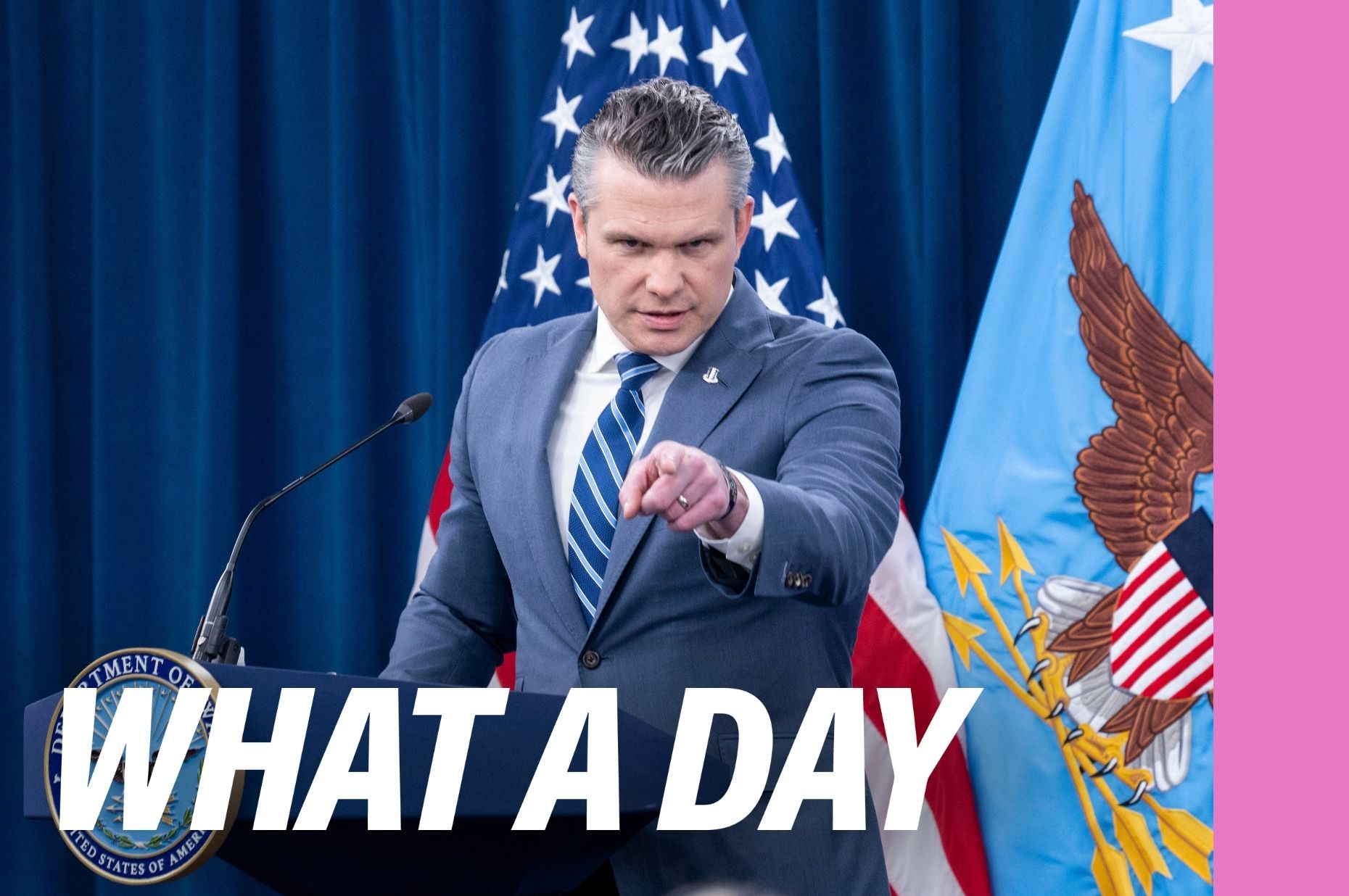
Jane Coaston: Mike Johnson, is the last year and a half what grown-ups do? Because I hate it. [music break] On today’s show, it’s time to invest in a good bike, because gas prices are still on the rise. And later, how a beach day turned into a federal indictment for former FBI Director James Comey. But let’s start with Secretary of War/little boy Pete Hegseth. Hegseth will be testifying before Congress this week. According to The Hill, he’ll be pitching the Senate Armed Services Committee on a $1.5 trillion budget next year. He’ll also probably be answering a lot of questions about the Iran War. But he’s starting his tour of Congress today by appearing before the House Armed Services Committee for the first time since the war began. If you ask him, everything in Iran and everything else is going just fine. Great even. Here he is at a Pentagon press briefing Friday.
[clip of Pete Hegseth] America’s military is unmatched, projecting power, denying passage to adversaries and protecting our interests at the time and place of our choosing. No one sails from the Strait of Hormuz to anywhere in the world without the permission of the United States Navy. To the regime in Tehran, the blockade is tightening by the hour. We are in control. Nothing in, nothing out.
Jane Coaston: TLDR, everything is awesome, even though to pretty much everyone else, it looks like it’s not. Here’s what we know. The war in Iran is in a stalemate, and Hegseth has been making some unpopular decisions at the Defense Department, firing the Army Chief of Staff and the Secretary of the Navy in just the last few weeks. North Carolina Republican Senator Thom Tillis told The Hill, quote, “I think he’s missing the mark on personnel. He has separated some of the most extraordinary generals that we’ve had in play. I don’t quite know what’s going on there.” He later said Hegseth’s lack of experience is reminiscent of former Homeland Security Secretary Kristi Noem, which is not you know ideal. But Hegseth is staying busy and putting his energy towards the important things. For example, the former Fox and Friends weekend host took Kid Rock on a joyride in an Apache helicopter Monday. A sentence that is real. He even posted pictures. Colorado Democratic Representative Jason Crow serves on the House Armed Services Committee, and he has a lot of questions for Pete Hegseth. I asked him to give me a preview ahead of today’s hearing. Representative Crow, welcome back to What a Day!
Jason Crow: Thanks for having me back.
Jane Coaston: Hegseth is expected to testify before the House Armed Services Committee today for the first time since the start of the Iran War. What questions do you need him to answer?
Jason Crow: Well, I mean, there’s so much to go on here. Number one, how much exactly is this costing the American people? We know it’s somewhere between one and a half to two billion dollars a day just for the cost of the munitions. Number two, why isn’t he protecting U.S. troops adequately, right? There was a strike that killed multiple U.S. soldiers and it looks like there weren’t air defenses in place. Number three, why does he keep on painting such a rosy picture to President Trump about how this war uh is gonna play out right what seems to be pretty clear at this point is that Donald Trump had a bunch of advisors around him and and you know I’m no fan of Donald Trump. They had people like Lindsey Graham and Pete Hegseth and others that told him that this was going to be a cakewalk. A couple of weeks, a buncha bombs and it would be over which is obviously far from the truth so what exactly did he tell the president uh and you know, why does he keep on lying to President Trump about how wars like this are going to play out?
Jane Coaston: Yeah, I want to talk a little bit about that stockpile concern. There have been reports that the U.S. is exhausting our stockpile of very expensive and important weapons in the war. And the Atlantic reported that Vice President J.D. Vance is worried about it. That piece also said that people close to the vice president suspect Hegseth is presenting a more positive view of the situation than is accurate. In your view, is Vance right to be concerned? Are you concerned?
Jason Crow: Yeah, Vance is right to be concerned and I share it. Uh. We don’t have unlimited amounts of ammunitions. Right? Tomahawks don’t grow on trees. They’re extremely expensive. They take a long time to produce. It takes us years to build up these stockpiles. And in the last, now almost 60 days, we have spent thousands of these things, right? Precision bombs, Tomahawk cruise missiles, you know all basically all sorts of munitions. And and not only is this expensive, but these stockpiles are used for all sorts of potential contingencies. In Europe, in Asia, in Central South America, we have all these plans in the military that are called CONOPs. If you can imagine it, there’s probably a CONOP that you know you break glass in case of emergency, and the military does what it’s supposed to do according to this plan, and all of those require these stockpiles. So a really important question is, what can’t we do anymore now? Because of the fact that we spent these stock piles down, how many of these conops are ineffective and that we couldn’t actually execute tomorrow if there was an emergency that our country had to respond to?
Jane Coaston: Yeah, I mean, I’m thinking about a potential defense of Taiwan. I’m thinking about our allies in South Korea. I think Asia is a major concern, especially with China watching all of this. But–
Jason Crow: Right.
Jane Coaston: You’re a veteran, you’ve served in the Iraq war. When we’re talking about a depletion of our weapons stockpile, what do we actually mean here? What does that mean to troops who may be on the ground in the future or troops who might be in the region?
Jason Crow: Yeah, well, it’s not just our offensive weapons. You always think about it in terms of like the offensive weapons and munitions and the defensive ones. And right now, what I’m most concerned about are the defensive munitions. They’re called interceptors. Right, we have these Patriot missiles. We have these things called THADs, which are these high-altitude, long-range interceptors, we have all sorts of munitions that are designed to intercept drones, these [?] drones that Iran sends. We have depleted vast stockpiles. I’m not gonna go into the specifics because I can’t over this uh conversation, but I am increasingly concerned about our ability to protect our service members, not just in the Middle East, but around the world as we spin down the stockpiles of all these interceptors and air defense munitions that we rely on to create a shield over the top of our military bases and installations and our service numbers. We have 55,000 roughly service members in the Middle East right now. We have close to 100,000 stationed throughout Europe. We have tens of thousands in Asia. In any given moment, we have hundreds of thousands of service members deployed around the world, all of which rely upon this air defense shield that has been diminished over the last 60 days.
Jane Coaston: I think that that leads to another quick question I had for you, which was that part of the messaging I think, that Trump got was that Iran would run out of weapons very quickly, and that their weapons stockpile had been demolished. And that’s something you keep hearing from Hegseth, basically, like, we have complete control of the air over Iran. If that were true, how are they still firing drones? How are they still firing missiles? And what does that mean in terms of Iran’s capabilities? Because I think that if we learned anything from Iran and Iraq, it’s that you can end a war, but the enemy still gets a say.
Jason Crow: Yeah. But there’s, I think that last point that you just made is actually the operative point, but to address the earlier one about just, you know, force on force, as we say in the military sometimes, this idea of atriding the other side. First of all, like we’re we’re on the economic losing side of this, right? Because we’re using million dollar missiles and systems to shoot down 20,000, 30,000 dollar drones, right, so a factor of 20 to one, 30 to one more expensive on our side than their side. So economically, uh they can continue to produce these things, which they can produce very quickly. They can rebuild their stockpiles very quickly, they can do it for you know pennies on the dollar of what it costs us to shoot them down. So from their perspective, it’s a pretty good deal. Right. They can just continue to do this and eventually, we break the bank. But to your larger point, when are we going to get out of this construct, this framework that we can just use our fancy systems and win wars by just, you know, atriding the other side, because if that were true, we would have won in Afghanistan. We would have won in Iraq. We would have won in a lot of different conflicts that we’re fighting around the world, but you can’t defeat movements and ideologies in a regime like the Iranian regime, which is actually built for this moment. It’s built for survival. It’s built for a long term conflict. Uh, to try to wear us down and outlast our political will. You can’t win that militarily, right? Which, which I always say the problem is, is that we, we just have a series of tactical decisions that we make with no strategy, right? That’s the same problem in Iraq and Afghanistan. We never lost a battle in 20 years of war in Iraq and Afghanistan. We won every single battle, right. We are great at tactics. What we’re not great at is having a strategy that’s going to actually win it and wind it down and provide an off-ramp for the American people.
Jane Coaston: There’s obviously a lot going on here, even outside of the depletion of the weapons stockpile. Hegseth has been firing military leaders, like now former Army Chief of Staff General Randy George, Navy Secretary John Phelan, during the war. I know John Phelan’s job was not about deploying sailors, but still. There’s also been reports that he’s integrating a very specific type of Christian rhetoric into the Pentagon that’s making even other Christians feel pretty concerned. There’s so much happening here. What are your biggest concerns about Hegseth and the Pentagon right now, even outside of the war?
Jason Crow: My biggest concern is that Pete Hegseth is changing the very nature of our military, or attempting to, right? We have had, for my entire life, a military that reflects this nation. You know, when I went to war in Iraq and Afghanistan, I think about those paratroopers that I went to war with, and they reflected this nation, white, Black, Asian, Hispanic, straight, gay, rich, poor, urban, rural. Like when I think about America, I think about those faces of those paratroopers I went to war with. Right? Democrat, Republican, Independent, just kids trying to make a better life and didn’t care about politics. Like that was our nation, right? And our nation has had great confidence in its military because it draws upon the diversity of this nation. It reflects the nation, it’s the standard bearer of our values. And that’s not to say that we haven’t had failings and it hasn’t fallen short throughout our history, because it has. I’m not trying to whitewash or paint a simple picture here. But when it’s at its best, that’s what it is. Pete Hegseth does not want that. Right? He wants a military that reflects him, that serves him and his closest advisors, and he’s trying to build a fiefdom that only he controls. And if he is able to accomplish that, then then we will lose something so precious in our nation, and that is a civilian-controlled military that reflect our nation, that has the competence and the support of the American people, that can serve us and defend us and represent us around the world.
Jane Coaston: Representative Crow, as always, thank you so much for joining me.
Jason Crow: Thanks, Jane. Appreciate it.
Jane Coaston: That was my conversation with Colorado Democratic Representative Jason Crow. We have a healthy stockpile of episodes to enjoy, so you can go back and watch them all. If you like the show, make sure to subscribe, leave a five-star review on Spotify and Apple podcasts, watch us on YouTube, and share with your friends. More to come after some ads. [music break]
[AD BREAK]
Jane Coaston: Here’s what else we’re following today.
[sung] Headlines.
Jane Coaston: Joining me is Crooked’s news editor, Greg Walters, to talk about the big stories. Hey Greg!
Greg Walters: Hey, Jane.
Jane Coaston: Greg, oil prices are not low right now, and they are not likely to go down anytime soon. Here’s Richard Quest on CNN Tuesday, sounding enthusiastic about oil prices.
[clip of Richard Quest] Now the important point to realize is this bit. Once the oil price got up there over a hundred dollars a barrel, I’m just going to shade it in so you can see, it doesn’t matter how long it continues, this bit is baking in slow growth, slowing economy, higher inflation.
Jane Coaston: If you’re watching on YouTube, you can see Quest holding up an illustration of a big ol’ rise in the price of oil. And that means gasoline prices have also risen, which you probably know. They’ve reached their highest point in four years, with the average cost of a gallon of gas reaching $4.18 across the country. Gas prices are sky high because of Trump’s war in Iran, which, Greg, it’s still happening!
Greg Walters: Yeah, and Jane, I’ve said this before, and I’ll say it again. This is literally the opposite of what Trump ran on. He promised to be the no more wars and I will make gas cheap guy. And here we are. It’s like running for high school class president on the free cookie platform and then handing out broccoli.
Jane Coaston: Yeah, broccoli and a naval blockade of the neighboring high school.
Greg Walters: Right. And as long as the Strait of Hormuz stays closed, oil prices are unlikely to come back to Earth anytime soon. In fact, it may get worse. In another major turn of events, the United Arab Emirates just announced it’s going to quit OPEC, the oil cartel that has been trying to manage crude markets for decades. This is a big deal. The UAE counted for 13% of OPEC’s total production capacity. And some folks are now wondering if the organization can survive this. Apparently the UAE had been chafing under production quotas that it thought were too low, but, you know, all the conflict in the Middle East seems to have piled pressure on it and sped this exit along.
Jane Coaston: Speaking of complicated monarchies, King Charles spoke to Congress on Tuesday. It was a packed house and one that seemed pretty receptive to the King and his jokes.
[clip of King Charles] For all of that time, our destinies as nations have been interlinked. As Oscar Wilde said, we have really everything in common with America nowadays, except of course language. [laughter]
Jane Coaston: [?].
[clip of King Charles] We meet too in the aftermath–
Greg Walters: Oscar Wilde never misses.
[clip of King Charles] –of the incident not far from this great building that sought to harm the leadership of your nation and to ferment wider fear and discord. Let me say with unshakable resolve such acts of violence will never succeed. Today, Mr. Speaker, that same unyielding resolve is needed for the defense of Ukraine. And her most courageous people. [applause] It is needed in order to secure a truly just and lasting peace. From the bitter divisions of 250 years ago, we forged a friendship that has grown into one of the most consequential alliances in human history.
Greg Walters: But, awkwardly, uh this comes as the new UK ambassador to the US, Christian Turner, was captured on tape in private remarks saying the US-UK special relationship isn’t really so special anymore. And this is a term that goes all the way back to a quote by former British Prime Minister Winston Churchill in 1946, and we’ve all kind of grown up with this, right? The US-UK special relationship. But Turner was caught on tape telling a group of high school students visiting the U.S. in February. That he tries not to use the phrase special relationship because it’s quote, “nostalgic and backwards looking” according to the financial times and he then said here’s the kicker he said quote, “I think there is probably one country that has a special relationship with the United States and that is probably Israel.”
Jane Coaston: Yeah, that’s not great. That’s not great at all. It’s also awkward because King Charles is here to strengthen the special relationship that might not be that special. Of the relationship between the UK and the U.S., the King also said, quote, “Our defense, intelligence and security ties are hardwired together through relationships measured not in years, but in decades.”
Greg Walters: Yeah, the special hard wiring doesn’t have quite the same ring to it. Um, so we still don’t know how this recording was leaked, and who’s responsible. But I would say, Jane, generally speaking, if you’re gonna tell a room full of high school students your diplomatic secrets, don’t say anything that you don’t want to end up on TikTok, because the kids are posting everything these days. So speaking of posts that get people into trouble, Donald Trump’s Department of Justice is targeting James Comey once again. He was indicted on Tuesday for allegedly making a threat against the president. And the threat, I am not making this up, they’re charging him for taking a picture of seashells on the beach arranged into the numbers 8647 and posting it on Instagram with the caption, cool shell formation on my beach walk.
Jane Coaston: The actual indictment is arguing that Comey’s seashell art shows he obviously held a quote, “intent to do harm to President Trump.” Here’s acting Attorney General Todd Blanche on Tuesday.
[clip of Todd Blanche] Today, a grand jury sitting in the Eastern District of North Carolina returned an indictment against James Comey on two counts. The first count is at honor about May 15th of last year. He knowingly and willfully making a threat to take the life of and to inflict bodily harm upon the President of the United States. Count two, same day, May 15th, 2025. That the defendant, James Comey, knowingly and willfully transmitting an interstate commerce a communication that contained a threat to kill the President of the United States. Both of these counts carry a maximum term of imprisonment of of 10 years.
Jane Coaston: My favorite part of the press conference announcing this, Greg, was when FBI Director Kash Patel said that this case took more than nine months to investigate. Nine months. It was an Instagram post, Kash, of seashells.
Greg Walters: Yeah, I imagine them like staring at this Instagram post for nine months, deciding what to do. It brings a new meaning to the phrase doom-scrolling. Anyway, Merriam-Webster says, ’86 is a slang term that goes back decades and typically means to throw out or get rid of, and Trump is the 47th president, so ’86, 47. At the time, Comey deleted the post saying he didn’t know it could be meant to construe violence, and here he is speaking shortly after the indictment came down on Tuesday.
[clip of James Comey] Well, they’re back. This time about a picture of seashells on a North Carolina beach a year ago. And this won’t be the end of it. But nothing has changed with me. I’m still innocent. I’m still not afraid. And I still believe in the independent federal judiciary, so let’s go. But it’s really important that all of us remember this is not who we are as a country. This is not how the Department of Justice is supposed to be. And the good news is we get closer every day to restoring those values. Keep the faith.
Greg Walters: Now a reminder, Trump fired former Attorney General Pam Bondi, reportedly in part because he was big mad that she didn’t prosecute more of Trump’s political enemies. I think it’s fair to say that this is going to be seen as political, extremely political, coming soon after a previous indictment against Comey was tossed out.
Jane Coaston: But Greg, I would never toss you out. Thanks for hanging out with me.
Greg Walters: Good transition Jane, thank you.
Jane Coaston: And that’s the news. [music break]
[AD BREAK]
Jane Coaston: That’s all for today. If you like the show, make sure you subscribe, leave a review, gorillas have bank accounts now, and tell your friends to listen. And if you’re into reading, and not just about how it’s part of a strategy to help safeguard animals and plants by letting them pitch in for their own protection, like me, What a Day is also a nightly newsletter, check it out and subscribe at Crooked.com/subscribe. I’m Jane Coaston, and I look forward to seeing gorillas at my local financial establishment, getting mortgages and asking about fun check designs. [music break] What a Day is a production of Crooked Media. Our show is produced by Caitlin Plummer, Emily Fohr, Erica Morrison, and Adriene Hill. Our team includes Hayley Jones, Greg Walters, Matt Berg, Joseph Dutra, Johanna Case, and Desmond Taylor. Our music is by Kyle Murdock and Jordan Cantor. We had help today from the Associated Press. Our production staff is proudly unionized with the Writers Guild of America East. [music break]


