


In This Episode
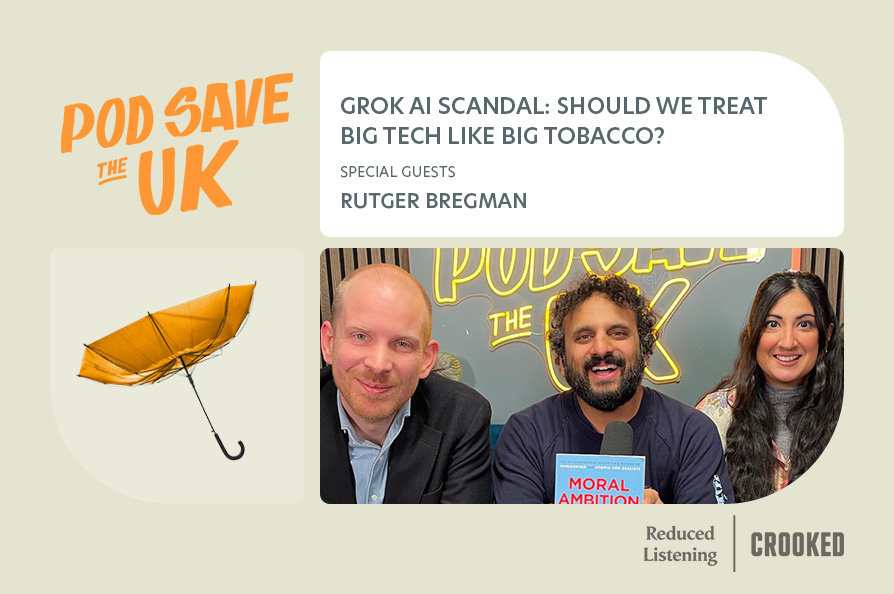
X has been firmly in the firing line after its Grok AI tool was used to create sexualised images of women and children. Elon Musk’s company could face a fine of up to 10% of its global earnings by internet regulator Ofcom, or a ban in the UK. He denies that the AI has done anything illegal and says users are responsible for the images they create.
How can we regulate AI? Rutger Bregman, historian and author who called out billionaires at Davos, argues Big Tech should be treated like Big Tobacco. He also gives his take on Iran, as thousands of protestors take to the streets, and what a radical policy platform looks like for the UK Left today.
Plus – what on earth is UKIP proposing as a terrifying rebrand?
*Update on Palestinian Hunger Strikers*: On 14th Jan Heba, Kamran, and Lewie collectively paused their hunger strike. They made British history, lasting 73 days.
CHECK OUT THESE DEALS FROM OUR SPONSORS
SHOPIFY
BABBEL
GUESTS
Rutger Bregman – Historian and Author of Moral Ambition, out in paper back on 15th Jan
USEFUL LINKS
https://www.moralambition.org/book
CREDITS
Liz Kendall MP, Technology Secretary – Parliament TV
Rutger Bregman – Publicae
Rutger Bregman and Tucker Carlson – Now This
Tehran protests – Shaparak Khorsandi/Instagram
Donald Trump – New York Times
Laila Cunningham – Daily Express/YouTube
Nadim Zahawi – Sky News
Pod Save the UK is a Reduced Listening production for Crooked Media.
Let us know your experiences of SEND support in schools – or any other stories.
Contact us via email: PSUK@reducedlistening.co.uk
Like and follow us on Youtube: https://www.youtube.com/@PodSavetheUK
Instagram: https://instagram.com/podsavetheuk
TikTok: https://www.tiktok.com/@podsavetheuk
BlueSky: https://bsky.app/profile/podsavetheuk.crooked.com
Facebook: https://facebook.com/podsavetheuk
X: https://x.com/podsavetheuk
TRANSCRIPT
[AD]
Nish Kumar All right, this is Pod Save the UK. I’m Nish Kumar.
Coco Khan And I’m Coco Khan, the showdown over what feels like never ending social media controversies has finally come to a head with X under investigation for allowing users to create and share sexualized images of women and children.
Nish Kumar Meanwhile, Iranians are defying a violent crackdown by security forces after more than two weeks of protests against the government. The UK says it hopes for a peaceful transition of power, but Donald Trump is considering whether to send in airstrikes.
Coco Khan We’ll be joined by historian and author Rutger Bregman. His book, Moral Ambition, takes a practical approach to making the world a better place, which would be quite nice. But how does any single person make a difference when we are facing such massive challenges? And what on earth is UKIP’s new look?
Nish Kumar Now, Grok, X’s AI tool, has been firmly in the firing line after it was used to create sexualized images of women and children. Following a backlash, X made the heroic effort to limit image generation and editing to paid subscribers. So don’t worry guys, digital sexual assault is now a premium feature.
Coco Khan Under pressure to act, this week tech secretary Liz Kendall told MPs in the Commons that this content is not just vile but illegal.
Clip The Data Act passed last year made it a criminal offense to create or request the creation of non-consensual intimate images. And today I can announce to the House that this offense will be brought into force this week.
Nish Kumar This statement came just hours after Ofcom, Britain’s internet regulator, launched a formal investigation into X. If found to have broken the law, Ofcom can potentially issue X with a fine of up to 10% of its worldwide revenue. And if X does not comply, Ofcon can seek a court order to block the site altogether. So it’s very serious stuff.
Coco Khan It feels like there are so many challenges facing us right now, whether it’s what’s happening on social media, in Iran, climate change, or the rise of the far right. Pod Save the UK, of course, isn’t just about letting you know what’s happening, it’s also about understanding how we can all help or make these positive changes together. So this is a really good time to hear from our guest today.
Nish Kumar Yes, we’re joined by the historian and author Rutger Bregman. His most recent book, Moral Ambition, is out in paperback this week. If you haven’t read one of his previous books, you may well have come across one of his extremely viral clips. Whether it’s bluntly telling billionaires to pay their fair share of tax or speaking out against the BBC edits to his comments about Donald Trump and corruption. Rutger, welcome to Pod Save the UK.
Rutger Bregman Thanks for having me.
Nish Kumar One of the key themes of the book is the idea that high flyers should quit their jobs and kind of lead the way in improving the world. How do you make that an attractive option in a kind of professional environment and climate where at the moment we, I think we value money over mission, right now.
Rutger Bregman Yeah, so I think the greatest waste of our time is indeed the waste of talent. The data is pretty striking here. There’s one study done a couple of years ago that found that around 25% of people in modern economies think that their own job is socially meaningless. So that means they think they can go on strike and nothing much would happen. Now, these are not the teachers, obviously, not the nurses, not the plumbers. But there are some people who went to fancy universities who have nice LinkedIn profiles who may work. I don’t know, is a marketeer, a consultant, a lawyer, a banker. Well, I’d rather like stand-up comedians actually, I don’t want you all to go on strike.
Nish Kumar Initially, I felt very attacked. People who went to nice, fancy universities, when you said LinkedIn profile, I thought, okay, this is it, I don’t have a problem with that.
Rutger Bregman Yeah, so it’s like you listed all those problems, but maybe like the ultimate problem is that we do not have enough talented people working to solve those problems. And I think the antidote to that is moral ambition. And what we’re trying to do with this book and the movement we’re building, the organization I co-founded is indeed to basically make that popular. And I think there are movements in the past we can look to. When this happened and we were actually successful in convincing a lot of people to pivot their careers and work on what matters.
Nish Kumar So someone like Elon Musk fits into this conversation quite nicely in a lot of ways, because he is obviously, you know, he’s the richest man in the world. I never know who’s number one, neither do I care particularly about particular chart, but he presents himself as somebody who’s advancing the kind of human race. When we’re constantly told that AI is this incredible tool that’s going to change medical science, unfortunately, a lot of our day-to-day lives, it seems to be leading to some pretty malign outcomes, where does someone like Elon Musk sit in this kind of paradigm that you’re presenting.
Rutger Bregman So my whole career I’ve been obsessed with small groups of really committed people changing the course of history for better or for worse. Yeah. So we have the amazing example of the abolitionists, the suffragettes, you know these movements started in a very very small way with just a few people coming together and then devoting their whole lives to the good cause. But obviously we also have examples on the other side. The group around Vladimir Lenin was a very small group. When they took over in 1917 and people said, you know, they’ll last for maybe a couple of weeks while they lost it for 70 years. If you look at the people, you now, who are currently taking over in the US, you can go back to small groups such as the PayPal mafia, you, know, the people like Elon Musk, like Peter Thiel, who bankrolled the rise of JD Vance as vice president. It’s a fairly small group and they have a very clear ideology. They hate democracy. They want to take it down and they’re dead serious about it. Now, I think that this is just social physics in a way. It is like not bad or good. It’s just basically the way the world works. We got to acknowledge that very often it is these small groups of people who are for real, that they changed the world.
Nish Kumar I don’t think people are talking enough about how real this is, I think that there is still this sense of, oh you know Trump is a kind of agent of chaos, he doesn’t know what he’s doing from minute to minute.
Rutger Bregman And I find that so annoying.
Nish Kumar Yeah.
Rutger Bregman People all the time say oh, yeah, Elon Musk is dumb or yeah, it’s not dumb He’s fucking brilliant. I mean you don’t become like a centi-billionaire by Being dumb you don’t t build SpaceX you don t build Tesla by being dumb. It’s just that sometimes extremely smart and extremely talented people can also be extremely evil. So I think that we are now in February 2020 that’s the equivalent people I really respect, like super forecasters, for example, who specialize in forecasting the future and have a great track record. And they were all stockpiling mass. They were, this is serious. But then on the other hand, you know, I went to the BBC or the New York Times and it was like, no, it’s totally fine. You know, this weird Chinese virus, nothing’s going to happen.
Nish Kumar I mean, if you roll the tape forward a few weeks, the Prime Minister of this country was saying, I went to a ward with people who had COVID and I shook hands with all of them.
Rutger Bregman Yeah, yeah, yeah. Well, there you go. And I think the situation right now is very similar, but for two other things. One is the rise of AI. It is going to be way, way bigger, I think, than people realize. Like, what’s going to hit us in the next three to four years is absolutely massive. And then fascism. Historians have a very precise vocabulary to describe this. And I don’t think it’s easy to give a… Simple definition of fascism, but we do have like what we call these family resemblances, right? That the whole list that many of these regimes have in common. And the list is getting very, very long now. And it’s that serious. Like if you really listen, like really listen to people like Vance or the US, well basically the Prime Minister now in the US Stephen Miller, that’s fascism. That’s really what it is. I was at a exclusive Silicon Valley conference not that long ago, and I spoke to many people on the tech ride. And at some point, you know, there was a guy very high up at Google, and he spoke in a language that really reminded me of, as a historian, you know, of people like Mussolini. And I pointed this out to him and I said, you kind of sound like a fascist. And he’s like, yeah, yeah. Yeah. But we should get a little bit fashy, Rutger. That is, that is exactly what the country needs right now. So these people, again, they’re dead serious and too many people still think that, I don’t know, it’s just a joke. It’s just clowns. Roman salute. That’s not, that’s not what this is.
Coco Khan Well, it’s so fascinating that you mentioned the word fascist because that is the word that Elon Musk has used. He has talked about because Ofcom are potentially going to take action, potentially ban X in the UK. He’s described it as fascist. To what extent is our understanding or lack of understanding around fascism getting us into A.
Rutger Bregman Yeah, so what has happened basically is that we have developed a super shallow conception of what liberalism is. People have come to believe that liberalism is just allowing people to do whatever the hell they want. And that maybe in some scenarios, when you’re really threatening to kill someone, then, oh, maybe that goes a little bit too far. Now we have to intervene. We have this very shallow conception of the good life, just consume, consume, and that’s about it. When we want to convince people to do the right thing, the only thing we can do maybe is to give them subsidies or do better marketing or whatever. But that is… View that many of our politicians have right now of what liberalism is, but if you really look at the history of the idea, it is a way more demanding and powerful and robust ideology that indeed sometimes requires that we have very clear limits. For example, in the case of X, like if we would really have a robust liberal social democratic society, we would have banned the platform years ago, in my view. Really? Yeah, absolutely. Or at least regulated the algorithm. The man has absolutely wrecked the platform. Have you seen the For You page? I mean, I get his own posts all the time. It has absolutely nothing to do with freedom of speech or whatsoever. He’s polluting the discourse in so, so many ways. And that, like for the life of me, I don’t understand why we don’t regulate it. It’s such a stupid, shallow conception of what freedom of speech or democratic debate is. Um, so I’m very glad that now Finally, finally something seems to be happening. I hope the EU will do it as well.
Nish Kumar So you think you would support, because there’s kind of two proposals being aired here at the moment, two separate conversations, but around the same subject. So we’ve got this idea that Ofcom might ban X. Yeah. We’ve also got the Australian government outlawing social media for under 16s. Um, are those both ideas that you think have merit?
Rutger Bregman Yes, yes, but we should probably go further than that. So the 19th century had three big moral movements, three big, moral revolutions. Two that we’re all familiar with. One was the abolitionist movement, the big fight against the slave trade and slavery. The second one was the fight for women’s rights that lasted for a quarter of a century until women finally got the right to vote. And the third one is basically forgotten nowadays, or at least when people know about it, it has a very bad reputation. But many abolitionists and many suffragettes were also temperance activists. So in the 19th century, big alcohol was like big tobacco and like big tech today. It was like the addiction industry of the day. So many men went to their jobs, went back, spent all their money on extremely cheap alcohol. It was hardly regulated at all. And this industry was ruthlessly exploiting human weakness and it was an absolute social scourge. Now what happened is that people rose up against it. Women rose up against it, workers rose up against it. Religious people rose up against it it became one of the biggest democratic movements in history that you know gained so much power that eventually they were able to push even a constitutional amendment through congress banning alcohol completely which took things a little bit too far but it is an example of of what could happen right now and that’s actually one of my warnings to Silicon Valley they have no idea they have absolutely no idea how angry people are getting. And I think that there’s a huge potential now for a political coalition that spans the left to the right.
Nish Kumar You know, we keep hearing about how polarized everything is often driven by kind of algorithmic conversations that we’re having on social media platforms. But this idea that there is a consensus forming that actually some level of intervention would be welcome in.
Rutger Bregman The tech industry is really important. Yeah, yeah, yeah. And a big reframe should happen here. So for a long time, we saw big tech as, well, as big tech. It’s like powerful, sure, but also innovative. And I think more and more people are starting to realize that companies like Meta in particular, they’re like big tobacco. Yeah. That’s what it is. So these companies, they lie and they deceive. They know what they’re doing. They’re making a shitload of money on destroying our kids’ brains. Now does that sound familiar?
Nish Kumar Yeah.
Rutger Bregman That is, that is big tobacco.
Nish Kumar Just about limiting the action of tech companies. All of this sort of AI debacle highlights the kind of immense power that people like Peter Thiel and Elon Musk wield over our democracies. Ruka, one of the things that you’re most famous for is talking about how billionaires need to pay their fair share of tax. It’s worth watching. This is a clip of you at Davos in 2019.
Rutger Bregman And I hear people talk in the language of participation and justice and equality and transparency. But then, I mean, almost no one raises the real issue of tax avoidance, right? And of the rich just not paying their fair share. I mean it feels like I’m at a firefighter’s conference and no one’s allowed to speak about water.
Nish Kumar That’s a great line.
Coco Khan Obviously that’s just one clip. I was not in the room sadly. How did it go down? I just want to know.
Rutger Bregman Well, it was the last day of the conference, actually, on Friday. And, you know, it’s quite funny because in the media it was all like Rutger Bregman tells the billionaires of Davos the truth. I don’t think there were many billionaires in the room. It was just what made it powerful is that I was there and the World Economic Forum logo was behind me and I was like, this is the moment. So, yeah, it is always funny these things, how You know, what you see is not always what it is. And I had a spat with Tucker Carlson not long after this.
Clip I went to Davos to speak truth to power. And I’m doing exactly the same thing right now. You might not like it, but you’re a millionaire funded by billionaires. And that’s the reason why you’re not talking about these issues. But I am talking about this issue. Yeah, only now. Come on, you jumped a bandwagon. You’re all like, Oh, I’m against the globalist elite. Blah, blah, blah. It’s not very convincing, to be honest. Yourself, you tiny brain, and I hope this gets picked up.
Rutger Bregman Yeah, Tucker Carlson completely lost it. Then they refused to air it, but the producer in Amsterdam had filmed the whole thing. And so we put that on socials. But what’s interesting is that there was a latency. You hear me say something, and then it takes like four or five seconds for Tucker to respond. So he looks like this. And it comes across as if I’m like absolutely completely destroying him. But that’s just the effect of the video. And we were like, well, we’re not going to correct for this. Then he should just have aired it, right? Because he was censoring me.
Coco Khan You said that Tucker Carlson called you immoral. I’m interested to hear that.
Rutger Bregman He called me more than that.
Coco Khan The reason I’m interested in that is because I often wonder if morality is like sexy. Like, does it sell? Does it work? If the government was like, do you know what? We are going to restore some morality back to the world. And part of that is taking on, you know, big tech and part of it is also looking at, you now, whatever other social scourges. Do you think that would play well?
Rutger Bregman Yes, absolutely, especially right now. So if you listen to speeches by JD Vance, if you listened to recent comments from Stephen Miller, their worldview is that some people are better and more important than others, that it is the right thing to care about your own people, about your tribe, and to not give a shit about the others. I mean, that is a very dark view of human nature. I wrote my previous book about this. It goes back all the way to people like Thomas Hobbs, who believed that the state of nature was this you know, back in the days when people were hunter-gatherers, that we were engaged in a war of all against all. And what those on the right want us to believe, that that is just what the world is and we just have to accept it. I’m part of a completely different tradition that believes that moral progress is overcoming all of that and recognizing that we’re in this together on this pill-blue dawn.
Nish Kumar I just want to talk about a group of people that are engaged in a kind of moral mission, which is, you know, we’ve got a group of hunger strikers here who are protesting about what’s going on in Gaza. Hiba Marasi is on 70 plus days, I think, as we record of her hunger strike. And for context, Bobby Sands died on the 66th day of his protest. She’s told Al Jazeera that she no longer feels hunger and that she knows her death may be imminent. This is a 31 year old who’s putting her life on the line as part of a moral mission. And we have spoken about The Hunger Strikes a couple of times on this show, and clips of it have been put on online. And I’m, I have been sort of slightly taken aback by the number of comments under those videos that are just saying things like, well, they could just choose to eat and not really acknowledging that there is a moral mission here. How does something like that, that kind of extreme protest fit into your sense of people needing to have a moral vision in their life?
Rutger Bregman Well, I find that deeply, deeply impressive. You know, there are many, many books in, you know, in those airports, the whole self-help section of books that will teach you how to be more productive, more helpful, and I wanted to write a book that will make your life perhaps more difficult. It’s one of those books that you may health wish you didn’t read when you finished the last page. Now, I’m not saying you’re going to go on hunger strike after that, but yes, we live in hard times and challenging times. And I think we need way more people who have at least a little bit of that energy. When I study the memoirs and the biographies of the great moral pioneers, I talk a lot about Thomas Clarkson and Equiano, two of the greatest British abolitionists. They didn’t have easy lives, I’m sorry to say. For me, it’s all about trying in whatever way we can to step in their footsteps. So I find that deeply admirable when people realize that life is about so much more than just them. And that’s very clear in the case of those hunger strikers.
Coco Khan If you want to write to your MP, or if you want to attend one of the weekly protests, they are happening in London. There’s a link in our show notes.
Nish Kumar And there are things that the government should be doing, you know, this is an unusual period without trial that these people are being detained for. So it is really worth highlighting that and keeping the pressure up. Coming up after the break, more on morality from Rutger, plus we’ll be talking Trump and the latest on Iran.
Nish Kumar [AD]
Nish Kumar AI is incredible. It can teach you how to fry an egg and even write a poem, pirate-style. But it knows nothing about your work. Slackbot is different. It doesn’t just know the facts. It knows your schedule. It can turn a brainstorm into a brief. And it doesn’t need to be taught. Because Slackbot isn’t just another AI. It’s AI that knows your work as well as you do. Visit slack.com forward slash meet slackbot to learn more.
Coco Khan The UK government has summoned the Iranian ambassador to condemn the brutal crackdown on protests in Iran, but that’s too late for those killed during the unrest. So far estimates vary from 600 up to 2,400 people, thousands more are thought to be injured.
Nish Kumar These numbers are, because of this sort of internet blackout, best guesses, and people are making calculations based on the limited information that they have, because the Iranian government has shut down internet access. So it’s impossible for anyone to know the true extent of the demonstrations and the violent crackdown by security forces.
Coco Khan So nonetheless, some pictures have emerged. This clip was shared by British Iranian comedian Shafiq al-Sandi, she’s obviously a friend of the show. Please do check out her episode over the Christmas break. It’s not been independently verified, but it seems to show massive crowds on the streets in Tehran. Reports suggest that protests have happened in more than 180 towns and cities.
Nish Kumar Government response to the demonstrations has been brutal, and it’s feared that some arrested protesters may be executed today. The US president is threatening to take very strong action if that happens. Rukka, moral ambition calls for high-flyers to quit their jobs and turn their talents towards making the world a better place. But sometimes, like we’re seeing in Iran, it’s mass movements that are the only thing that can make this kind of change happen. How do you see your ideas? Working in tandem with mass protests.
Rutger Bregman Absolutely need both. We need the top-down pressure and we need the bottom-up pressure. So forgive me, I’m trained as a historian, so I’m always looking for the historical examples. So I’m afraid I’m going to talk about the abolitionists again. Obviously, for centuries, there were massive, massive slave revolts of the most brave men and women rising up again and again. But this system was so totalitarian, so horrific, that for centuries that was not enough. And so what you needed was the double movement, basically. What you needed, was both people in the colonies rising up, but also people here in the UK. And so, what happened is that initially, it started with a small group, mainly led by entrepreneurs, by the way, and Quakers. They galvanized a huge movement of hundreds of thousands of people. This was the first consumer boycott, for example, that happened in all of human history when. Hundreds of thousands of British people refused to put sugar in their tea. You had the biggest petitions ever, you know? What is it, a fifth, a quarter of all people in Manchester, for example, signing one of those petitions? You really needed both. If you look at, for examples, something like the progressive era in the United States, you know, the early 20th century. This came after the Gilded Age. The Gilding Age was an age of incredible inequality, corruption. Robber Barons, a little bit like, you know, the tech. I was going to say, yeah, sounds familiar. Yeah, yeah. I mean, today we have Musk and Teal and Zuckerberg. Back then they had Vanderbilt and Rockefeller and Carnegie. And what happened is that again, a movement bottom up, you know, people organizing together, mainly in unions for the first time on a massive scale, that was extremely important, that pressure. But you also needed people. At the top, people like Theodore Roosevelt, who had gone to Harvard and who was utterly fed up with his peers. You could see it as a counter-cultural revolt of elites against other elites. These people were utterly fed up, with their peers who were so lazy, who were so cynical, and they were like, the purpose of power is to do good, you know? The fact that you had the privilege to go to a great university means that, you know, you got to do something and do way more than what you’re currently doing. So I deeply believe it is both, we really need both.
Coco Khan So Donald Trump has threatened very strong U.S. Military action against Iran’s ruling regime and warned that any country that does business with Iran will face a tariff rate of 25% on trade with the U. S. First is Venezuela. Now it could be Iran. And that’s not to mention his Greenland threats. When asked by the New York Times if there is anything that could restrain him, this was Trump’s response.
Clip Do you see any checks on your power on the world stage? Is there anything that could stop you if you wanted?
Clip Yeah, there’s one thing my own morality, my own mind, it’s the only thing that can stop and that’s very good.
Clip I don’t need international law, I’m not looking to hurt people.
Coco Khan I mean, my first question is how worried should I be if international law is just at the whim of Donald Trump’s morality?
Rutger Bregman So I think we should be extremely worried. And we also should stop being surprised all the time. So I mean, this whole administration has been like one shock after another. And people are like, surely he won’t do this. And then he does it. Surely he won’t t do that. And then, he does it. If you keep being surprised, maybe your whole framework was wrong. Maybe your whole frame work that this is, you know… A Republican administration that is maybe a little bit more authoritarian and that Trump, you know, is this weird reality TV guy so he says some weird things. And sure, you, know, some of these people like Miller and Musk, they have some, like, I don’t know, toxic masculine views. But apart from that, it is, no, we’re in a completely different paradigm now. And again, I’m going to use the F word. Like this is the fascist paradigm. And then it’s completely normal in that paradigm to have a leader an autocrat who believes that indeed he is some kind of voice of God. That he has the direct connection to the people and the people have the direct connection to him and that indeed nothing, absolutely nothing restrains this guy. So I would not be surprised at all if we have boots on the ground in Greenland. I would be surprised if we had more invasions. We are one year in, right? Three more to go at least? Maybe more? We got to start believing the autocrat. When Steve Bannon says, you know, 2028, you know, there’s going to be a third term. Like he’s dead serious that they want to take democracy down. So it is extremely existential that the midterms are going to be extremely, extremely important. It’s all hands on deck and we got to stop being surprised about all this.
Nish Kumar There’s an interesting sort of selective morality at work, because Trump is on the one hand saying that if the Iranian government opens fire on protesters, then that’s cause for him to potentially take military action, but certainly he’s making vague threats that some intervention will take place. Obviously, the same week that that happens, an ICE agent shoots an unarmed woman in a car in Minneapolis, and it’s very difficult for Trump to derive any moral authority. Apart from one that he essentially fabricates from his own mind, right, in that sense. The US has put itself in a very complicated position.
Rutger Bregman And it’s sometimes also confusing for us, right? Because you do want to be aware that you don’t end up in a situation where you’re like, oh, whenever the other side is saying this or that, then surely we must be against it. And the world is way more complicated than that. Like, all the people, you know, who for exactly the right reasons protested the genocide that happened in Gaza, they should also be absolutely horrified by what the Iranian regime… Is doing and should be extremely proud and in whatever way they can support the hundreds of thousands of extremely brave people going out on the street. For me, there’s absolutely no contradiction there and sometimes I find the political So annoying here is that you know if we come so tribal
Coco Khan You talk a lot about how we’ve gotten ourselves tied up in moral purity. It’s a conversation that I find myself returning to all the time. I think some people are unwilling to join in with causes because there are some people in those causes who are weird or nuts. And I’ve seen it myself of people being less fulsome to talk about, you know, Gaza, for example, because there aren’t genuinely anti-Semitic voices in that space by far, not the majority, but nonetheless, there’s that fear. What is your advice for people like that, that are genuinely afraid that if they speak up and join something that they will, it will come back to bite them in the future, that it will be seen in the feature that there were some fringe people that made it unsavory, or unpure?
Rutger Bregman One, if people agree with you for 70, 80% of the time, they’re not your enemy, they’re your ally. That’s rule number one. Rule number two is develop a thick skin. It will pass. I’ve been in this game for more than a decade now. There were moments where I was in fetus position, hoping that the world would end. But a couple of days go by and you still remember, but the rest of the world is forgotten. In that sense, we’re less important than we often like to think. Yeah. But yeah, no other easy, happy advice there. The most important thing really is that we gotta be focused on actually achieving those results and you achieve results if you have power and you build power through building coalitions in my view, and that by necessity implies that you often work together with people that you don’t always agree with. In the book, I’ve got one story of an animal rights campaigner, Lea Garces. Now, vegans are not exactly in the majority, are they? Ah. It’s kind of hard to make a change. And if you really believe that… Embarrassingly, they’re not currently the majority on this podcast. We’re only on one out of three. Well, and if you believe that the way we treat animals is one of those great moral atrocities of our time, it’s pretty easy to make that case. I mean, we slaughter 80 billion animals, torture them horrendously. I think pretty much everyone listening to this show, if I could give them a tour around an average factory farm, they would be shocked and it would be a nightmare for many years for them. So what do you do about that when so many people have their hands in the sand? Well, you work together with other people on the other side. So what Lia Garces did is she started connecting with factory farmers and she discovered that many farmers, particularly in the US, are very poor. Many of them live below the poverty line. Many of the hate their jobs. Many of then feel just as trapped as the animals and they hate the corporations that exploit them in a massive way. So she started building these coalitions. And in that way, she was suddenly able to pressure politicians and policy makers in a way that wasn’t possible before. So I really admire those people.
Nish Kumar I just want to briefly talk about the kind of British political situation. My expertise. In 2014, you wrote Utopia for Realists, there’s an incredible photo of Rupert Murdoch reading it on a holiday. And I mean, I don’t know if you’ve ever had any feedback, did you write a book before? This was before AI.
Rutger Bregman And this was before AI, like the photo is real. And it’s really hilarious because the book is about universal basic income, a 15-hour work week and open borders around the globe. And he really seems to be enjoying it.
Coco Khan I don’t know what to make of that!
Nish Kumar But is that do you think he’s reading it like when I read a telegraph article just to write myself up?
Rutger Bregman My theory of what happened, I think it’s his daughter or something, or like his son-in-law who is like more progressive. And my guess is that one of them gave it to him to say like, you should read this and that. I don’t know. I think that it was some kind of family obligation for him.
Nish Kumar Radical proposals, UBI, short workweek, open borders, are those still policy platforms you would advocate? Because currently, we’re at this moment where we don’t know how many years we are away from an election, but we’re potentially a good few years away from the election, which gives parties like the Green Party, your party, and the Labour Party, the SNP, Plaid Kamri, Sinn Fein, all of these kind of broadly progressive political parties. Time to craft a kind of coherent political philosophy? Are those still policies that you would advocate for over a decade later?
Rutger Bregman So to be honest, indeed, I wrote Utopia Free List 10 years ago. And I think especially the part about universal basic income was pretty prescient and more relevant than ever. I talk page after page about, you know, the declining Labour share in the economy and that capital is going to soak up everything and that what really matters is who owns the assets, who owns to robots, that’s what we called them 10 years and now we call it AI. And yeah, I mean, there are two big risks of the rise of AI. One is basically the sci-fi scenario that is already happening. It’s just misaligned AI, AI going rogue, doing things that we don’t want and us losing control. It’s a very, very real possibility. And the second one is extreme power concentration. And that is obviously also already happening, but it’s going to get way worse. And that’s not just a national story, by the way, but it’s very much an international story. So in my first brief lecture, I talk about the immorality and the unseriousness of American elites. But for European elites, I would also add their relevance. This is a massive, massive problem. A couple of years ago, the EU proudly announced its AI act to the world. So like, we’re going to regulate these tech companies. But the thing is we don’t have AI companies. Like we are barely have anything. So we’ve become really good at regulating industries we don’t have. If you look at the top 10 companies in Europe. It’s mostly big fashion. It’s Dior, it’s Louis Vuitton, there’s a little bit of Big Pharma. The one exception that we can be really proud of happens to be a Dutch company, which is ASML, an extremely important player in the whole chip supply chain, but we’re not in a great position. And if you have big ideals, what really matters is that you have power as well. Why were the British able to force 80% of all other countries to end the slave trade, including the Netherlands, by the way? We didn’t want to stop. There was one British abolitionist who came to Holland and said the famous words This is a cold and debt place because no one gave a shit about this whole idea of abolishing the slave trade and slavery Why did it happen? Because Britain forced all the other countries with power with might with violence with the Royal Navy I mean, it’s a great story. It was connected to the colonialism and the imperialism of that time as well But it was moral progress and that is the big question that we need to ask ourselves in Europe Like if we are really the new leader of the free world, if we really are the ones who want to uphold international law, the rule-based orders, human rights, then perhaps we need to accumulate power as well. And what I see when I look at countries like the UK, well, pensioners’ incomes still go up, worker incomes stagnate. In France, they’re now in a situation where for the first time in all of human history, a country has achieved the situation where pensioners actually earn more money than the working population. Germany, it’s become mainly a country of dynastic wealth. So 75% of millionaires and billionaires have inherited their wealth. You can say whatever you want, but after living in the US for a year, what really struck me is that people from the left to the right look at Europe and they look at us and think like, this is Venice. Like this is an open-air museum. This is not really where the future is made anymore. And I kind of understand that a lot of ambitious young people are like, How do we get out? You know, this is not where it happens, and especially in the space of AI. So we need a big, massive wake-up call. That would be central to my political program. Like how do we galvanize some of the best and brightest and convince them to stay here in Europe, build the future here in European, because there is a really beautiful, utopian, socio-democratic, liberal possibility out there as well, that we, where we galvanize the enormous benefits of. Of AI and give everyone that universal basic income and move forward to, indeed, a beautiful good society where everyone will be able to live their lives in the most beautiful way. But we’re a little bit far away from that right now.
Nish Kumar Final question for you. I just want to loop back to the 16-year-old you that was writing about free will. Now there are 16- year-olds still like that out there right now because we talked about how we need to entice young people and you know make them part of this kind of moral mission but there are sixteen-year olds that have that burning idealism right now and we know because a lot of them listen to this show and write some of our most thoughtful emails come from young people. And so I just wanna ask you what do you say to the 16 year olds who are walking around thinking about moral missions and free will right now. What’s your message to them? Because so much of what we’re telling young people at the moment is, it’s going to be difficult for you, it is going to hard. What is your message to the sixteen year old version of yourself that’s walking around?
Rutger Bregman Listening to this right now. You are the captain of your own ship. You’re the master of your fate. You know, we can look back at the great pioneers of history and think, oh, these were like different people, but they were, they were ordinary people just like us. Read their memoirs and they had their same fear, the same fears, the same insecurities, the Same doubts. Um, I think what made them different is that they realized that they were agents, that they will not just cogs in a machine, but they could be the master there. Their own destiny and they could at least decide what they would make of their own life on this. And that is the freedom that I think we should all aspire to. And then indeed, now is also a time for young people to really doubt the scripts that were and are written for them, also because we’re in this age of massive technological change. I think a lot of things don’t make sense anymore. The whole traditional career path is gonna break down. You can do things like, I don’t know, go to graduate school and then a couple of years later, you realize that everything you learned is irrelevant, right? I think now it’s really important to think autonomously and not just be a herd animal and do whatever is expected of you.
Coco Khan Rutger Bregman, thank you so much for joining us on Pod Save the UK.
Rutger Bregman Thank you. Thanks for having me.
[AD]
Nish Kumar Now, look, if you listen to Elon Musk, which you absolutely fucking shouldn’t under any circumstances, you might think that London is extremely dangerous with the police allocating their limited resources to arresting comedians. Or if you pay attention to the things Nigel Farage says, which again you absolutely shouldn’t, you may think that he’s in a state of collapse with crime out of control. That is certainly the thinking of Reform’s new London mayoral candidate, Leila Cunningham.
Clip London, one of the greatest cities on earth, is no longer safe. And that didn’t happen by accident. That happened on Sadiq Khan’s watch.
Nish Kumar Once again we have another candidate for London mayor who is running on a platform of this place is a shithole full of arseholes. It’s genuinely incredible how often people run for mayor of the city that we both live in. And on a platform of, I hate it here, it’s the worst, you’re all terrible, vote for me. Like, it is so unbelievable. Also, I love it because it sounds like they’re running for Mayor of Gotham City. Like, you hear them talk about, like, the streets are crime ridden, there are terrorist clowns, penguins are on the loose wreaking havoc, and a man in a suit is beating up people in his spare time. It’s really astonishing. So listen, Leila is pretty far from being on the money. Some new stats released this week by the Metropolitan Police show that London’s murder rate has dropped to the lowest in more than a decade. In 2025, just 97 homicides were recorded, down from 153 in 2019, which is obviously brilliant news.
Coco Khan So what’s driven the improvement? Well, the Met said this is a result of arresting an additional 1,000 offenders each month and using new technologies, including the controversial facial recognition. But they also mentioned the violence reduction unit, which was set up by Sadiq Khan in 2019.
Nish Kumar That’s right. The program embeds specially trained youth workers in police stations, giving support, guidance and education to young people when they first enter custody. 80% of the under-18s supported by the unit did not re-offend within 12 months. That’s much better than the stats for the country as a whole. All of this sort of follows on from work that Karen McCluskey did in Glasgow about a decade ago. And it’s part of treating violent crime. Not so much as a criminal issue, as a kind of public health issue. It’s a really, really interesting piece of innovative thinking that London under Sadiq Khan has really sort of picked up on.
Coco Khan It’s just really nice to see policies that are much more about saying, well, what does, what actually works, rather than I’m scared of the daily mail or I’m trying to appease people’s desire for revenge, essentially. So anyway, so here we have some statistics that can challenge this right-wing rubbish about London that is really going global. It’s quite scary how if I talk to international people, they might ask, oh, I hear that London’s very unsafe. It’s, it’s quite kind of bananas. Although the question is, will any of these statistics cut through? Clearly, this narrative has taken a hold. Sadly, despite crime reducing, the picture is not all positive. The fall in the murder rate has largely been driven by a reduction in white victims. As reported in the Londoner, for black people, the last decade has actually seen a rise in the number of homicides. The number of black victims of knife homicides compared to 20 years ago has actually increased, whilst for white people, it has more than halved.
Nish Kumar And I mean, there’s obviously a worry in even talking about this kind of stuff for playing into far right stereotypes, but it’s actually about inequality and poverty, which disproportionately affects black Londoners. According to 2021 census data analyzed by Trust for London, there is a, and this is direct quote, clear correlation between neighborhoods with higher proportions of black African Londoners and neighborhoods that are more deprived.
Coco Khan Yeah. And when you understand certain amounts of crime being related to poverty, I think that’s important because actually this desire for locking them up that we see it’s just, it’s not helpful. And particularly when that’s coming from the Met, the Met has so much work to do in rebuilding trust in black communities, amongst women, amongst many, many groups, and they do need to ultimately reduce this homicide rate. I was wondering whether one of the reasons this narrative has taken hold It’s because. Essentially because of poverty. If you walk around London, it is undeniable that homelessness is at record high. It’s very visible. You can see that. Where I live in East London, things about just the social fabrics falling apart, that feeling of disrepair and centers being closed down. There’s quite a lot of people walking around that you think, oh God, I think maybe you’re unwell. And even that level of care falling away. I wonder if that’s what people are picking up on, so when people say, oh. London’s full of crime, they’re actually thinking of that, even though obviously being poor is not a crime, but I think for some sections of society, and certainly the right-wing press, that that’s what they reach for, and they prefer to kind of stigmatize.
Nish Kumar The positives here are, I think all the time about a conversation we had with Pia Sinher about the prison system in this country and how when she was working in government, they would often discuss and use the phrase daily mail test, that policy had to pass the daily mail test of how it was going to be written about in the conservative press. So they weren’t able to have evidence-based conversations of looking at things that actually worked. They had to be a policy that was not going to attract too much heat from the conservative Press. And it’s really good to see that evidence-based approaches are being used in London and are actually having a positive impact, rather than just what you say, like the lock them up school, which isn’t working and hasn’t worked for years and years. It’s really, really positive. Elsewhere, the Reform Party continues its mission to essentially just become the Conservative Party. So Nadeem Zahawi, the former chairman of the Conservative Bye! Has defected to reform. Here he is speaking at a press conference shown by Sky News.
Clip In your heart of hearts that our wonderful country is sick. How many of you at home have thought to yourselves that nothing works? I know I have. That is why I’m standing here today as the newest member of Reform UK.
Coco Khan This is the same Zahawi, who said in 2015 that he would be frightened to live in a country run by Nigel Farage. And it appears the bad blood went both ways. In July 2022, in response to Zahawy becoming Chancellor, Farage accused him of climbing that greasy pole. Surely the same could be said of this defection.
Nish Kumar Just a quick reminder, Nadeem Zahawi is the person who in 2023 was sacked from the Tory chairman role after he was found to have breached the ministerial code in relation to his tax affairs. It came out that HMRC had been examining Zahawy’s taxes and later confirmed he paid a penalty of nearly £5 million in the time that he was chancellor. That wasn’t even his only scandal. He’s also famously the man who on his MPs expenses. Had claimed money for electricity used to run his horse’s stables on his private estate. So once again, it really feels like reform is really, you know, reaching out to ordinary British people who were concerned about ordinary things like how they’re going to get the electricity to heat their horse’s stable.
Coco Khan My goodness me. I should also mention that some Tory sources speaking to The Independent have come out and said that Zahawi only defected after begging the Tories for a peerage. They claim that Zahawe only jumped ship after his request to sit in the House of Lords was denied by Conservative leader, Kebby Badenock, which makes me think that, you know, when he said, you have that feeling the country is sick, he had that feeling because he didn’t get exactly what he wanted, even though he’s really rich.
Nish Kumar It’s also, I will say, if this story is true, we’re getting it from Tory sources. It’s been reported in The Independent. If that story is truth, it is an example of Kevin Badenock having some political instincts, because even Kevin Badenoch looked at that request and thought, not a great look. So, Harvey’s not the first conservative to join reform, so Nadine Dorries is the former culture secretary and close ally of Boris Johnson joined last September. Dame Andrea Jenkins joined the Reform Party, she has immediately become a rising star of the party after she performed her self-written song Insomniac at the Reform Conference. I mean, I don’t know how you feel about this. Is this good for the Reform party? Because I mean presumably what they’re trying to do is show that they’re the party of government so they’re bringing in experienced people. I mean, the only thing I would say is… Do you want experienced people from that particular government? Because, I mean, I have to say, when I was listening to Nadeem Zahawi talk about the state of the country, I thought, man, that sounds really bad. And I would be absolutely livid if I had been a key player in the party that has run the country for most of the last 15 years.
Coco Khan Yeah, yeah, yeah. I know what you mean. It’s a really weird tactic as well because they’re going for politicians that have kind of name recognition, certainly to people that follow politics, so they can say, look, all these big dogs are followers. But the reason they have name recognition is because they’ve all been embroidered in scandals. Jeffrey Dahmer has fantastic library. They’re like, I remember that name. It’s like when you watch, you know, I’m a celebrity, get me out of here. You don’t really know why you know them, but you do know them. But in other horrible news, Ukip, remember them, has submitted a new logo to the election commission and you’ll never guess what it looks like.
Nish Kumar Is it something very friendly and nice that has no dreadful historical ramifications?
Coco Khan No, you’re so close. It’s actually, actually before we do this, I should just tell you what their previous logo was. So the previous logo, was purple and yellow. It had a pound sign. It could have been mistaken for, you know, a cost cutter or a pound structure, but they’re actually hoping to replace it with what appears to be an iron cross. That’s right. Similar to the one associated with the Nazis and other white nationalist groups. The logo also features a shield and a spear. As well as a slogan branding the party the new right.
Nish Kumar Maybe this is an unfortunate coincidence, I’m being legally careful with how I phrase this, but maybe it isn’t, because in August last year UKIP leader Nick Tankoni posted a video of himself appearing to give a Nazi salute, and he denied the gesture was Nazi-esque. So the new logo does still need to be approved, and so far UKIP has denied the symbol as an iron cross, insisting it is a cross pate, which is a Christian symbol apparently.
Coco Khan The similarities are strong though, aren’t they?
Nish Kumar I am a Hindu. I was raised a Hindu, but largely we’ve tended to leave the swastika behind. Bit too much baggage on that right now. Let’s go with the much less loaded ohm symbol.
Coco Khan General terms. The friendly home symbol scene on… Yeah, exactly, just…
Nish Kumar Exactly, just very friendly and largely Hinduism has tried where possible to move away from the swastika. Yes, listen, the similarities are strong. Maybe this is an attempt to get some attention for the UK Independence Party. I’ll be honest with you, I am, every time it pops up in the news, I’m sort of amazed that it still exists because there doesn’t seem to be any need for it to exist given that the person who was its figurehead from the best part of two decades. Nigel Farage now has his own political party. It seems very strange, but you know, they secured 6,530 votes at the 2024 general election. So I mean, maybe this is just an attempt for some attention. Now, before we go, on Monday Save Our Children’s Rights campaign delivered a petition to Downing Street urging the government to protect existing legal rights of children and young people with special education needs. According to the National Education Union, the SEND system is in crisis with children and young people struggling to receive the support that they need.
Coco Khan We’ll be covering the story on Pod Save the UK, so we want to hear your experiences. Please do get in touch. You can email us at psuk@reducelistening.co.uk or drop a note in the comments.
Nish Kumar And that’s it, thanks for listening to Pod Save the UK. Don’t forget to follow at Pod Save The UK on Instagram, TikTok, X, and Blue Sky.
Coco Khan Pod Save the UK is a Reduced Listiening production for Crooked Media.
Nish Kumar Thanks to lead producer May Robson and digital producer Jacob Liebenberg.
Coco Khan Our theme music is by Vasilis Fotopoulos.
Nish Kumar Our engineer is Jeet Vasani and our social media producer is Nada Smiljanić.
Coco Khan The executive producers are Kate Fitzsimmons and Katie Long with additional support from Ari Schwartz.
Nish Kumar And remember to hit subscribe for new shows on Thursdays on Amazon, Spotify or Apple or wherever you get your podcasts.


