


In This Episode
- Check out the Center For Climate Integrity
- Call Congress – 202-224-3121
- Subscribe to the What A Day Newsletter – https://tinyurl.com/y4y2e9jy
- What A Day – YouTube – https://www.youtube.com/@whatadaypodcast
Follow us on Instagram – https://www.instagram.com/crookedmedia/
TRANSCRIPT
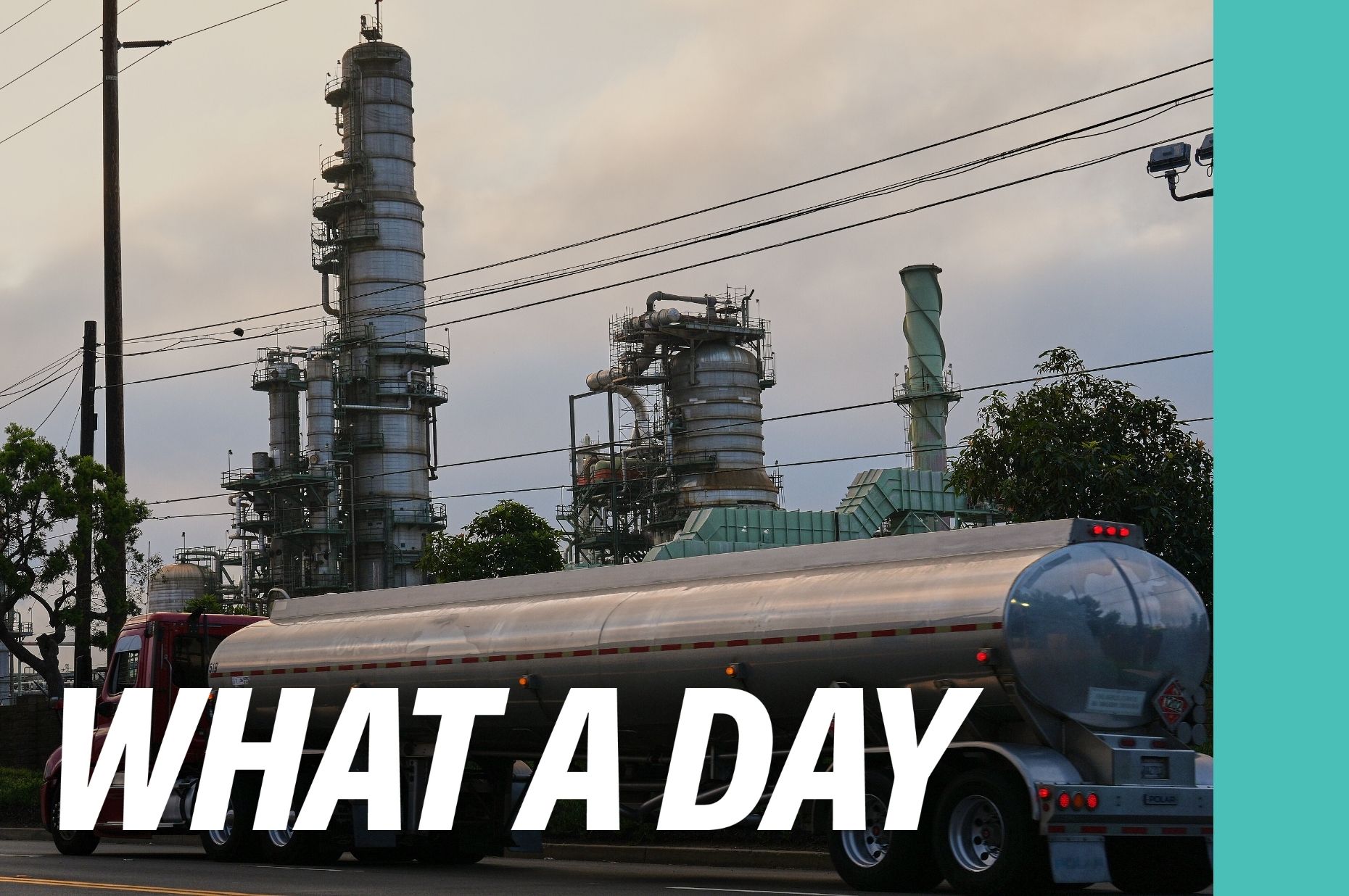
Jane Coaston: It’s Monday, March 16th, I’m Jane Coaston, and this is What a Day, the show that says when your war in Iran has lost former Trump National Security Advisor and bombing Iran enthusiast John Bolton, you’re having a bad time. Last week, Bolton who suggested bombing Iran in 2015 tweeted, quote, “I favor regime change in Iran, but I’m deeply worried that inadequate preparation will prevent that goal from being achieved. There seem to be holes in the strategy, from the lack of coordination with the opposition to the lapse in preparing the American people ahead of the attack.” Again, when you’ve lost John Bolton. Well. [music break] On today’s show, the department tasked with keeping Americans safe at home is still shut down, even as war rages on in the Middle East. And the Federal Communications Commission will just not let us be. But let’s start with oil. The war in Iran, a war of choice with no ending in sight, has essentially closed the Strait of Hormuz, the world’s most important oil transfer point. Because of that, oil prices are now over $100 a barrel and threatening to go even higher. But when NBC’s Meet the Press host Kristen Welker asked if Americans should be worried on Sunday, Energy Secretary Chris Wright did not exactly have an answer prepared.
[clip of Kristen Welker] Should they be worried that this war will actually drive the price of oil above $200 a barrel?
[clip of Chris Wright] So, Iran for 47 years has called the United States the Great Satan. So, because they call us the Great Satan, I don’t think we are the great Satan. In fact, clearly we’re not. So, I don’t listen much to Iranian projections of what’s going to happen.
[clip of Kristen Welker] So, that’s a no?
[clip of Chris Wright] But there is disruptions of–
[clip of Kristen Welker] Is that a no?
[clip of Chris Wright] –flow in a very important waterway. It’s a I would pay no attention to what Iran says.
Jane Coaston: That was not a no. And when asked when oil prices will go down by Martha Raddatz on ABC’s This Week Sunday, Secretary Wright had more non-answers.
[clip of Martha Raddatz] Are you really sure it’s going to be short term? Can you guarantee it’ll just be weeks before prices go down?
[clip of Chris Wright] Hey, there’s no guarantees in wars at all.
Jane Coaston: So that’s not ideal. Now, you might be thinking, wouldn’t this be less of a crisis if the US wasn’t so reliant on fossil fuels? That’s the argument that plenty of climate experts have been making recently. But the odds of the Trump administration suddenly pivoting to invest in renewable energy are pretty much zero. Remember, in his first term, Trump claimed with no evidence that wind turbines cause cancer. And in his second term, the president has gone after subsidies for renewables. In an executive order targeting those subsidies, Trump said relying on green energy, quote, “threatens national security by making the United States dependent on supply chains controlled by foreign adversaries. Interesting. But oil? Trump loves oil. And it’s not just Trumpian rhetoric. His administration has repeatedly gone out of its way to back big oil. Last year, the Department of Justice submitted a brief urging the Supreme Court to take up a case that could limit the ability of cities and states to file lawsuits against oil and gas companies for environmental damage. And now, the Court has agreed to hear the case. For more on what’s at stake here, I spoke with Mike Meno. He’s a Communications Director for the Center for Climate Integrity, an advocacy organization that works with communities to hold big oil accountable. Mike, welcome to What a Day!
Mike Meno: Thanks for having me, Jane.
Jane Coaston: The Supreme Court recently agreed to hear arguments in a case involving a lawsuit by Boulder County, Colorado against ExxonMobil and Suncor Energy. Before we get to the Supreme Court case, what is Boulder County suing these companies for?
Mike Meno: All across the United States, from Maine to Hawaii, dozens of state and local governments are right now suing major oil and gas companies like Exxon, Chevron, Shell, BP for deceiving the public about their fossil fuel products role in the climate crisis to hold them accountable for that deception and to make them pay for the associated damages that they caused. So the arguments in these cases are a lot like the lawsuits against tobacco companies or opioid manufacturers. These companies knew they were selling a harmful product. They lied to protect their profits. And now communities like Boulder are saying they need to be held accountable and pay for the damages that their deception has caused. And you know for Boulder, this question of who should pay for climate damages is not theoretical. In 2021, part of Boulder County was hit by the Marshall Fire. It was the most destructive wildfire in Colorado history. More than 1,000 homes were destroyed. And Boulder’s lawsuit, which was filed in 2018, specifically names the increased risk of wildfires as one of the things the county needs to pay for and protect residents against going forward.
Jane Coaston: So I wanted to ask, because you made a comparison that was really interesting to me, the comparison to lawsuits made against big tobacco and lawsuits made against Purdue Pharma and opioid manufacturers. Both of those entities, there’s a very clear paper trail where both said, our products are not harmful. What is Boulder, Colorado arguing is the similar element here? What did oil companies tell us that wasn’t true?
Mike Meno: So thanks to whistleblowers, journalists, congressional investigations, we have a well-documented body of evidence that shows that companies like Exxon knew decades ago, as early as the 1970s, that in the words of one internal industry document, if we didn’t stop using fossil fuels, it could lead to potentially catastrophic events. But what did the companies do with this information? We also have internal industry documents showing that they decided that rather than warn the public about the problem and help to steer the nation toward a safer, cleaner energy future, instead they decided to lie, to deceive the public, to spread misinformation. And in doing so, they stole decades of time when we could have been doing more on climate change and now communities like Boulder are paying the price for that deception.
Jane Coaston: Now the reason this case is going before the Supreme Court is not because of Boulder County, it’s because of the oil companies. Why are the oil companies arguing the Supreme court needs to intervene here?
Mike Meno: As you might imagine, big oil companies are terrified of standing trial in these cases. They’ve argued in their own Supreme Court briefs that they’re facing massive monetary liability in these lawsuits. And they’re if they’re really held accountable to stop deceiving the public and pay for the damages that they’ve caused, they’re staring at billions and billions of dollars in liability. The oil companies claim that by trying to make these companies pay for local climate damages, these communities are somehow trying to actually set national climate policy and that these cases are therefore preempted by federal law. Of course Boulder’s lawsuit is trying to do no such thing and a growing number of courts including the Colorado Supreme Court that have looked at this issue have rejected big oils’ arguments.
Jane Coaston: So given the makeup of the Supreme Court, um which is uh pretty conservative right now, is there any reason to think they won’t just side with the energy companies in this case?
Mike Meno: You know, obviously a lot of people hear a case is going to the Supreme Court and it raises alarm bells. Um. But again, the U.S. Supreme Court has turned down many previous requests to take up one of these lawsuits as they’re making their way through the lower courts, as they are heading to trial. And the justices sat on the petition in this case for several months. And when they finally agreed to take the case, we got a hint at what might have been going on between closed doors. And that was that the justices added a second question, which was, do we, the Supreme Court, even have jurisdiction, meaning the authority, to hear this case right now at this time before there’s a final judgment? So there are really signs that the justices internally might have doubts that they should even be weighing in on this issue yet. But on that core issue of are these cases preempted by federal law? Look, every state Supreme Court to rule on this to date, including the Colorado Supreme Court has said no. These cases are squarely about holding companies accountable for deceptive conduct, and that communities like Boulder should be allowed to proceed toward discovery in trial.
Jane Coaston: Last spring, the Wall Street Journal reported on a meeting President Trump had with oil and gas executives at the White House. What have those executives been lobbying for from the Trump administration?
Mike Meno: Yeah, so I think what’s really telling is that Wall Street Journal’s story said one of the top concerns oil executives brought directly to President Trump in person were lawsuits exactly like Boulder’s. So a month after that meeting where they asked President Trump, can you help us fight these lawsuits? Trump issued an executive order. He directed Attorney General Bondi to take all appropriate action to try to stop these lawsuits. The Justice Department actually sued two states, Michigan and Hawaii, that had said we’re gonna file our own lawsuits against big oil companies. And the case against Michigan has been dismissed, but the one against Hawaii is still pending. And perhaps the most consequential thing the Trump administration has done to date to help bail out big oil was to tell the Supreme Court, again in an uninvited brief, a rare thing, you should take up this Boulder case.
Jane Coaston: Oil companies are also working with Republican members in Congress to create legislation that would shield them from lawsuits that hold them responsible for environmental damage. What do we know about those efforts?
Mike Meno: Yeah, it’s true. They are so terrified of facing any kind of accountability. They’re not content to just make their case in court and take their chances. They’re actually going around the courts directly lobbying Congress for what’s called the liability waiver. This would be essentially immunity from any laws or lawsuits that could hold them accountable. The American Petroleum Association, the biggest oil lobbying group said that killing these types of lawsuits is their top priority for 2026. And a House Republican, Harriet Hageman from Wyoming, has said she’s working with colleagues in the House and Senate to introduce a bill that would shield oil companies from having to face any type of legal liability.
Jane Coaston: It’s been interesting because you would think, and I you know when Trump came back into office, you kind of had this idea, like this is going to be boom times for the oil and gas industry. He’s going to open up drilling in a host of environmental refuges. There’s going be you know big oil and big gas are going to the beneficiaries of this administration. And that hasn’t really been true to the extent that I think a lot of oil companies probably expected in 2024. And now we’re in the midst of a war with Iran that is pushing gas prices up because even with domestic production, there’s only so much that the United States can do if the Strait of Hormuz is closed. But I think the wider thing I think everyone should be thinking about is why are we so reliant on oil? It seems like, to me, a worthwhile opportunity to be rethinking our relationship with big oil.
Mike Meno: Amen. And in fact, the reason we’re still so reliant on oil and gas is because decades ago, Big Oil saw the writing on the wall, hey, if we don’t do something, there’s going to be growing demands to transition to cleaner energy. And so what did they do? They launched this unprecedented, consequential, massive deception campaign to spread climate denial and disinformation and stall the clean energy transition, which if we had been further along right now, without those decades of lies from oil and gas companies, you know, we would not be perhaps in as big a mess as we are today. Now climate damages are costing the United States somewhere in the neighborhood of a trillion dollars a year. And all those costs right now are falling on taxpayers while the companies that knowingly caused the problem lied about it and continue to deceive the public, right? They pretend, hey, we’re actually part of the energy transition where they’re not. They’re still doubling down on fossil fuels. And if big oil isn’t held accountable for that, it’s gonna continue to be communities and taxpayers that continue to pay all the costs of climate damages.
Jane Coaston: Mike, thank you so much for your time.
Mike Meno: Jane, thanks so much.
Jane Coaston: That was my conversation with Mike Meno, Communications Director for the Center for Climate Integrity. Talking about climate change always gets me worked up. I think we could all use a little break. So grab yourself a cup of water. Get your steps in. And if you like the show, hit subscribe, leave us a 5-star review on Spotify and Apple podcasts, check us out on YouTube, and share with your friends. We’ll be back after some ads. [music break]
[AD BREAK]
Jane Coaston: As you’ve probably noticed, we’ve been trying something new with our headlines. Crooked’s Washington correspondent, Matt Berg, will be back on Wednesday. But for now, here’s what else we’re following today.
[sung] Headlines!
[clip of Sean Duffy] Are Democrats waiting for Americans to get hurt, to get killed, before they actually put your security before those who have come to this country unlawfully and illegally? Um. I hope that’s not their position, but we can get to a better place um if they would just come to their senses and negotiate after they open it up.
Jane Coaston: Transportation Secretary Sean Duffy went on Fox News Sunday to remind everyone that the Department of Homeland Security is still shut down. There’s growing concern that the agency that’s supposed to keep Americans safe here at home is closed while the U.S. is at war with Iran. Of course, when sharing those concerns, Duffy conveniently forgot that DHS is shut down partly because Americans were killed by the department’s immigration officers. It’s already been a month since funding for DHS expired, and it doesn’t look like a deal is coming anytime soon. The board of the Kennedy Center is expected to vote on President Trump’s grand renovation plans today. Back in February, Trump announced his intention to close the center for two years starting July 4th for quote, “construction, revitalization, and complete rebuilding.” Trump also removed 18 board members and replaced them with his own picks, like White House Chief of Staff Susie Wiles and Second Lady Usha Vance. So his odds of getting those plans approved look pretty good. But Ohio Democratic Representative Joyce Beatty is hoping to throw a wrench in things. Her position on the board is designated by Congress, and on Saturday, a federal judge ruled she must be included in this week’s meeting. The judge did not guarantee her right to vote, but he did rule she must be sent information about the renovation within 24 hours of the meeting. This is all happening as Trump confirmed plans to replace the center’s head, Ric Grenell, on Friday, using Trump’s favorite platform for hiring and firing, Truth Social. The Performing Arts Center will now be led by Matt Floca, who has been its vice president of facilities since 2024. Tomorrow is primary day in Illinois, Democratic Governor J.B. Pritzker is running for a third term. Pritzker is also a potential Democratic presidential candidate for 2028. There is a crowded field in the Senate race to replace Democratic Senator Dick Durbin, who decided not to run for a sixth term. House Representatives Robin Kelly and Raja Krishnamoorthi both gave up their seats to run for Durbin’s. Big money is being spent in these races. According to the Chicago Sun-Times, more than $50 million has been spent by super PACs and special interest groups in Chicago-area congressional primaries. WBEZ Chicago found that a lot of that money has come from donors and groups with links to the American Israel Public Affairs Committee, or AIPAC. They’ve spent more than 13 million dollars in these races. Support for Israel has become a major issue in the primary for Illinois’ 9th Congressional District, specifically. Candidates including State Senator Laura Fine, Evanston Mayor Daniel Biss, and former journalist Kat Abughazaleh are running to replace retiring Representative Jan Schakowsky. Federal Communications Commission Chairman Brendan Carr is back at it with the thinly-veiled threats. Carr wrote on Twitter Saturday that broadcasters airing fake news have, quote, “a chance now to correct course before their license renewals come up.” Carr’s warning followed a Truth Social post by President Trump who slammed the fake news media for negative coverage involving the Iran war. Trump directed his ire at The New York Times and The Wall Street Journal, which the FCC does not regulate. Carr wrote in his own post, quote, “broadcasters must operate in the public interest and they will lose their licenses if they do not.” Public interest or Trump’s interest? The threat received pushback from Democratic lawmakers. California Governor Gavin Newsom tweeted quote, “if Trump doesn’t like your coverage of the war his FCC will pull your broadcast license. That is flagrantly unconstitutional.” In the lamenting words of Eminem, the FCC won’t let me be or let me be me. So let me see. They tried to shut me down on MTV but it feels so empty, without me. And that’s the news. [music break]
[AD BREAK]
Jane Coaston: That’s all for today. If you like the show, make sure you subscribe, leave a review, get pumped for March Madness, and tell your friends to listen. And if you’re into reading, and not just about how you can start filling out your men’s and women’s brackets today, and yes, your bracket will be destroyed in a week, but that’s what’s so fun about it. Like me, What a Day is also a nightly newsletter. Check it out and subscribe at Crooked.com/subscribe. I’m Jane Coaston, and remember, watching college basketball at work is a time-honored American tradition. [music break] What a Day is a production of Crooked Media. It’s recorded and mixed by Desmond Taylor. Our associate producer is Emily Fohr. Our producer is Caitlin Plummer. Our video editor is Joseph Dutra. Our video producer is Johanna Case. We had production help today from Greg Walters, Matt Berg, and Ethan Oberman. Our senior producer is Erica Morrison, and our senior vice president of news and politics is Adriene Hill. Our theme music is by Kyle Murdock and Jordan Cantor. We had help today from the Associated Press. Our production staff is proudly unionized with the Writers Guild of America East. [music break]


